
Synonym for inclusion are vital phrases for anyone who wants to talk about bringing people together, sharing access, or creating belonging.
Imagine planning a neighborhood event where every single person feels truly welcome, supported, and valued from the moment they step through the door.
When you describe such a welcoming community, repeating the same word over and over again can quickly make your prose feel repetitive and plain.
Learning a wide variety of synonyms allows writers to explain social unity, policy decisions, and academic ideas with exact precision in every scenario.
What Does “Inclusion” Really Mean?
The word inclusion means the act of adding someone or something into a group, space, system, or overall structure. It focuses on making sure nobody is left out or ignored.
Native English speakers use this word when talking about school programs, company hiring policies, community building, and general social fairness. You will hear it often in news reports, business meetings, and educational speeches.
- Part of Speech: Noun (Uncountable / Countable)
- Definition: The state of being included, or the practice of providing equal access and opportunities to everyone.
Connotative Meaning
(Connotation is the emotional feeling or social association that a word carries beyond its literal dictionary definition.)
- Positive tone: Represents fairness, warmth, safety, equity, and open community support.
- Negative tone: Implies tokenism, forced compliance, or empty corporate buzzwords when used insincerely.
- Neutral tone: Refers purely to mathematical addition, technical data integration, or simple containment.
Etymology
The word originates from the Latin noun inclusio, coming from the verb includere (meaning to shut in or enclose). This combines in- (into) with claudere (to shut).
- Old English (450–1100): The term did not exist in Old English, as Germanic roots were used for concepts of togetherness.
- Middle English (1100–1500): Entered Middle English through Anglo-Norman French as enclusion, mainly referring to physical confinement.
- Modern English (1500–Present): Shifted during the 20th century from physical containment to social equity, diversity, and active participation.
Syllables & Structure
- Syllables: in-clu-sion (3 syllables)
- Root: clud / clus (meaning to shut or close)
- Prefix: in- (meaning in or into)
- Suffix: -sion (noun suffix forming an action or state)
Synonyms List
Involvement (Noun)
- Meaning: The act of taking part in an activity, event, or situation actively.
- Tone/Register: Neutral, Everyday
- Example 1: Parent involvement in school activities boosts student confidence.
- Example 2: Her involvement in the charity project brought great results.
Incorporation (Noun)
- Meaning: The process of combining something into a larger existing system or body.
- Tone/Register: Formal, Technical
- Example 1: The incorporation of new safety features improved the product.
- Example 2: We planned the incorporation of user feedback into our design.
Integration (Noun)
- Meaning: The act of joining different groups or systems into a unified whole.
- Tone/Register: Formal, Academic
- Example 1: Smooth integration of foreign students helps build strong communities.
- Example 2: The software allows seamless integration with your phone.
Belonging (Noun)
- Meaning: The comfortable feeling of being accepted and connected to a group.
- Tone/Register: Warm, Expressive
- Example 1: Every child deserves a true sense of belonging at school.
- Example 2: The club creates a strong feeling of social belonging.
Acceptance (Noun)
- Meaning: The act of welcoming and approving someone without judgment.
- Tone/Register: Positive, Social
- Example 1: Genuine acceptance helps people express their true thoughts easily.
- Example 2: The community showed warm acceptance toward the new family.
Insertion (Noun)
- Meaning: The physical act of placing one object inside another thing.
- Tone/Register: Neutral, Technical
- Example 1: The careful insertion of the key unlocked the heavy door.
- Example 2: Please review the insertion of the new paragraph in the draft.
Addition (Noun)
- Meaning: The act of adding something extra to increase quantity or size.
- Tone/Register: Neutral, General
- Example 1: The addition of a new library helps local readers.
- Example 2: She was a welcome addition to our sports team.
Embracement (Noun)
- Meaning: The enthusiastic acceptance or welcoming of an idea, culture, or person.
- Tone/Register: Formal, Expressive
- Example 1: The embrace of new technologies transformed the school district.
- Example 2: Their eager embrace of diversity inspired neighboring towns.
Unity (Noun)
- Meaning: The state of being joined together as one complete group.
- Tone/Register: Inspiring, Public
- Example 1: Community unity helped the town rebuild after the storm.
- Example 2: The team showed remarkable unity throughout the tournament.
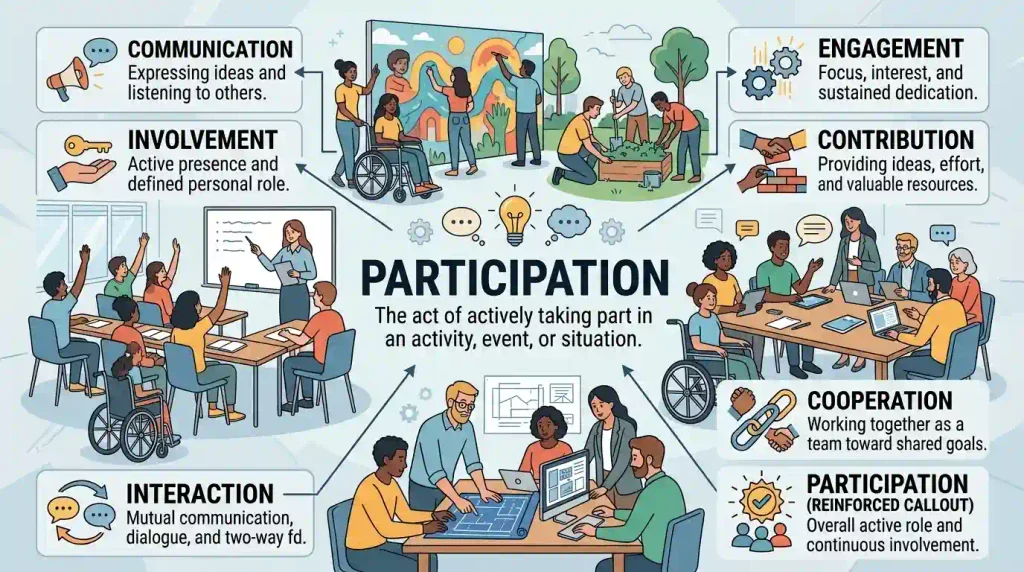
Participation (Noun)
- Meaning: The act of taking part in an event or shared task.
- Tone/Register: Professional, Academic
- Example 1: Student participation in classroom discussions is encouraged.
- Example 2: Full participation is required for this group exercise.
Inclusionary (Noun)
- Meaning: The policy or state of aiming to include all people equally.
- Tone/Register: Legal, Policy
- Example 1: The city adopted inclusionary housing laws last month.
- Example 2: We support inclusionary practices across all departments.
Access (Noun)
- Meaning: The right or opportunity to use, enter, or reach something.
- Tone/Register: Direct, Business
- Example 1: The program provides equal access to digital learning tools.
- Example 2: Ramp installation gives wheelchair users easy building access.
Assimilation (Noun)
- Meaning: The process of absorbing a minority group into a larger culture.
- Tone/Register: Academic, Sociological
- Example 1: Cultural assimilation happened over several generations in the city.
- Example 2: Scholars study the rapid assimilation of new ideas.
Enclosure (Noun)
- Meaning: The state of surrounding or shutting something within physical walls.
- Tone/Register: Neutral, Descriptive
- Example 1: The glass enclosure protected the rare plants from cold wind.
- Example 2: Please find the document in the mail enclosure.
Membership (Noun)
- Meaning: The state of belonging to an organization, club, or community.
- Tone/Register: Everyday, Functional
- Example 1: Club membership grew quickly after the summer campaign.
- Example 2: She renewed her library membership for another full year.
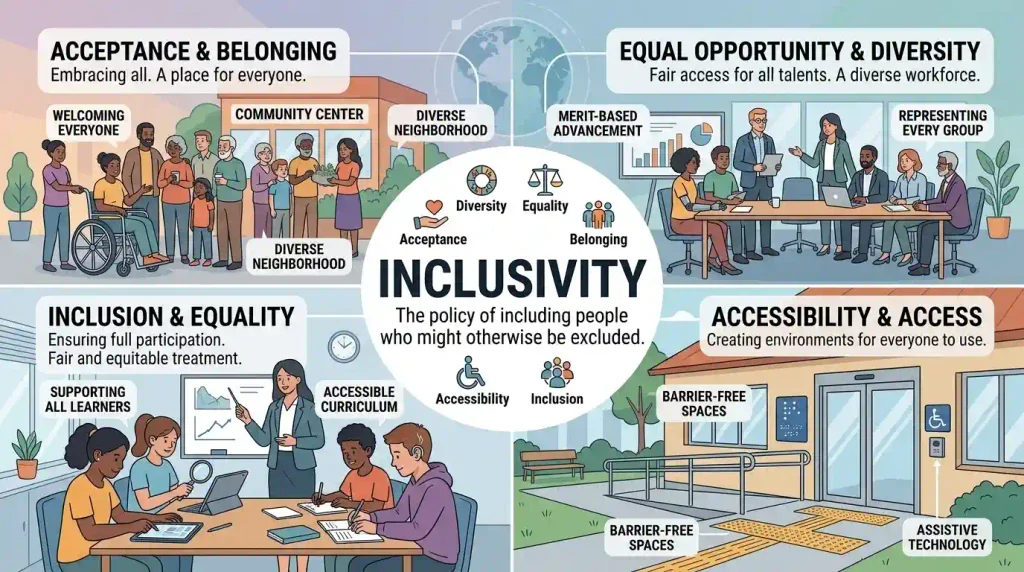
Inclusivity (Noun)
- Meaning: The policy of including people who might otherwise be excluded.
- Tone/Register: Modern, Corporate
- Example 1: Workplace inclusivity leads to happier and more creative teams.
- Example 2: The festival celebrates inclusivity through art and music.
Admittance (Noun)
- Meaning: Permission to enter a physical space or formal organization.
- Tone/Register: Formal, Legal
- Example 1: The security guard checked passes before granting admittance.
- Example 2: Free admittance was granted to all students with valid IDs.
Comprehensive (Noun)
- Meaning: The condition of covering or including all necessary elements fully.
- Tone/Register: Professional, Analytical
- Example 1: The report gives a comprehensive overview of urban growth.
- Example 2: We offer comprehensive care for every single patient.
Comprehension (Noun)
- Meaning: The inclusion of broad ideas within a mental framework or scope.
- Tone/Register: Academic, Educational
- Example 1: The comprehension of complex issues requires careful study.
- Example 2: Her broad comprehension of history impressed the committee.
Fullness (Noun)
- Meaning: The condition of containing everything possible without omissions.
- Tone/Register: Descriptive, Literary
- Example 1: The essay expressed the fullness of human emotion well.
- Example 2: We appreciated the fullness of details in the report.
Welcome (Noun)
- Meaning: A friendly greeting and reception given to a new arrival.
- Tone/Register: Warm, Everyday
- Example 1: The city gave a warm welcome to all visiting athletes.
- Example 2: She smiled and offered a friendly welcome at the door.
Inclusion-Mindedness (Noun)
- Meaning: An active awareness and commitment toward keeping space open for all.
- Tone/Register: Academic, Modern
- Example 1: Inclusion-mindedness shapes every policy decision in our school.
- Example 2: Their inclusion-mindedness ensures no volunteer feels ignored.
Equity (Noun)
- Meaning: The quality of being fair and impartial so everyone gets what they need.
- Tone/Register: Legal, Social Justice
- Example 1: Promoting educational equity is a priority for the board.
- Example 2: True equity ensures equal outcomes for diverse groups.
Entitlement (Noun)
- Meaning: The right to have, use, or be included in a benefit or system.
- Tone/Register: Legal, Formal
- Example 1: Workers claimed their legal entitlement to health benefits.
- Example 2: Citizenship grants full entitlement to vote in elections.
Partnership (Noun)
- Meaning: A state of shared participation and cooperative inclusion between groups.
- Tone/Register: Business, Strategic
- Example 1: The city built a strong partnership with local business owners.
- Example 2: Close partnership between parents and teachers helps students.
Coalition (Noun)
- Meaning: A temporary joining of distinct groups to achieve a common goal.
- Tone/Register: Political, Formal
- Example 1: Diverse charities formed a coalition to fight poverty.
- Example 2: The local coalition organized a successful community event.
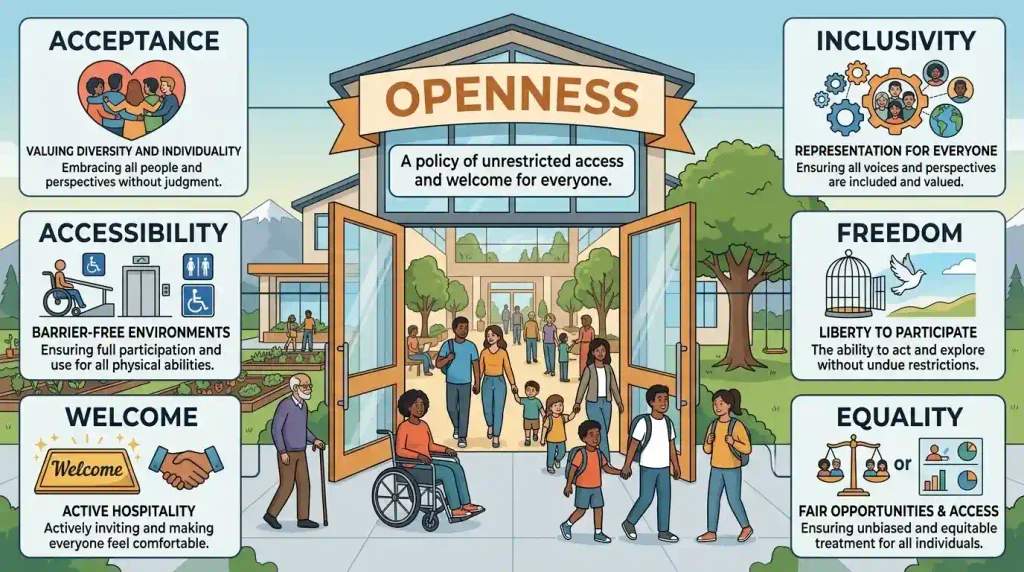
Openness (Noun)
- Meaning: Willingness to accept new people, ideas, and experiences without bias.
- Tone/Register: Positive, Casual
- Example 1: Her openness to new cultures makes her a great leader.
- Example 2: We value transparency and openness in our discussions.
Whole-Group (Noun)
- Meaning: The state of bringing every single member together as one unit.
- Tone/Register: Educational, Everyday
- Example 1: The teacher started a whole-group reading session.
- Example 2: Whole-group activities encourage shy kids to participate.
Encompassment (Noun)
- Meaning: The act of taking in or surrounding within boundaries.
- Tone/Register: Formal, Academic
- Example 1: The broad encompassment of topics made the textbook very useful.
- Example 2: His plan relies on the encompassment of diverse views.
Integrationist (Noun)
- Meaning: The policy or belief favoring full social integration of all groups.
- Tone/Register: Sociological, Formal
- Example 1: The leader promoted an integrationist approach to public schooling.
- Example 2: Her integrationist vision brought peace to the community.
Non-Exclusion (Noun)
- Meaning: The policy or rule of explicitly avoiding the removal of anyone.
- Tone/Register: Legal, Technical
- Example 1: Strict non-exclusion rules guarantee public library access for all.
- Example 2: The festival maintains a firm non-exclusion stance.
Subsumption (Noun)
- Meaning: The action of incorporating something into a higher or broader category.
- Tone/Register: Academic, Logic
- Example 1: The subsumption of small towns into the metropolis took years.
- Example 2: Scholars debated the subsumption of the rule into law.
Mainstreaming (Noun)
- Meaning: Placed into regular education or standard social settings.
- Tone/Register: Educational, Policy
- Example 1: The mainstreaming of support needs improves students’ overall social skills.
- Example 2: Mainstreaming eco-friendly habits benefits the entire city.
Interconnection (Noun)
- Meaning: A state where different parts or people are linked mutually.
- Tone/Register: Technical, Environmental
- Example 1: Global markets show deep interconnection across all regions.
- Example 2: Ecosystems depend on the interconnection of plant and animal life.
Mix (Noun)
- Meaning: A vibrant combination of different elements or people together.
- Tone/Register: Casual, Everyday
- Example 1: The city features a rich mix of cultures and traditions.
- Example 2: We invited a friendly mix of neighbors to dinner.
Universal Design (Noun)
- Meaning: Creating spaces accessible to everyone without needing adaptation.
- Tone/Register: Architecture, Technical
- Example 1: The new hall uses universal design to help disabled guests.
- Example 2: Universal-design principles make web browsing easy for all.
Equal-Footing (Noun)
- Meaning: The condition of having the same rights and status as others.
- Tone/Register: Legal, Social
- Example 1: All workers must compete on an equal footing for promotions.
- Example 2: The treaty placed small nations on an equal footing.
Togetherness (Noun)
- Meaning: A warm feeling of unity and closeness shared by a group.
- Tone/Register: Casual, Warm
- Example 1: Family holiday dinners always foster a sense of togetherness.
- Example 2: The neighborhood party created genuine warmth and togetherness.
Open-Door (Noun)
- Meaning: A policy of unrestricted access and welcome for everyone.
- Tone/Register: Corporate, Informal
- Example 1: Management maintains an open-door policy for all staff questions.
- Example 2: Our community center has an open-door approach to visitors.
Solidarism (Noun)
- Meaning: A social theory prioritizing shared human responsibility and inclusion.
- Tone/Register: Academic, Political
- Example 1: Early thinkers advocated solidarism to support struggling workers.
- Example 2: Solidarism emphasizes community welfare over individual gain.
Representation (Noun)
- Meaning: The state of having diverse individuals included in decision-making bodies or media.
- Tone/Register: Political, Social
- Example 1: Greater representation in parliament builds public trust.
- Example 2: The media praised the novel for its accurate cultural representation.
Admission (Noun)
- Meaning: The act of allowing entry into a venue, institution, or group.
- Tone/Register: Formal, Administrative
- Example 1: University admission requirements were posted online today.
- Example 2: Ticket holders received prompt admission to the stadium.
Cohesion (Noun)
- Meaning: The action or state of sticking together closely as a united group.
- Tone/Register: Sociological, Professional
- Example 1: Social cohesion helps neighborhoods overcome economic hardship.
- Example 2: The retreat improved team cohesion across departments.
Shared Access (Noun)
- Meaning: The condition of granting equal opportunity to use a common resource.
- Tone/Register: Technical, Modern
- Example 1: Shared access to high-speed internet empowers rural communities.
- Example 2: The platform provides shared access to research databases.
Broadening (Noun)
- Meaning: The process of expanding boundaries to include more people or ideas.
- Tone/Register: General, Descriptive
- Example 1: The broadening of the curriculum helped engage more students.
- Example 2: We welcomed the broadening of our advisory panel.
Inclusion-Focus (Noun)
- Meaning: A deliberate concentration on maintaining inclusive policies and practices.
- Tone/Register: Business, Corporate
- Example 1: The company retains an inclusion focus during major hiring drives.
- Example 2: Their inclusion focus guarantees accessible facilities.
Engagement (Noun)
- Meaning: Active involvement and emotional commitment to a shared activity.
- Tone/Register: Professional, Educational
- Example 1: High employee engagement leads to better company output.
- Example 2: Interactive learning tools increase student engagement.
Equalization (Noun)
- Meaning: The process of bringing different individuals to a common standard or level.
- Tone/Register: Policy, Economic
- Example 1: Tax equalization measures aim to balance regional wealth.
- Example 2: Educational reforms led to the equalization of opportunity.
Alliance (Noun)
- Meaning: A union or association formed for mutual benefit and inclusion.
- Tone/Register: Political, Formal
- Example 1: Neighboring towns allied to protect local forests.
- Example 2: The corporate alliance expanded access to digital technology.
Synergy (Noun)
- Meaning: The combined action of groups working together to create a total effect greater than the sum of the parts.
- Tone/Register: Business, Academic
- Example 1: Team synergy increased productivity across all projects.
- Example 2: Cross-departmental synergy generated innovative solutions.
Receptivity (Noun)
- Meaning: Willingness or readiness to receive new ideas, people, or suggestions.
- Tone/Register: Professional, Psychological
- Example 1: Management showed great receptivity to new community projects.
- Example 2: Cultural receptivity promotes smoother international trade.
Concurrence (Noun)
- Meaning: Agreement or cooperation in action, opinion, or group position.
- Tone/Register: Legal, Formal
- Example 1: The council acted in concurrence with neighborhood requests.
- Example 2: Full concurrence was achieved before passing the policy.
Inclusion-Pact (Noun)
- Meaning: A formal agreement among entities to ensure mutual access and representation.
- Tone/Register: Legal, Corporate
- Example 1: Regional universities signed an inclusion pact for student transfers.
- Example 2: The global alliance updated its inclusion pact this year.
Blend (Noun)
- Meaning: A harmonious mixture of different elements or groups.
- Tone/Register: Casual, Creative
- Example 1: The school displays a wonderful blend of background traditions.
- Example 2: A harmonious blend of ideas helped solve the design problem.
Fellowship (Noun)
- Meaning: Friendly association, support among people sharing similar interests.
- Tone/Register: Warm, Traditional
- Example 1: Members enjoyed deep fellowship during the annual conference.
- Example 2: The club fosters genuine fellowship among local artists.
Synonyms by Tone
Positive
- Inclusivity: Highlights welcoming actions and warm social policies.
- Belonging: Emphasizes deep emotional connection and personal safety.
- Equity: Focuses on fairness, justice, and tailored support.
- Togetherness: Describes cozy, warm, informal group connection.
- Unity: Inspires public strength and collective harmony.
- Fellowship: Emphasizes friendly, warm community bonds.
Neutral
- Incorporation: Focuses on structural combination without emotion.
- Addition: Reports simple mathematical or physical growth.
- Insertion: Strictly describes placing an object inside something.
- Comprehensive: Describes complete coverage without social nuance.
- Admission: Strictly reports official entry permissions.
Negative / Controversial
- Assimilation: Can imply forcing minority groups to drop their unique identities to fit in.
- Subsumption: Suggests smaller elements losing their identity when absorbed by a larger system.
Playful / Informal
- Mix: Casual word for combining different people or ideas.
- Open-door: Everyday phrase for easy access and friendly leadership.
- Blend: Creative word for mixing diverse elements smoothly.
Selecting the right word tone prevents misunderstandings. Calling a cultural program “assimilation” can sound harsh, whereas calling it “integration” or “inclusivity” sounds positive and respectful.
What Are Some Synonyms for Assimilation?
Assimilation refers to the process of adapting to a larger culture, group, or system. Depending on the context, several words can express a similar idea, although each carries a slightly different meaning.
- Integration: Joining a group or system while potentially maintaining individual cultural identity.
- Adaptation: Adjusting to new surroundings, expectations, or cultural practices.
- Acculturation: Adopting certain customs or behaviors from another culture through contact.
- Absorption: Becoming part of a larger group or system, sometimes with a loss of distinct identity.
- Conformity: Adjusting behavior or beliefs to match the expectations of a group.
- Adjustment: Making changes to fit a new environment or situation.
- Assimilating: Gradually adopting the practices, values, or characteristics of another group.
Assimilation vs. Integration
Assimilation and integration are closely related, but they do not always mean the same thing. Assimilation can involve adopting the dominant culture’s customs and expectations, sometimes at the expense of one’s original identity. Integration generally emphasizes participation in a shared society while allowing people to preserve their cultural backgrounds.
Example: The school encouraged integration by welcoming students from different cultures while respecting their languages and traditions.
When choosing a synonym, consider whether you want to emphasize cultural change, adjustment, participation, or conformity. This distinction helps you communicate the intended meaning accurately.
Mini Comparison
Inclusion vs. Integration vs. Belonging
- Inclusion: Focuses on changing systems so that everyone can participate fully from day one.
- Integration: Focuses on bringing outside members into an existing system, often requiring them to adjust.
- Belonging: Focuses on the internal emotional feeling of being accepted and valued by others.
| Word | Core Focus | Best Context | Tone |
| Inclusion | Systemic openness and equal access | Corporate policies, schools | Professional / Policy |
| Integration | Combining elements into a whole | Sociology, technology, software | Academic / Technical |
| Belonging | Emotional feeling of acceptance | Community, mental health, family | Warm / Personal |
Context-Based Usage
Daily Conversation
In casual chats, rely on easy, warm terms like togetherness, welcome, belonging, blend, or mix.
“We had a great mix of old and new friends at the park yesterday.”
Writing or Blogging
For articles and personal blogs, use expressive words like inclusivity, openness, fellowship, or unity to keep readers connected.
“Creating a sense of belonging makes your blog community thrive.”
Professional or Academic
In legal documents, essays, and business plans, choose formal terms like incorporation, equity, integration, cohesion, or comprehensive.
“The incorporation of diverse viewpoints strengthens market research.”
Common Mistakes & Native Usage
Misuse Scenarios
- Confusing Inclusion with Assimilation: Inclusion respects differences; assimilation often forces people to conform to the majority.
- Confusing Inclusion with Diversity: Diversity means having different people present; inclusion means giving them equal voice and access.
- Using “Insertion” for People: Use “insertion” for text or objects, never for human beings joining a group.
Register Notes
In written English, hyphenate compound adjectives before nouns (e.g., an open-door policy), but leave them separate when following verbs (e.g., the policy is open door).
Real-Life Mini Scenarios
- Workplace: An HR manager updates hiring rules to promote workplace inclusivity across all global offices.
- Social Situations: Neighbors host a block party to foster togetherness among long-time residents and new renters.
- Media & Pop Culture: A movie reviewer praises a new film for its authentic representation and cultural depth.
- Storytelling: A novelist describes a traveler finding a true sense of belonging in a remote mountain village.
Conclusion
Building your vocabulary with a varied synonym for inclusion allows you to discuss unity, access, and community with greater clarity and care.
Using accurate synonyms enriches your essays, sharpens professional proposals, and helps you communicate complex social concepts with real nuance.
Start trying out these terms in your daily emails, academic papers, and social conversations to expand your language skills naturally.
Interactive Practice Quiz
- Which synonym carries the warmest emotional feeling of personal acceptance?
- A) Insertion
- B) Belonging
- C) Subsumption
- D) Enclosure
- What is the best word for combining a new software tool into an old computer system?
- A) Integration
- B) Belonging
- C) Togetherness
- D) Solidarism
- Which term can sometimes carry a negative connotation of forced conformity?
- A) Openness
- B) Assimilation
- C) Inclusivity
- D) Equity
- “Inclusion” and “Diversity” mean the same thing in business.
- A) True
- B) False
- Select the most appropriate term for a casual neighborhood gathering:
- A) Subsumption
- B) Insertion
- C) Togetherness
- D) Encompassment
- Which word describes building physical spaces accessible to everyone without modification?
- A) Universal design
- B) Assimilation
- C) Enclosure
- D) Subsumption
- Complete the sentence: “The board voted for the full __________ of user ideas.”
- A) Insertion
- B) Incorporation
- C) Enclosure
- D) Admittance
- Which term fits best in a legal or social justice context regarding fairness?
- A) Mix
- B) Equity
- C) Togetherness
- D) Open-door
- Which word strictly describes putting physical objects inside a container or text?
- A) Inclusion
- B) Belonging
- C) Insertion
- D) Unity
- What term refers to a friendly leadership style allowing open communication?
- A) Open-door
- B) Enclosure
- C) Subsumption
- D) Assimilation
Short Reflection Task: Write 1 original sentence about your school or workplace using the synonym inclusivity.
Answer Key:
1: B | 2: A | 3: B | 4: B | 5: C | 6: A | 7: B | 8: B | 9: C | 10: A
FAQs
1. What is the single best synonym for inclusion in a corporate setting?
The best synonyms for inclusion in a corporate setting are inclusivity, equity, and integration. These terms describe formal policies that grant equal access, career growth, and fair treatment to all employees regardless of background.
2. Is “diversity” a direct synonym for “inclusion”?
No, diversity and inclusion are related but distinct terms. Diversity refers to the presence of varied identities within a group, while inclusion describes the active practice of ensuring those diverse individuals are welcomed and valued.
3. How does “incorporation” differ from “inclusion”?
Incorporation focuses on combining physical items, data, or structural parts into a larger whole. Inclusion deals primarily with social access, human belonging, rights, and equal participation within groups.
4. What is a good casual synonym for inclusion in everyday conversation?
In everyday conversation, great casual synonyms include togetherness, welcome, openness, blend, and mix. These terms sound friendly and simple while expressing the idea of bringing people together comfortably.
5. Can “assimilation” be used safely as a synonym for inclusion?
Use assimilation cautiously. While it means integrating into a culture, it often implies that minority groups must give up their original heritage to fit into the dominant majority.

Samia Noor is the founder and lead writer at SynonymGenius.com, where she creates accurate, reader-focused English language content that helps people communicate with clarity and confidence. She specializes in synonyms, antonyms, word meanings, idioms, and practical vocabulary guides that make complex language concepts simple and easy to understand. Every article is thoroughly researched, carefully fact-checked, and written in clear, accessible language using reliable sources and real-world examples. Her mission is to provide trustworthy, high-quality content that supports students, writers, educators, professionals, and English learners at every stage of their language journey.
Her editorial approach emphasizes accuracy, transparency, and genuine value for readers while following modern E-E-A-T and content quality standards. She regularly reviews and updates published content to ensure it remains current, reliable, and easy to understand. Through SynonymGenius.com, Samia Noor is committed to publishing dependable language resources that help readers expand their vocabulary, strengthen their writing skills, improve communication, and build confidence in academic, professional, and everyday English.