
Synonyms for technical help you describe complex skills, specialized knowledge, or precise operational details clearly.
Imagine trying to explain a software glitch to a friend who only knows how to turn a computer on and off.
Finding the exact word bridges the gap between expert mechanics and everyday conversation.
Learning distinct terms allows students, bloggers, content writers, and professionals to express complex ideas with total clarity.
This comprehensive guide breaks down synonyms so you can choose the best word for every situation.
Core Meaning Section
“Technical” describes anything relating to a particular subject, art, science, trade, or practical craft requiring specialized knowledge.
Native speakers use it to describe detailed processes, specialized tools, or exact legal and scientific rules.
It appears often in technology manuals, legal contracts, engineering guides, and academic essays.
- Part of Speech: Adjective
- Definition: Relating to a specific practical skill, trade, science, or complex specialized field.
Connotative Meaning
(Connotation is the cultural or emotional association that a word carries beyond its explicit dictionary definition.)
- Positive Tone: Highlights high expertise, mastery, precision, and professional skill.
- Negative Tone: Implies dry, overly complicated, or confusing jargon that confuses readers.
- Neutral Tone: Refers objectively to specialized methods, equipment, or industry rules.
Etymology
The word “technical” stems from the Ancient Greek word tekhnikos, which means “artistic, skilled, or relating to an art or craft.” It transitioned into French as technique before entering the English language.
- Old English (450–1100): The word was not present; Old English used terms like cræftig (crafty/skilled) or læred (learned).
- Middle English (1100–1500): Latin and French manuscripts used variants, but the exact modern English adjective had not yet formed.
- Modern English (1500–Present): Introduced in the 1600s to describe arts and sciences, expanding rapidly during the Industrial Revolution.
Pronunciation (US & UK)
- US: /ˈtek.nɪ.kəl/
- UK: /ˈtek.nɪ.kəl/
Syllables & Structure
- Syllables: tech-ni-cal
- Root: tech (from Greek tekne, meaning art or skill)
- Prefix: None
- Suffix: -ical (adjective-forming suffix meaning “relating to”)
Synonyms List
Specialized (Adjective) — US: /ˈspeʃ.ə.laɪzd/ | UK: /ˈspeʃ.əl.aɪzd/
- Meaning: Designed, developed, or appropriate for a particular specific purpose or area of knowledge.
- Tone/Register: Professional / Academic
- Example 1: The hospital opened a specialized clinic to treat rare neurological disorders.
- Example 2: She uses specialized design tools to render three-dimensional architectural models.
Complex (Adjective) — US: /kəmˈpleks/ | UK: /ˈkɒm.pleks/
- Meaning: Consisting of many interconnected parts that make an idea intricate or challenging to grasp.
- Tone/Register: General / Standard English
- Example 1: The software developer wrote a script to handle complex data migrations.
- Example 2: Explaining tax law requires breaking complex theories into simple points.
Specialized-knowledge (Phrase) — US: /ˈspeʃ.ə.laɪzd nɑː.lɪdʒ/ | UK: /ˈspeʃ.əl.aɪzd nɒl.ɪdʒ/
- Meaning: Advanced understanding gained through rigorous study or focused practical training.
- Tone/Register: Formal / Business
- Example 1: Working in cybersecurity demands specialized knowledge of network defense layers.
- Example 2: The firm seeks consultants with specialized knowledge in international finance.
Scientific (Adjective) — US: /ˌsaɪənˈtɪf.ɪk/ | UK: /ˌsaɪənˈtɪf.ɪk/
- Meaning: Relating to or based on the principles, methods, and systematic study of science.
- Tone/Register: Academic / Formal
- Example 1: The research team published their scientific findings in a peer-reviewed journal.
- Example 2: Environmental policies must rely on verified scientific data to succeed.
Expert (Adjective) — US: /ˈek.spɝːt/ | UK: /ˈek.spɜːt/
- Meaning: Displaying or requiring comprehensive authoritative skill and knowledge in a specific area.
- Tone/Register: Business / General
- Example 1: She offered expert testimony regarding the structural integrity of the bridge.
- Example 2: The project succeeded thanks to expert guidance from senior engineers.
Intricate (Adjective) — US: /ˈɪn.trə.kət/ | UK: /ˈɪn.trɪ.kət/
- Meaning: Having many complicated, closely woven, or detailed elements.
- Tone/Register: Descriptive / Literary
- Example 1: The antique watch contained an intricate arrangement of tiny brass gears.
- Example 2: Writers must plan intricate plot twists long before finishing a mystery book.
Mechanical (Adjective) — US: /məˈkæn.ɪ.kəl/ | UK: /məˈkæn.ɪ.kəl/
- Meaning: Relating to machinery, physical tools, or automatic physical processes.
- Tone/Register: Technical / Practical
- Example 1: The technician repaired the mechanical assembly in less than an hour.
- Example 2: Modern vehicles combine mechanical power with electronic sensor controls.
Professional (Adjective) — US: /prəˈfeʃ.ən.əl/ | UK: /prəˈfeʃ.ən.əl/
- Meaning: Relating to or suitable for a qualified career requiring advanced education.
- Tone/Register: Business / Formal
- Example 1: He maintained a professional tone throughout the stressful negotiation.
- Example 2: Writing a professional grant proposal requires meticulous attention to detail.
Practical (Adjective) — US: /ˈpræk.tɪ.kəl/ | UK: /ˈpræk.tɪ.kəl/
- Meaning: Concerned with the actual doing or application of something rather than theories.
- Tone/Register: Common / Workplace
- Example 1: The workshop provides practical experience in welding and metal fabrication.
- Example 2: She offered practical advice on managing daily household expenses efficiently.
Methodical (Adjective) — US: /məˈθɑː.dɪ.kəl/ | UK: /mɪˈθɒd.ɪ.kəl/
- Meaning: Performed or done according to a systematic, orderly, and precise procedure.
- Tone/Register: Formal / Analytical
- Example 1: The accountant performed a methodical audit of every corporate account.
- Example 2: Solving coding bugs requires a methodical approach to checking line items.
Analytical (Adjective) — US: /ˌæn.əˈlɪt̬.ɪ.kəl/ | UK: /ˌæn.əlˈɪt.ɪ.kəl/
- Meaning: Relating to or using logical reasoning and systematic analysis.
- Tone/Register: Academic / Corporate
- Example 1: Data analysts use strong analytical skills to spot long-term market trends.
- Example 2: Her analytical review highlighted key areas where operational costs could drop.
Specialized-skill (Phrase) — US: /ˈspeʃ.ə.laɪzd skɪl/ | UK: /ˈspeʃ.əl.aɪzd skɪl/
- Meaning: A particular ability learned through dedicated practice within a limited field.
- Tone/Register: Business / Professional
- Example 1: Glassblowing is a rare specialized skill that takes years to master.
- Example 2: The job opening requires a specialized skill in cloud database administration.
Procedural (Adjective) — US: /prəˈsiː.dʒɚ.əl/ | UK: /prəˈsiː.dʒər.əl/
- Meaning: Relating to established official methods, rules, or steps for doing things.
- Tone/Register: Legal / Corporate / Official
- Example 1: The court dismissed the case due to a minor procedural error.
- Example 2: New staff members must read the procedural manual during onboarding.
Technological (Adjective) — US: /ˌtek.nəˈlɑː.dʒɪ.kəl/ | UK: /ˌtek.nəˈlɒdʒ.ɪ.kəl/
- Meaning: Relating to or resulting from advances in technology and digital systems.
- Tone/Register: General / Industry
- Example 1: Rapid technological innovation continues to reshape modern global commerce.
- Example 2: Schools invest heavily in technological tools to support digital learning.
Exacting (Adjective) — US: /ɪɡˈzæk.tɪŋ/ | UK: /ɪɡˈzæk.tɪŋ/
- Meaning: Making severe demands or requiring extreme care and precise effort.
- Tone/Register: Formal / Literary
- Example 1: The master carpenter worked to exacting standards on the custom cabinet.
- Example 2: Aerospace engineering involves exacting measurements where mistakes are costly.
Precise (Adjective) — US: /prəˈsaɪs/ | UK: /prɪˈsaɪs/
- Meaning: Marked by exact accuracy, detail, and complete correctness.
- Tone/Register: Standard English
- Example 1: Please provide precise directions so the delivery driver finds the entrance.
- Example 2: The chemist added a precise amount of solution to the test beaker.
Detailed (Adjective) — US: /dɪˈteɪld/ | UK: /ˈdiː.teɪld/
- Meaning: Having many individual facts, items, or intricate details included.
- Tone/Register: Everyday / Workplace
- Example 1: The contractor gave us a detailed estimate before beginning renovation.
- Example 2: She kept a detailed log of every transaction made during the trip.
Algorithmic (Adjective) — US: /ˌæl.ɡəˈrɪð.mɪk/ | UK: /ˌæl.ɡəˈrɪð.mɪk/
- Meaning: Following a set of rules or steps in computer programs or logic operations.
- Tone/Register: Technical / Computing
- Example 1: Social media networks use algorithmic systems to curate content feeds.
- Example 2: Financial traders rely on algorithmic calculations to execute instant trades.
Operational (Adjective) — US: /ˌɑː.pəˈreɪ.ʃən.əl/ | UK: /ˌɒp.ərˈeɪ.ʃən.əl/
- Meaning: Relating to the routine functioning or active performance of an organization.
- Tone/Register: Corporate / Business
- Example 1: The chief executive streamlined operational workflows to increase total output.
- Example 2: Factory workers followed strict operational guidelines during the night shift.
Skilled (Adjective) — US: /skɪld/ | UK: /skɪld/
- Meaning: Having the training, knowledge, and ability to execute complex tasks well.
- Tone/Register: General / Workplace
- Example 1: The company hired skilled technicians to install the new solar power grid.
- Example 2: Crafting handmade leather goods requires a patient and skilled artisan.
Systematic (Adjective) — US: /ˌsɪs.təˈmæt̬.ɪk/ | UK: /ˌsɪs.təˈmæt.ɪk/
- Meaning: Done according to a fixed plan, system, or organized methodology.
- Tone/Register: Academic / Business
- Example 1: The team conducted a systematic review of all recent customer feedback.
- Example 2: Organizers took a systematic approach to registering thousands of attendees.
Empirical (Adjective) — US: /ɪmˈpɪr.ɪ.kəl/ | UK: /ɪmˈpɪr.ɪ.kəl/
- Meaning: Based on observation, testing, or experience rather than theory alone.
- Tone/Register: Academic / Scientific
- Example 1: Scientists gathered empirical evidence to support their environmental model.
- Example 2: The study offers empirical proof that regular exercise boosts cognitive health.
Mathematical (Adjective) — US: /ˌmæθ.əˈmæt̬.ɪ.kəl/ | UK: /ˌmæθ.əmˈæt.ɪ.kəl/
- Meaning: Relating to numbers, calculations, geometry, or rigorous logical proofs.
- Tone/Register: Academic / Educational
- Example 1: The researcher developed a mathematical formula to predict market changes.
- Example 2: Logic puzzles help students build strong mathematical reasoning skills.
Structural (Adjective) — US: /ˈstrʌk.tʃɚ.əl/ | UK: /ˈstrʌk.tʃər.əl/
- Meaning: Relating to the framework, arrangement, or essential construction of a system.
- Tone/Register: Technical / Engineering
- Example 1: Civil engineers evaluated the structural safety of the historic bridge.
- Example 2: The firm made structural changes to its executive management hierarchy.
Theoretical (Adjective) — US: /ˌθiː.əˈret̬.kəl/ | UK: /ˌθɪəˈret.ɪ.kəl/
- Meaning: Concerned with the ideas and principles of a subject rather than practical use.
- Tone/Register: Academic / Highly Formal
- Example 1: Physics students study theoretical models before working in laboratory settings.
- Example 2: The debate remained purely theoretical since neither side had concrete proof.
Scientific-grade (Phrase) — US: /ˌsaɪənˈtɪf.ɪk ɡreɪd/ | UK: /ˌsaɪənˈtɪf.ɪk ɡreɪd/
- Meaning: Meeting the strict standards of precision required for advanced laboratory testing.
- Tone/Register: Technical / Commercial
- Example 1: The lab purchased scientific-grade sensors to record minor temperature shifts.
- Example 2: Cleanrooms use scientific-grade air filters to trap microscopic particles.
Highly-specialized (Phrase) — US: /ˈhaɪ.li ˈspeʃ.ə.laɪzd/ | UK: /ˈhaɪ.li ˈspeʃ.əl.aɪzd/
- Meaning: Extremely focused on a very specific niche, field, or practical application.
- Tone/Register: Professional / Academic
- Example 1: Neuro-otology is a highly specialized branch of modern medical science.
- Example 2: Deep-sea oil drilling requires highly specialized machinery and equipment.
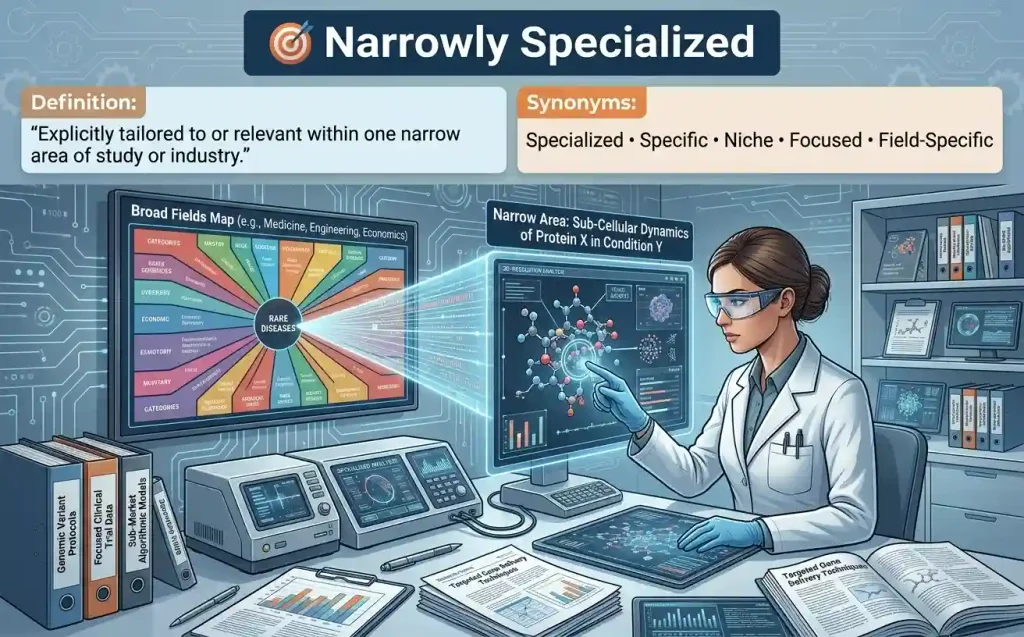
Domain-specific (Phrase) — US: /doʊˈmeɪn spəˈsɪf.ɪk/ | UK: /dəˈmeɪn spəˈsɪf.ɪk/
- Meaning: Explicitly tailored to or relevant within one narrow area of study or industry.
- Tone/Register: Academic / Tech
- Example 1: Artificial intelligence models perform best when trained on domain-specific data.
- Example 2: Every industry relies on domain-specific terminology that outsiders rarely know.
Jargon-heavy (Phrase) — US: /ˈdʒɑːr.ɡən ˈhev.i/ | UK: /ˈdʒɑː.ɡən ˈhev.i/
- Meaning: Filled with specialized terms that are difficult for general readers to understand.
- Tone/Register: Informal / Critical
- Example 1: The manual was so jargon-heavy that non-engineers could not follow it.
- Example 2: Writers should simplify jargon-heavy articles to improve public readability.
In-depth (Adjective) — US: /ˌɪnˈdepθ/ | UK: /ˌɪnˈdepθ/
- Meaning: Comprehensive, thorough, and covering all detailed aspects of a topic.
- Tone/Register: General / Journalism
- Example 1: The reporter wrote an in-depth article exploring regional energy needs.
- Example 2: The course offers in-depth instruction on advanced financial reporting.
Niche (Adjective) — US: /niːʃ/ | UK: /niːʃ/
- Meaning: Denoting products, services, or topics appealing to a small, specialized audience.
- Tone/Register: Marketing / Business
- Example 1: The publisher focuses on niche books about rare historical artifacts.
- Example 2: Software developers create niche tools for independent game creators.
Skilled-craft (Phrase) — US: /skɪld kræft/ | UK: /skɪld krɑːft/
- Meaning: Practical work that demands manual dexterity, experience, and training.
- Tone/Register: Vocational / Trade
- Example 1: Fine woodworking is a skilled craft that takes decades to fully master.
- Example 2: Vocational schools train students in skilled-craft trades like plumbing.
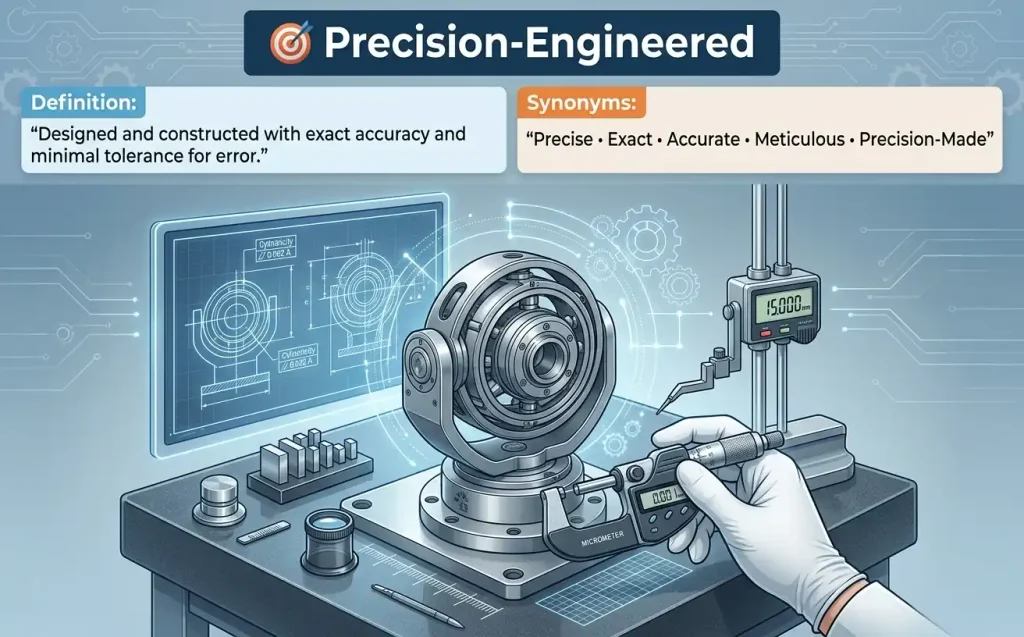
Precision-engineered (Phrase) — US: /prəˈsɪʒ.ən ˌen.dʒəˈnɪrd/ | UK: /prɪˈsɪʒ.ən ˌen.dʒɪˈnɪəd/
- Meaning: Designed and constructed with exact accuracy and minimal tolerance for error.
- Tone/Register: Commercial / Engineering
- Example 1: German auto manufacturers are famous for producing precision-engineered vehicles.
- Example 2: The surgical knife features a precision-engineered steel blade.
Hard-skill (Phrase) — US: /hɑːrd skɪl/ | UK: /hɑːd skɪl/
- Meaning: A specific, measurable ability acquired through training, such as coding or welding.
- Tone/Register: Corporate / Career
- Example 1: Python programming is a valuable hard skill for modern data analysts.
- Example 2: Resumes should highlight measurable hard-skill achievements clearly.
Mechanical-minded (Phrase) — US: /məˈkæn.ɪ.kəl ˈmaɪn.dɪd/ | UK: /məˈkæn.ɪ.kəl ˈmaɪn.dɪd/
- Meaning: Naturally adept at understanding how machinery, engines, and tools operate.
- Tone/Register: Casual / Descriptive
- Example 1: Her mechanical-minded brother fixed the lawnmower without reading the manual.
- Example 2: Being mechanically minded helps technicians troubleshoot complex engine failures.
Highly-detailed (Phrase) — US: /ˈhaɪ.li dɪˈteɪld/ | UK: /ˈhaɪ.li ˈdiː.teɪld/
- Meaning: Containing an abundance of small, specific facts, instructions, or features.
- Tone/Register: Everyday / Business
- Example 1: The architect presented a highly detailed floor plan to the city board.
- Example 2: She wrote a highly detailed summary of the legal contract for her client.
Specialized-field (Phrase) — US: /ˈspeʃ.ə.laɪzd fiːld/ | UK: /ˈspeʃ.əl.aɪzd fiːld/
- Meaning: A distinct branch of study, trade, or profession requiring unique expertise.
- Tone/Register: Formal / Career
- Example 1: Medical genetics is a specialized field experiencing rapid scientific breakthroughs.
- Example 2: Entering a specialized field often opens doors to higher earning potential.
Blueprint-level (Phrase) — US: /ˈbluː.prɪnt ˈlev.əl/ | UK: /ˈbluː.prɪnt ˈlev.əl/
- Meaning: Providing exact structural specifications akin to architectural floor plans.
- Tone/Register: Industry / Professional
- Example 1: The team developed a blueprint-level strategy for launching the new product line.
- Example 2: Engineers require blueprint-level accuracy before starting building work.
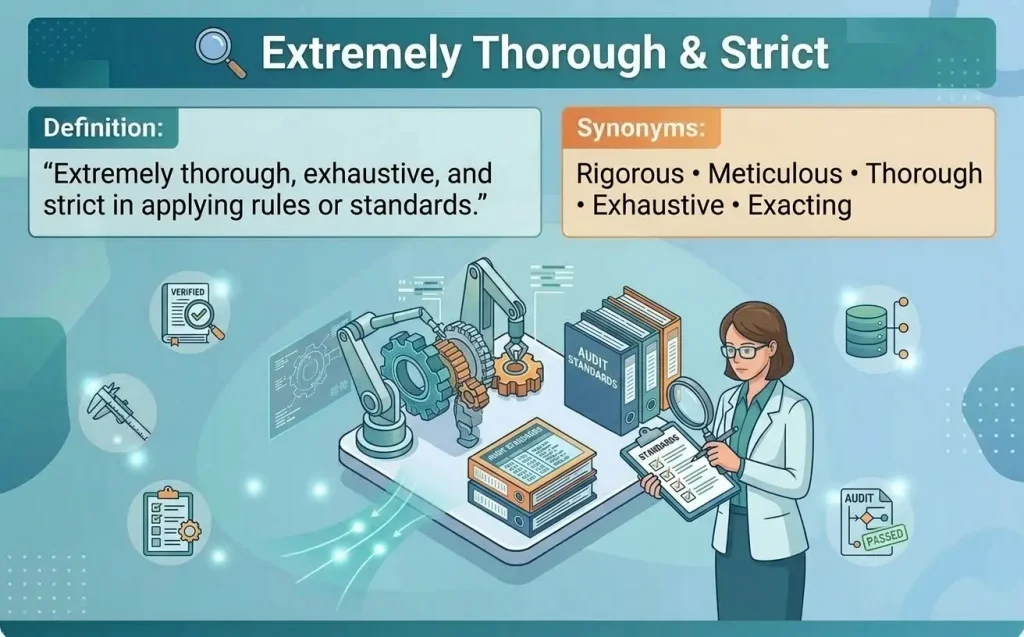
Rigorous (Adjective) — US: /ˈrɪɡ.ɚ.əs/ | UK: /ˈrɪɡ.ər.əs/
- Meaning: Extremely thorough, exhaustive, and strict in applying rules or standards.
- Tone/Register: Academic / Professional
- Example 1: The drug underwent rigorous clinical trials before gaining FDA approval.
- Example 2: Academic journals enforce a rigorous peer-review process for all papers.
Specialized-discipline (Phrase) — US: /ˈspeʃ.ə.laɪzd ˈdɪs.ə.plɪn/ | UK: /ˈspeʃ.əl.aɪzd ˈdɪs.ɪ.plɪn/
- Meaning: A specific subject area governed by strict academic or practical methodologies.
- Tone/Register: High Formal / Academic
- Example 1: Quantum computing is a specialized discipline combining physics and computer science.
- Example 2: Scholars in this specialized discipline meet annually at international conferences.
Synonyms by Tone
Positive
Words like specialized, expert, precision-engineered, methodical, and empirical highlight high competence, mastery, and exact performance.
Neutral
Terms such as practical, detailed, procedural, structural, and systematic describe methods, rules, or setups objectively.
Negative
Phrases like jargon-heavy, overly complex, or dry describe communication that is confusing or unnecessarily complicated.
Playful / Informal
Expressions like mechanical-minded, hard-skill, niche, and in-depth fit well in casual workplace chat or descriptive blogs.
Why Tone Matters
Selecting the correct tone ensures your audience understands your intent. Calling a clear presentation “jargon-heavy” sounds like criticism, whereas “specialized” commends the speaker’s expertise.
Mini Comparison
| Feature | Technical | Specialized | Complex |
| Core Meaning | Relating to practical skills, trade, or science | Tailored to a narrow area or purpose | Having many intricate interconnected parts |
| Tone/Register | Industry / Practical | Professional / Academic | General / Descriptive |
| Best Used When | Referring to machinery, code, or exact rules | Describing niche expertise or tailored tools | Describing difficult concepts with many parts |
- Technical vs. Specialized: “Technical” focuses on practical mechanics, code, or scientific processes, while “specialized” emphasizes a narrow focus or niche application.
- Technical vs. Complex: Something can be “technical” without being difficult, but “complex” always implies many intricate, hard-to-understand parts.
Context-Based Usage
Daily Conversation
In everyday speech, skip academic jargon. Use approachable options like practical, detailed, skilled, or in-depth.
Writing or Blogging
Bloggers should balance accuracy with readability. Words like specialized, intricate, precise, or niche work well.
Professional or Academic Tone
In formal reports and business documents, use authoritative terms such as procedural, methodical, empirical, or systematic.
Creative or Informal Use
Fiction writers and essayists use vivid terms like mechanical-minded, exacting, or precision-engineered to build detailed worlds.
Common Mistakes & Native Usage
Misuse Scenarios
A common error is using “technical” when you simply mean “difficult.” A task can be hard without requiring specialized technology or rules.
Overuse Warnings
Repeating “technical difficulties” or “technical details” makes business writing sound lazy. Alternate with procedural steps or operational delays.
Register Notes
- Formal / Written: Use empirical, procedural, methodical, domain-specific.
- Informal / Spoken: Use practical, in-depth, skilled, hard-skill.
Internal Linking Hint: Writers striving for professional language can explore our master guide on academic transition words to improve essay flow.
Real-Life Mini Scenarios
- Workplace: A team sets up a step-by-step process for customer refunds. Result: They created a clear procedural workflow.
- Social Situations: A friend helps you build a custom desktop PC. Result: They demonstrated great practical knowledge.
- Media / Pop Culture: A documentary explores how CGI effects are made. Result: It gives an in-depth look behind the scenes.
- Writing or Storytelling: An author details the inner workings of a clockwork city. Result: The story features an intricate setting.
Conclusion
Expanding your vocabulary with precise synonyms transforms how effectively you explain complex processes and professional skills.
Swapping repetitive adjectives keeps your writing engaging while demonstrating true language proficiency in every document.
Try incorporating two or three new specialized terms into your next report, essay, or blog post.
Start practicing these expressive words today, and watch your daily communication become clearer and far more professional!
MCQs
1. Which word is the closest synonym for “technical”?
A) Emotional
B) Specialized
C) Ordinary
D) Casual
2. “She has strong technical knowledge.” What does “technical” mean here?
A) Specialized
B) Personal
C) Social
D) Simple
3. Which word can replace “technical” in “technical skills”?
A) Practical
B) Specialized
C) Artistic
D) Emotional
4. Which is NOT a synonym for “technical”?
A) Specialized
B) Professional
C) Complex
D) Unrelated
5. “The engineer explained the technical details.” Which word best replaces “technical”?
A) Specialized
B) Friendly
C) Emotional
D) Informal
6. Which word is closest in meaning to “technical” when referring to a field of expertise?
A) Professional
B) Personal
C) General
D) Social
7. Choose the best synonym for “technical.”
A) Specialized
B) Natural
C) Ordinary
D) Unusual
8. “The manual contains technical information.” This means the information is:
A) Specialized
B) Entertaining
C) Emotional
D) Unrelated
9. Which sentence uses “technical” correctly?
A) He needs technical knowledge to repair the machine.
B) She gave a technical smile at the party.
C) They enjoyed a technical vacation.
D) He bought a technical sandwich.
10. Which word is most suitable as a synonym for “technical” in “technical expertise”?
A) Specialized
B) Casual
C) Social
D) Ordinary
Answer Key
- B
- A
- B
- D
- A
- A
- A
- A
- A
- A
Application Task: Write one original sentence using specialized or methodical to describe a task you complete at work or school.
FAQs
1. What is the most common synonym for technical in business writing?
The most common business synonym for technical is specialized or professional. When referring to processes, terms like procedural or operational are frequently used to describe detailed workflows without using confusing jargon.
2. Can technical mean the same thing as complex?
While technical topics are often complex, the terms are not identical. “Technical” refers to specialized skills, science, or tools, whereas “complex” simply means consisting of many complicated, interconnected parts.
3. What does “technical jargon” mean in everyday English?
Technical jargon refers to specialized words used by specific professions (like doctors or programmers) that sound confusing or unclear to everyday people outside that field.
4. How should I describe technical skills on a resume?
On a resume, describe technical abilities using clear phrases like hard skills, specialized expertise, or domain-specific knowledge, followed by concrete software names or measurable certifications.
5. What is the opposite of a technical explanation?
The opposite of a technical explanation is a layman’s terms explanation, a simplified summary, or a non-technical overview that uses everyday language.
6. Which synonym for technical works best in academic essays?
In academic papers, precise words like empirical, methodical, analytical, or systematic work best because they reflect rigorous scholarly research standards.

Samia Noor is the founder and lead writer at SynonymGenius.com, where she creates accurate, reader-focused English language content that helps people communicate with clarity and confidence. She specializes in synonyms, antonyms, word meanings, idioms, and practical vocabulary guides that make complex language concepts simple and easy to understand. Every article is thoroughly researched, carefully fact-checked, and written in clear, accessible language using reliable sources and real-world examples. Her mission is to provide trustworthy, high-quality content that supports students, writers, educators, professionals, and English learners at every stage of their language journey.
Her editorial approach emphasizes accuracy, transparency, and genuine value for readers while following modern E-E-A-T and content quality standards. She regularly reviews and updates published content to ensure it remains current, reliable, and easy to understand. Through SynonymGenius.com, Samia Noor is committed to publishing dependable language resources that help readers expand their vocabulary, strengthen their writing skills, improve communication, and build confidence in academic, professional, and everyday English.