
Synonyms for societal norms help you express implicit rules, cultural standards, and social expectations with precision.
Imagine walking into a quiet library and instinctively whispering on your phone. Nobody handed you a written rulebook when you entered through the front doors. Yet, you automatically modified your behavior to match everyone else around you.
That unspoken agreement is a classic example of how expectations govern our daily public interactions.
Understanding synonyms for societal norms improves your vocabulary, sharpens your writing tone, and prevents repetitive language. Writers, students, bloggers, and ESL learners rely on these variations to convey precise shades of cultural meaning across different contexts.
What Does “Societal Norms” Really Mean?
The phrase societal norms refers to the unwritten rules, expectations, and standards of behavior that a community or culture considers acceptable.
As a noun phrase, it describes collective patterns rather than formal legal codes. Native speakers use it to explain why people act similarly in shared social spaces. It carries a neutral to slightly analytical tone.
Connotative Meaning
Connotation is the emotional or cultural association a word carries beyond its explicit dictionary definition.
- Positive tone: Represents shared harmony, mutual respect, order, and community cohesion.
- Negative tone: Implies rigid pressure, restrictive tradition, conformity, or loss of individuality.
- Neutral tone: Denotes general sociological patterns, standard customs, or observational statistics.
Etymology
The term combines two distinct linguistic origins:
- Societal: Derived from the French société and Latin societas (meaning “fellowship” or “association”).
- Norms: Derived from the Latin norma, which originally referred to a carpenter’s square or standard rule.
History of development:
- Old English (450–1100): Early Germanic terms like theaw (custom or habit) described community rules.
- Middle English (1100–1500): French borrowings introduced words like custom and convention.
- Modern English (1500–Present): Academic sociology popularized “societal norms” in the 20th century to study group behavior scientifically.
Pronunciation (US & UK)
- US: /səˈsaɪ.ə.t̬əl nɔːrmz/
- UK: /səˈsaɪ.ə.təl nɔːmz/
Syllables & Root Structure
- Syllables: so-ci-e-tal norms
- Root: socio- (companion/society) + norm (rule)
- Prefix: None
- Suffix: -al (adjectival suffix meaning “relating to”)
Synonyms List (Core Section)
1. Social Conventions (Noun) — US: /ˈsoʊ.ʃəl kənˈven.ʃənz/ | UK: /ˈsəʊ.ʃəl kənˈven.ʃənz/
- Meaning: Accepted behaviors and practices established by general agreement within a community.
- Tone/Register: Formal, Academic
- Example 1: Shaking hands during business introductions remains standard practice across many cultures.
- Example 2: Online etiquette forms new social conventions for modern digital communication.
2. Cultural Expectations (Noun) — US: /ˈkʌl.tʃɚ.əl ˌek.spekˈteɪ.ʃənz/ | UK: /ˈkʌl.tʃər.əl ˌek.spekˈteɪ.ʃənz/
- Meaning: Standard behaviors that a specific ethnic or regional group anticipates from its members.
- Tone/Register: Academic, Neutral
- Example 1: Removing shoes before entering a home fulfills deep cultural expectations in East Asia.
- Example 2: Young adults often navigate conflicting cultural expectations between traditional families and modern workplaces.
3. Unwritten Rules (Noun) — US: /ʌnˈrɪt.ən ruːlz/ | UK: /ʌnˈrɪt.ən ruːlz/
- Meaning: Implicit social guidelines that people understand without formal documentation.
- Tone/Register: Informal, Conversational
- Example 1: Standing on the right side of the escalator is an unwritten rule in busy subway stations.
- Example 2: Employees quickly learn the unwritten rules about breaks during their first week.
4. Established Customs (Noun) — US: ɪˈstæb.lɪʃt ˈkʌs.təmz/ | UK: ɪˈstæb.lɪʃt ˈkʌs.təmz/
- Meaning: Long-standing practices passed down through generations within a community.
- Tone/Register: Formal, Historical
- Example 1: Local communities honor established customs during seasonal harvest festivals.
- Example 2: Wedding ceremonies often blend established customs with personal preferences.
5. Folkways (Noun) — US: /ˈfoʊk.weɪz/ | UK: /ˈfəʊk.weɪz/
- Meaning: Traditional social customs governing daily dress, greetings, and casual interaction without moral weight.
- Tone/Register: Academic, Sociological
- Example 1: Greeting neighbors with a nod reflects traditional rural folkways.
- Example 2: Sociologists analyze folkways to understand daily social routine stability.
6. Mores (Noun) — US: /ˈmɔːr.eɪz/ | UK: /ˈmɔː.reɪz/
- Meaning: Essential moral customs and strict behavioral standards crucial to a group’s ethical integrity.
- Tone/Register: Formal, Academic
- Example 1: Community mores strictly condemn acts of dishonesty in public office.
- Example 2: Violating core mores often results in severe social isolation or formal sanction.
7. Social Code (Noun) — US: /ˈsoʊ.ʃəl koʊd/ | UK: /ˈsəʊ.ʃəl kəʊd/
- Meaning: A system of principles governing acceptable conduct in social settings.
- Tone/Register: Professional, Formal
- Example 1: Members of the elite club strictly follow a traditional social code.
- Example 2: Modern workplace guidelines adapt the social code to remote environments.
8. Etiquette (Noun) — US: /ˈet.ɪ.kət/ | UK: /ˈet.ɪ.ket/
- Meaning: Rules governing polite behavior in specific social or professional circumstances.
- Tone/Register: Formal, Professional
- Example 1: Dining etiquette requires waiting for everyone to sit before eating.
- Example 2: Email etiquette discourages typing entire messages in capital letters.
9. Standard Practices (Noun) — US: /ˈstæn.dɚd ˈpræk.tɪ.səz/ | UK: /ˈstæn.dəd ˈpræk.tɪ.səz/
- Meaning: Routinely followed methods or behavioral rules in an organization or industry.
- Tone/Register: Business, Formal
- Example 1: Submitting weekly progress reports is one of our team’s standard practices.
- Example 2: Safety checks represent standard practices across the manufacturing industry.
10. Behavioral Standards (Noun) — US: bɪˈheɪ.vjɚ.əl ˈstæn.dɚdz/ | UK: bɪˈheɪ.vjər.əl ˈstæn.dədz/
- Meaning: Explicit or implicit measures defining appropriate conduct for individuals.
- Tone/Register: Educational, Formal
- Example 1: Schools maintain behavioral standards to ensure peaceful learning environments.
- Example 2: Professional associations enforce strict behavioral standards among their licensed members.
11. Prescribed Behaviors (Noun) — US: prɪˈskraɪbd bɪˈheɪ.vjɚz/ | UK: prɪˈskraɪbd bɪˈheɪ.vjəz/
- Meaning: Conduct officially or socially mandated by authority or long-held consensus.
- Tone/Register: Academic, Technical
- Example 1: Diplomatic events strictly require prescribed behaviors during official greetings.
- Example 2: Religious ceremonies rely on prescribed behaviors to preserve spiritual solemnity.
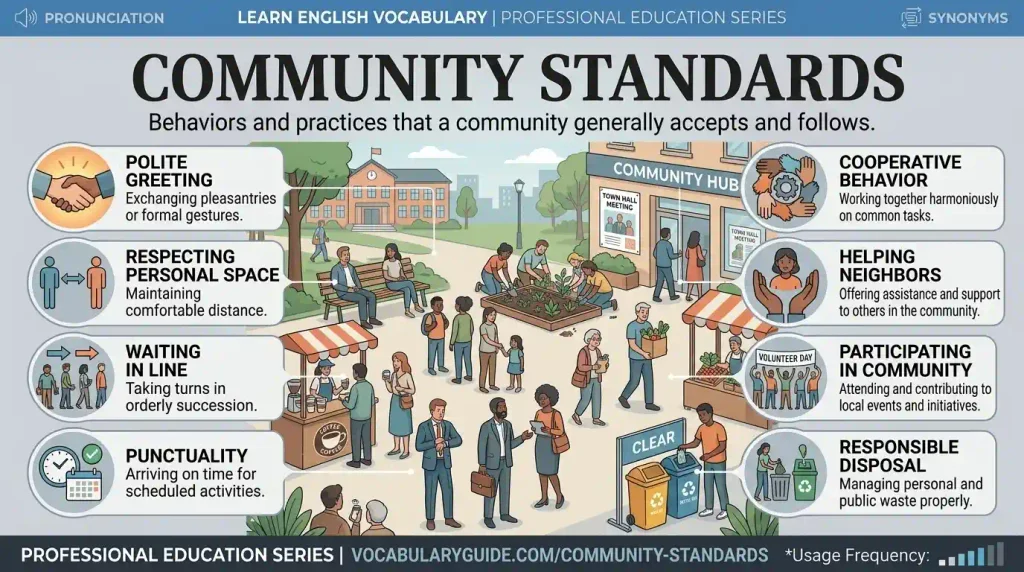
12. Community Standards (Noun) — US: kəˈmjuː.nə.t̬i ˈstæn.dɚdz/ | UK: kəˈmjuː.nə.ti ˈstæn.dədz/
- Meaning: Agreed-upon values and conduct rules accepted by residents or digital users.
- Tone/Register: Legal, Business
- Example 1: Moderation teams enforce community standards to prevent online harassment.
- Example 2: Local councils update community standards regarding public noise levels.
13. Public Decorum (Noun) — US: /ˈpʌb.lɪk dɪˈkɔːr.əm/ | UK: /ˈpʌb.lɪk dɪˈkɔː.rəm/
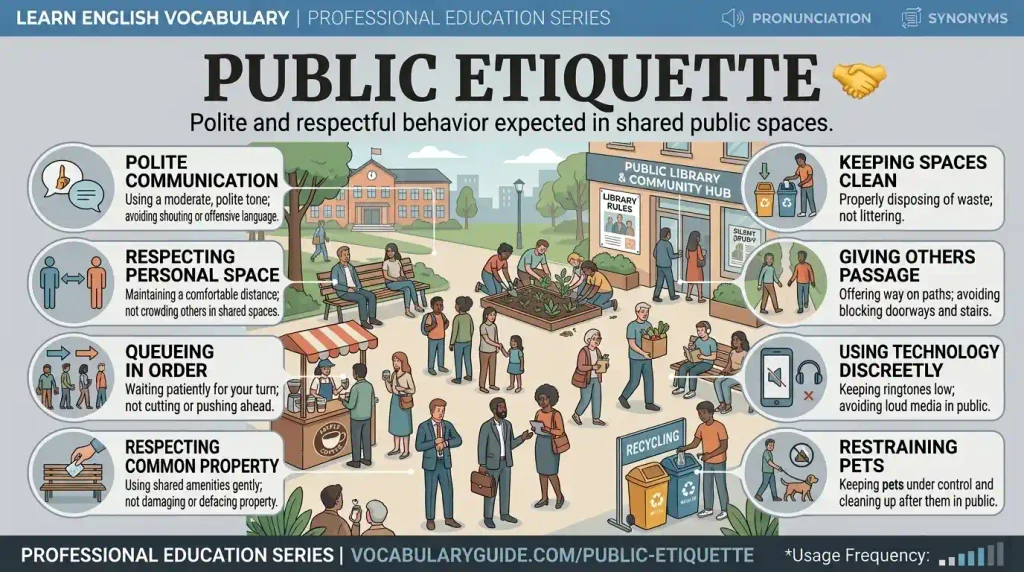
- Meaning: Behavior that is socially correct, polite, and respectful in open spaces.
- Tone/Register: Formal, Literary
- Example 1: Disruptive shouting during court proceedings violates public decorum.
- Example 2: Citizens maintained public decorum during the memorial service.
14. Standard Decorum (Noun) — US: /ˈstæn.dɚd dɪˈkɔːr.əm/ | UK: /ˈstæn.dəd dɪˈkɔː.rəm/
- Meaning: Expected conventional politeness suited to specific social environments.
- Tone/Register: Formal
- Example 1: High-end restaurants expect standard decorum from all patrons.
- Example 2: The host reminded guests about maintaining standard decorum during speeches.
15. Social Expectations (Noun) — US: /ˈsoʊ.ʃəl ˌek.spekˈteɪ.ʃənz/ | UK: /ˈsəʊ.ʃəl ˌek.spekˈteɪ.ʃənz/
- Meaning: General beliefs held by society about how individuals ought to behave.
- Tone/Register: Neutral, Conversational
- Example 1: Young professionals feel pressure to conform to contemporary social expectations.
- Example 2: Social expectations surrounding career timelines are shifting rapidly.
16. Collective Customs (Noun) — US: kəˈlek.tɪv ˈkʌs.təmz/ | UK: kəˈlek.tɪv ˈkʌs.təmz/
- Meaning: Habits shared universally across an entire population or group.
- Tone/Register: Academic, Sociological
- Example 1: Celebrating regional harvests represents one of their oldest collective customs.
- Example 2: Sociologists study collective customs to understand community stability.
17. Cultural Traditions (Noun) — US: /ˈkʌl.tʃɚ.əl trəˈdɪʃ.ənz/ | UK: /ˈkʌl.tʃər.əl trəˈdɪʃ.ənz/
- Meaning: Enduring beliefs and behavioral routines passed across generations.
- Tone/Register: General, Educational
- Example 1: Holiday gatherings preserve cherished cultural traditions across generations.
- Example 2: Storytelling serves as a vital tool to pass down cultural traditions.
18. Social Decency (Noun) — US: /ˈsoʊ.ʃəl ˈdiː.sən.si/ | UK: /ˈsəʊ.ʃəl ˈdiː.sən.si/
- Meaning: Basic standards of moral and polite behavior toward others.
- Tone/Register: Moral, Formal
- Example 1: Offering your seat to an older passenger reflects simple social decency.
- Example 2: Public debates require minimum levels of social decency to remain constructive.
19. Behavioral Norms (Noun) — US: bɪˈheɪ.vjɚ.əl nɔːrmz/ | UK: bɪˈheɪ.vjər.əl nɔːmz/
- Meaning: Measurable statistical expectations regarding how people act in social systems.
- Tone/Register: Scientific, Academic
- Example 1: Researchers observed shifting behavioral norms among adolescents using smartphones.
- Example 2: Changing workplace setups alter established behavioral norms during meetings.
20. Societal Expectations (Noun) — US: səˈsaɪ.ə.t̬əl ˌek.spekˈteɪ.ʃənz/ | UK: səˈsaɪ.ə.təl ˌek.spekˈteɪ.ʃənz/
- Meaning: Broad assumptions made by society about individual milestones and duties.
- Tone/Register: Formal, Sociological
- Example 1: Returning to school later in life challenges typical societal expectations.
- Example 2: Media portrayals shape societal expectations regarding personal success.
21. Standard Practices (Noun) — US: /ˈstæn.dɚd ˈpræk.tɪ.səz/ | UK: /ˈstæn.dəd ˈpræk.tɪ.səz/
- Meaning: Regularly repeated actions that define ordinary routines in a group.
- Tone/Register: Neutral
- Example 1: Weekly team briefings serve as standard practices in corporate offices.
- Example 2: Pre-flight announcements represent standard practices across airlines worldwide.
22. Moral Codes (Noun) — US: /ˈmɔːr.əl koʊdz/ | UK: /ˈmɒr.əl kəʊdz/
- Meaning: Systems of moral values dictating right versus wrong actions in society.
- Tone/Register: Philosophical, Formal
- Example 1: Ancient civilizations documented their moral codes on stone monuments.
- Example 2: Personal choices often align with the moral codes taught in childhood.
23. Social Mandates (Noun) — US: /ˈsoʊ.ʃəl ˈmæn.deɪts/ | UK: /ˈsəʊ.ʃəl ˈmæn.deɪts/
- Meaning: Strong social pressures forcing compliance with collective desires.
- Tone/Register: Political, Authoritative
- Example 1: Public health initiatives relied on strong social mandates during emergencies.
- Example 2: Environmental awareness transformed into a broad social mandate for businesses.
24. Traditional Practices (Noun) — US: trəˈdɪʃ.ən.əl ˈpræk.tɪ.səz/ | UK: trəˈdɪʃ.ən.əl ˈpræk.tɪ.səz/
- Meaning: Longstanding routines maintained out of historic duty or respect.
- Tone/Register: Cultural, General
- Example 1: Artisans preserve traditional practices by training young apprentices manually.
- Example 2: Festival schedules continue to honor traditional practices from past centuries.
25. Group Standards (Noun) — US: /ɡruːp ˈstæn.dɚdz/ | UK: /ɡruːp ˈstæn.dədz/
- Meaning: Conduct rules set by specific peer circles or small organizations.
- Tone/Register: Casual, Team-oriented
- Example 1: Creative agencies establish distinct group standards to encourage open debate.
- Example 2: New members must adapt quickly to existing group standards.
26. Peer Expectations (Noun) — US: /pɪr ˌek.spekˈteɪ.ʃənz/ | UK: /pɪər ˌek.spekˈteɪ.ʃənz/
- Meaning: Social pressure exerted by equals within a specific demographic or field.
- Tone/Register: Psychological, Conversational
- Example 1: Teenagers often modify their wardrobe choices based on peer expectations.
- Example 2: Professional athletes face intense peer expectations during high-stakes games.
27. Unspoken Rules (Noun) — US: /ʌnˈspoʊ.kən ruːlz/ | UK: /ʌnˈspəʊ.kən ruːlz/
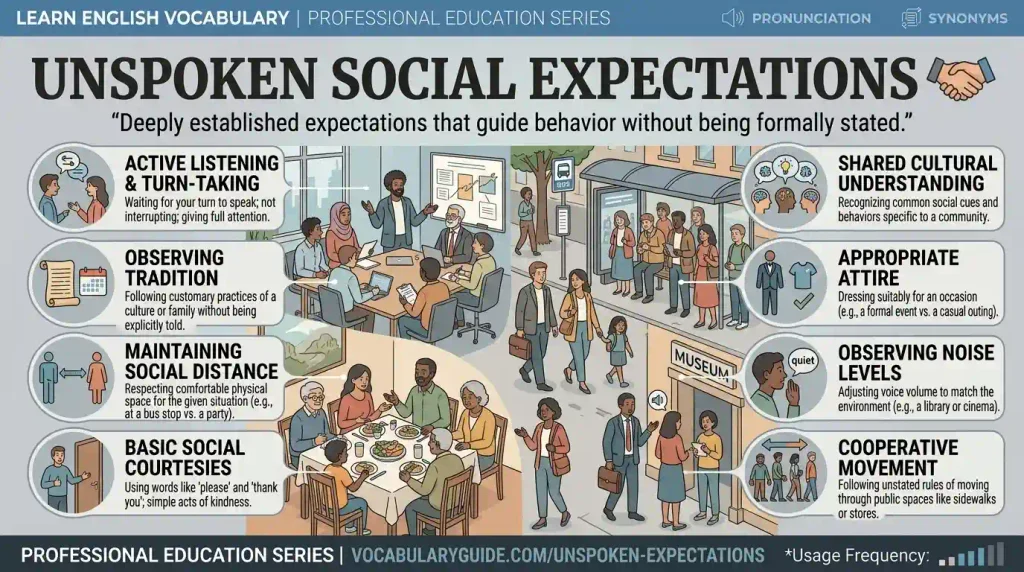
- Meaning: Deeply understood social boundaries that are never explicitly discussed.
- Tone/Register: Informal, Everyday
- Example 1: Leaving the middle seat open when possible is an unspoken rule on public transit.
- Example 2: Unspoken rules govern who speaks first during high-level negotiations.
28. Institutional Norms (Noun) — US: ˌɪn.stəˈtuː.ʃən.əl nɔːrmz/ | UK: ˌɪn.stɪˈtjuː.ʃən.əl nɔːmz/
- Meaning: Accepted rules driving corporate, educational, or governmental bodies.
- Tone/Register: Business, Formal
- Example 1: Changing institutional norms requires strong leadership across all levels.
- Example 2: Remote work models disrupted traditional institutional norms permanently.
29. Conventional Ways (Noun) — US: kənˈven.ʃən.əl weɪz/ | UK: kənˈven.ʃən.əl weɪz/
- Meaning: Standard or routine methods for approaching daily life tasks.
- Tone/Register: Conversational
- Example 1: Tech startups often challenge conventional ways of running software projects.
- Example 2: She preferred conventional ways of cooking using fresh local ingredients.
30. Orthodoxy (Noun) — US: /ˈɔːr.θə.dɑːk.si/ | UK: /ˈɔː.θə.dɒk.si/
- Meaning: Authorized, generally accepted theories, doctrines, or behavioral patterns.
- Tone/Register: Academic, Literary
- Example 1: Economic orthodoxy was questioned during the financial crisis.
- Example 2: Scientific discoveries frequently challenge prevailing medical orthodoxy.
31. Prescribed Customs (Noun) — US: prɪˈskraɪbd ˈkʌs.təmz/ | UK: prɪˈskraɪbd ˈkʌs.təmz/
- Meaning: Mandated ceremonies or social routines enforced by tradition or law.
- Tone/Register: Formal
- Example 1: State funerals require prescribed customs executed with extreme precision.
- Example 2: Historical reenactments honor prescribed customs from historical periods.
32. Social Protocols (Noun) — US: /ˈsoʊ.ʃəl ˈproʊ.tə.kɑːlz/ | UK: /ˈsəʊ.ʃəl ˈprəʊ.tə.kɒlz/
- Meaning: Formal procedures regulating interactions in official or diplomatic contexts.
- Tone/Register: Diplomatic, Professional
- Example 1: International summits follow strict social protocols during state dinners.
- Example 2: Understanding social protocols prevents embarrassing mistakes overseas.
33. Common Usage (Noun) — US: /ˈkɑː.mən ˈjuː.sɪdʒ/ | UK: /ˈkɒm.ən ˈjuː.sɪdʒ/
- Meaning: The customary way language or behavior is used by most people.
- Tone/Register: Linguistic, Everyday
- Example 1: Lexicographers track changes in common usage across generations.
- Example 2: Slang terms often transition into acceptable common usage over time.
34. Collective Standards (Noun) — US: kəˈlek.tɪv ˈstæn.dɚdz/ | UK: kəˈlek.tɪv ˈstæn.dədz/
- Meaning: Ethical or behavioral benchmarks maintained by an entire social group.
- Tone/Register: Academic, Sociological
- Example 1: Online communities require collective standards to maintain civil discussion.
- Example 2: Global environmental policy relies on establishing shared collective standards.
35. Accepted Standards (Noun) — US: ækˈsep.tɪd ˈstæn.dɚdz/ | UK: əkˈsep.tɪd ˈstæn.dədz/
- Meaning: Benchmarks generally acknowledged as normal or proper.
- Tone/Register: Professional, Formal
- Example 1: Software engineers follow accepted standards to write clean code.
- Example 2: Quality control teams verify products against accepted standards.
36. Traditional Codes (Noun) — US: trəˈdɪʃ.ən.əl koʊdz/ | UK: trəˈdɪʃ.ən.əl kəʊdz/
- Meaning: Older behavioral rules reflecting historical values.
- Tone/Register: Formal, Historical
- Example 1: Traditional codes of chivalry heavily influenced medieval literature.
- Example 2: Rural villages often maintain traditional codes of hospitality.
37. Social Benchmarks (Noun) — US: /ˈsoʊ.ʃəl ˈbentʃ.mɑːrks/ | UK: /ˈsəʊ.ʃəl ˈbentʃ.mɑːks/
- Meaning: Standards used to measure appropriate life achievements or behaviors.
- Tone/Register: Business, Sociological
- Example 1: Financial milestones serve as traditional social benchmarks for adulthood.
- Example 2: Modern society is redefining standard social benchmarks for success.
38. General Practice (Noun) — US: /ˈdʒen.ər.əl ˈpræk.tɪs/ | UK: /ˈdʒen.ər.əl ˈpræk.tɪs/
- Meaning: What is normally done in a given situation or context.
- Tone/Register: Business, Legal
- Example 1: It is general practice to send thank-you notes after job interviews.
- Example 2: Legal teams review general practice standard procedures before trial.
39. Public Expectations (Noun) — US: /ˈpʌb.lɪk ˌek.spekˈteɪ.ʃənz/ | UK: /ˈpʌb.lɪk ˌek.spekˈteɪ.ʃənz/
- Meaning: What civil society demands or anticipates from institutions and leaders.
- Tone/Register: Political, Media
- Example 1: Public expectations regarding corporate sustainability have increased dramatically.
- Example 2: Politicians must navigate intense public expectations during campaigns.
40. Societal Standards (Noun) — US: səˈsaɪ.ə.t̬əl ˈstæn.dɚdz/ | UK: səˈsaɪ.ə.təl ˈstæn.dədz/
- Meaning: Overall moral and behavioral expectations maintained across society.
- Tone/Register: Formal, Academic
- Example 1: Maintaining high societal standards improves civic life.
- Example 2: Authors often critique rigid societal standards through satire.
41. Prescribed Rules (Noun) — US: prɪˈskraɪbd ruːlz/ | UK: prɪˈskraɪbd ruːlz/
- Meaning: Explicit directives detailing precise conduct requirements.
- Tone/Register: Legal, Technical
- Example 1: The handbook lists prescribed rules for handling confidential data.
- Example 2: Drivers must obey prescribed rules on public roadways.
42. Civil Expectations (Noun) — US: /ˈsɪv.əl ˌek.spekˈteɪ.ʃənz/ | UK: /ˈsɪv.əl ˌek.spekˈteɪ.ʃənz/
- Meaning: Unwritten obligations governing how citizens treat one another in public.
- Tone/Register: Civic, Formal
- Example 1: Basic civil expectations keep public spaces pleasant for everyone.
- Example 2: Community workshops help reinforce shared civil expectations.
43. Standard Customs (Noun) — US: /ˈstæn.dɚd ˈkʌs.təmz/ | UK: /ˈstæn.dəd ˈkʌs.təmz/
- Meaning: Routinely observed rituals standard within a given area or group.
- Tone/Register: Neutral, Descriptive
- Example 1: Exchanging business cards with both hands is a standard custom locally.
- Example 2: Seasonal celebrations introduce tourists to standard customs.
44. Cultural Codes (Noun) — US: /ˈkʌl.tʃɚ.əl koʊdz/ | UK: /ˈkʌl.tʃər.əl kəʊdz/
- Meaning: Hidden systems of symbols and behavioral cues unique to a culture.
- Tone/Register: Academic, Analytical
- Example 1: Film directors use subtle cultural codes to tell stories effectively.
- Example 2: Deciphering local cultural codes helps travelers fit in naturally.
45. Standard Norms (Noun) — US: /ˈstæn.dɚd nɔːrmz/ | UK: /ˈstæn.dəd nɔːmz/
- Meaning: Default expectations regarding general human behavior.
- Tone/Register: Conversational, Technical
- Example 1: Normal conversations follow standard norms like taking turns to speak.
- Example 2: Remote meetings created standard norms for video etiquette.
46. Behavioral Expectations (Noun) — US: bɪˈheɪ.vjɚ.əl ˌek.spekˈteɪ.ʃənz/ | UK: bɪˈheɪ.vjər.əl ˌek.spekˈteɪ.ʃənz/
- Meaning: Explicit assumptions regarding individual actions within structured settings.
- Tone/Register: Educational, Professional
- Example 1: Teachers explain behavioral expectations on the first day of class.
- Example 2: Clear behavioral expectations prevent misunderstandings in teams.
47. Folk Expectations (Noun) — US: /foʊk ˌek.spekˈteɪ.ʃənz/ | UK: /fəʊk ˌek.spekˈteɪ.ʃənz/
- Meaning: Informal traditional beliefs held by common working people.
- Tone/Register: Informal, Historical
- Example 1: Old regional songs preserve classic folk expectations about labor and family.
- Example 2: Storytellers shared tales reflecting old folk expectations.
48. Traditional Norms (Noun) — US: trəˈdɪʃ.ən.əl nɔːrmz/ | UK: trəˈdɪʃ.ən.əl nɔːmz/
- Meaning: Historical behavioral rules retained into modern eras.
- Tone/Register: Historical, General
- Example 1: Modern couples often choose to redefine traditional norms around weddings.
- Example 2: Traditional norms favor face-to-face meetings over electronic mail.
49. Accepted Practices (Noun) — US: ækˈsep.tɪd ˈpræk.tɪ.səz/ | UK: əkˈsep.tɪd ˈpræk.tɪ.səz/
- Meaning: standard practices validated by community usage over extended periods.
- Tone/Register: Professional, Technical
- Example 1: Accounting teams adhere strictly to accepted practices for audits.
- Example 2: Industry organizations periodically review accepted practices.
50. Social Guidelines (Noun) — US: /ˈsoʊ.ʃəl ˈɡaɪd.laɪnz/ | UK: /ˈsəʊ.ʃəl ˈɡaɪd.laɪnz/
- Meaning: Non-binding suggestions outlining considerate behavioral patterns.
- Tone/Register: Friendly, Public
- Example 1: Parks display clear social guidelines regarding noise and pet control.
- Example 2: Online forums publish social guidelines to maintain healthy debates.
51. Corporate Norms (Noun) — US: /ˈkɔːr.pɚ.ət nɔːrmz/ | UK: /ˈkɔː.pər.ət nɔːmz/
- Meaning: Shared expectations governing office behavior and communication.
- Tone/Register: Business
- Example 1: Modern corporate norms emphasize flexible work arrangements.
- Example 2: Understanding corporate norms aids transition into new roles.
52. Community Conventions (Noun) — US: kəˈmjuː.nə.t̬i kənˈven.ʃənz/ | UK: kəˈmjuː.nə.ti kənˈven.ʃənz/
- Meaning: Local agreements on neighborhood manners and maintenance.
- Tone/Register: Local, Civic
- Example 1: Neighborhood community conventions govern parking arrangements.
- Example 2: Local groups discuss new community conventions at town hall meetings.
53. Unwritten Standards (Noun) — US: /ʌnˈrɪt.ən ˈstæn.dɚdz/ | UK: /ʌnˈrɪt.ən ˈstæn.dədz/
- Meaning: Deeply rooted, unstated expectations governing conduct.
- Tone/Register: Conversational
- Example 1: Every social group maintains distinct unwritten standards.
- Example 2: Navigating unwritten standards requires sharp observational skills.
54. Dominant Culture (Noun) — US: /ˈdɑː.mə.nənt ˈkʌl.tʃɚ/ | UK: /ˈdɒm.ɪ.nənt ˈkʌl.tʃər/
- Meaning: Mainstream behavioral patterns driving wider society.
- Tone/Register: Academic, Sociological
- Example 1: Subcultures often create unique habits distinct from the dominant culture.
- Example 2: Media plays a major role in reflecting dominant culture values.
55. Conventional Rules (Noun) — US: kənˈven.ʃən.əl ruːlz/ | UK: kənˈven.ʃən.əl ruːlz/
- Meaning: Standard rules accepted through widespread historical use.
- Tone/Register: Formal, General
- Example 1: Writers often master conventional rules before experimenting with form.
- Example 2: Conventional rules dictate formal seating arrangements at galas.
56. Prevailing Customs (Noun) — US: prɪˈveɪ.lɪŋ ˈkʌs.təmz/ | UK: prɪˈveɪ.lɪŋ ˈkʌs.təmz/
- Meaning: The most common habits observed during a specific time period.
- Tone/Register: Historical, Formal
- Example 1: Travelers kept travelogues recording prevailing customs in foreign lands.
- Example 2: Historical novels reflect the prevailing customs of their era.
57. Standard Decency (Noun) — US: /ˈstæn.dɚd ˈdiː.sən.si/ | UK: /ˈstæn.dəd ˈdiː.sən.si/
- Meaning: Minimum expectations of polite conduct toward fellow human beings.
- Tone/Register: Moral, General
- Example 1: Holding open doors demonstrates simple standard decency.
- Example 2: Maintaining standard decency fosters trust within communities.
58. Group Expectations (Noun) — US: /ɡruːp ˌek.spekˈteɪ.ʃənz/ | UK: /ɡruːp ˌek.spekˈteɪ.ʃənz/
- Meaning: Collective desires driving member behaviors in peer groups.
- Tone/Register: Everyday
- Example 1: Fulfilling group expectations strengthens social bonds.
- Example 2: Clear group expectations keep community projects moving smoothly.
59. Social Traditions (Noun) — US: /ˈsoʊ.ʃəl trəˈdɪʃ.ənz/ | UK: /ˈsəʊ.ʃəl trəˈdɪʃ.ənz/
- Meaning: Shared customary activities held continuously by a community.
- Tone/Register: General, Cultural
- Example 1: Annual parades remain vibrant social traditions across small towns.
- Example 2: Sharing Sunday dinner is a meaningful social tradition for many families.
60. Moral Norms (Noun) — US: /ˈmɔːr.əl nɔːrmz/ | UK: /ˈmɒr.əl nɔːmz/
- Meaning: Ethics-based rules guiding acceptable social actions.
- Tone/Register: Philosophical
- Example 1: Society relies on moral norms to maintain safety and mutual respect.
- Example 2: Philosophical debates often examine changing moral norms over time.
Synonyms by Tone
Choosing the right synonym requires matching the mood of your writing.
Positive Synonyms
- Social Decency
- Community Standards
- Cultural Traditions
- Public Decorum
Neutral Synonyms
- Social Conventions
- Behavioral Standards
- Standard Practices
- Cultural Expectations
Negative/Restrictive Synonyms
- Social Mandates
- Orthodoxy
- Prescribed Behaviors
- Societal Expectations
Mini Comparison
“Societal Norms” vs. “Social Conventions” vs. “Unwritten Rules”
| Feature | Societal Norms | Social Conventions | Unwritten Rules |
| Tone | Academic, Neutral | Formal, Professional | Casual, Conversational |
| Enforcement | Cultural Pressure | Politeness, Custom | Peer Pressure, Implicit Understanding |
| Best Context | Sociological analysis, formal essays | Business etiquette, explicit manners | Everyday social life, office culture |
- Societal Norms describes systemic cultural forces governing human action.
- Social Conventions emphasize politeness and traditional manners.
- Unwritten Rules captures real-world, practical guidelines that nobody states out loud.
Context-Based Usage
Daily Conversation
In casual speech, native speakers avoid heavy academic phrasing. Words like unwritten rules or the done thing sound natural and friendly.
- “Leaving a tip here is just an unwritten rule.”
Professional & Business Writing
Business environments demand precise language regarding standards. Terms like standard practices, corporate norms, and social protocols signal professionalism.
- “Remote work shifted our corporate norms significantly.”
Academic & Sociological Contexts
Research papers require precise terminology. Words like mores, folkways, institutional norms, and behavioral expectations work best.
- “Sociologists analyze how mores shape community policy.”
Common Mistakes & Native Usage
Mistake 1: Confusing “Mores” with “Folkways”
- Incorrect: Failing to hold the elevator violates strict community mores.
- Correct: Failing to hold the elevator breaks simple folkways, but breaking laws violates core mores.
- Note: Folkways cover simple manners; mores involve severe moral boundaries.
Mistake 2: Overusing Academic Jargon in Casual Settings
- Incorrect: My friends enforce rigid prescribed behavioral norms during game night.
- Correct: My friends have a few unwritten rules during game night.
Real-Life Mini Scenarios
Scenario 1: Office Etiquette
When joining a company, you observe how colleagues address managers. Adapting to these corporate norms helps you fit in without explicit instruction.
Scenario 2: Public Transit Manners
Offering your seat to an older traveler represents basic social decency. It reflects shared community standards in public spaces.
Interactive Practice Quiz
Test your understanding of synonyms for societal norms with these scenario questions.
1. Which phrase best fits an academic paper discussing core moral boundaries?
a) Unwritten rules
b) Community mores
c) Standard habits
d) Casual customs

2. What synonym works best when describing modern office email etiquette?
a) Social conventions
b) Historic folkways
c) Moral mandates
d) Orthodoxy

3. Which term carries a strong negative connotation implying rigid forced compliance?
a) Cultural expectations
b) Social mandates
c) General practice
d) Social decency

4. Choosing to stand in an orderly queue at a bus stop demonstrates:
a) Mores
b) Prescribed mandates
c) Unwritten rules
d) Legal mandates

5. Which word best describes long-held family holiday rituals?
a) Corporate norms
b) Cultural traditions
c) Institutional rules
d) Standard practices

6. When speaking casually with friends, which phrase sounds most natural?
a) Prescribed behaviors
b) Institutional expectations
c) Unwritten rules
d) Societal mandates

7. What is the main difference between "mores" and "folkways"?
8. "Public decorum" is most appropriate in which setting?
a) Casual texting
b) Formal ceremonies
c) Internal memo drafts
d) Gaming voice chats

9. Which term focuses specifically on business procedures?
a) Standard practices
b) Folkways
c) Moral codes
d) Cultural heritage

10. Releasing a study on human group behavior calls for which term?
a) Informal guidelines
b) Behavioral norms
c) Street rules
d) Everyday customs
Answer Key:
1: b | 2: a | 3: b | 4: c | 5: b | 6: c | 7: Mores deal with ethics; folkways deal with routine manners | 8: b | 9: a | 10: b
Reflection Task: Write two original sentences describing your local community using cultural expectations in the first sentence and unwritten rules in the second sentence.
FAQs
1. What are the best casual synonyms for societal norms?
The best casual options are unwritten rules, the done thing, and everyday customs. These phrases express social expectations in clear, accessible language suitable for personal blogs, social media posts, and everyday conversations.
2. How do “mores” and “folkways” differ in sociology?
Folkways refer to informal social customs like greeting habits or dress codes that carry no moral weight. Mores represent crucial moral standards that structure right and wrong behavior within a culture.
3. Which synonym works best for business writing?
Standard practices, corporate norms, and behavioral standards work best in professional contexts. They clearly describe expected workplace conduct without sounding overly casual or academic.
4. Are societal norms and laws the same thing?
No. Laws are formal written rules enforced by legal authorities. Societal norms are unwritten cultural expectations enforced through peer approval, social custom, or consensus.
5. Why should writers use varied synonyms for societal norms?
Using diverse synonyms prevents word repetition, matches tone precisely, improves SEO ranking, and clarifies specific context—whether academic, professional, or casual.
Conclusion
Expanding your vocabulary with synonyms for societal norms strengthens your ability to write clearly and adapt tone across different contexts.
Mastering these language variations allows you to transition smoothly between casual blog posts, professional business emails, and formal academic writing.
Start incorporating these terms into your daily writing practice to build precision and confidence in your English communication skills. You can explore more vocabulary resources on Sociology Dictionary to deepen your understanding of social concepts.

Samia Noor is the founder and lead writer at SynonymGenius.com, where she creates accurate, reader-focused English language content that helps people communicate with clarity and confidence. She specializes in synonyms, antonyms, word meanings, idioms, and practical vocabulary guides that make complex language concepts simple and easy to understand. Every article is thoroughly researched, carefully fact-checked, and written in clear, accessible language using reliable sources and real-world examples. Her mission is to provide trustworthy, high-quality content that supports students, writers, educators, professionals, and English learners at every stage of their language journey.
Her editorial approach emphasizes accuracy, transparency, and genuine value for readers while following modern E-E-A-T and content quality standards. She regularly reviews and updates published content to ensure it remains current, reliable, and easy to understand. Through SynonymGenius.com, Samia Noor is committed to publishing dependable language resources that help readers expand their vocabulary, strengthen their writing skills, improve communication, and build confidence in academic, professional, and everyday English.