
Synonyms for soon after are essential tools when you want to describe events that happen quickly without sounding repetitive in your daily prose. Imagine telling a friend about a sudden rainstorm that hit right as you stepped outside. Saying “soon after” repeatedly makes your story feel dull, flat, and predictable.
Using precise temporal transitions keeps your readers engaged whether you are drafting a personal blog post or a quick text update. Switching up your phrasing allows your narrative to flow smoothly and highlights the exact speed and nature of each event.
Learning semantic variations expands your vocabulary and sharpens your communication skills across every medium. The phrase appears everywhere in spoken and written English because humans naturally frame life through time sequences and connected moments.
Mastering these phrase alternatives benefits students writing essays, bloggers crafting engaging stories, content creators optimizing prose, and daily speakers. Broadening your word choices makes your communication vivid, precise, and highly professional.
What Does “Soon After” Really Mean?
“Soon after” is a transitional prepositional phrase used to indicate that one event happens a short time after another event has occurred.
It carries a neutral to slightly positive emotional tone. Native speakers understand it as a bridge connecting two sequential actions with minimal delay between them.
You will encounter this phrase in news reports, academic papers, casual stories, and business updates. Grammatically, it functions as an adverbial phrase of time, where “soon” modifies the preposition “after.”
Connotative Meaning
Connotation is the emotional feeling, idea, or secondary meaning that a word invokes in addition to its explicit or primary literal definition.
- Positive tone: Suggests a welcome, efficient, or joyful event following an initial action swiftly.
- Negative tone: Implies an abrupt, uncomfortable, or undesirable consequence occurring right away.
- Neutral tone: Simply states the chronological sequence of two occurrences without emotional bias.
Etymology
The phrase combines two ancient Germanic words. “Soon” comes from the Old English sōna, which originally meant “immediately” or “at once.” “After” derives from the Old English æfter, meaning “behind,” “later in time,” or “following.”
- Old English (450–1100): Sōna æfter was used to show direct temporal succession in early Germanic dialects.
- Middle English (1100–1500): The words evolved into sone after, becoming standard in narrative poetry and early chronicles.
- Modern English (1500–Present): The phrase stabilized into “soon after,” serving as a fundamental temporal transition.
Pronunciation (US & UK)
- US: /suːn ˈæf.tɚ/
- UK: /suːn ˈɑːf.tə/
Syllables
soon – af – ter (3 syllables)
Affixation Pattern
- Root: soon (adverb) / after (preposition)
- Prefix: None
- Suffix: -ter (historical comparative suffix in after)
70 Synonyms for “Soon After”
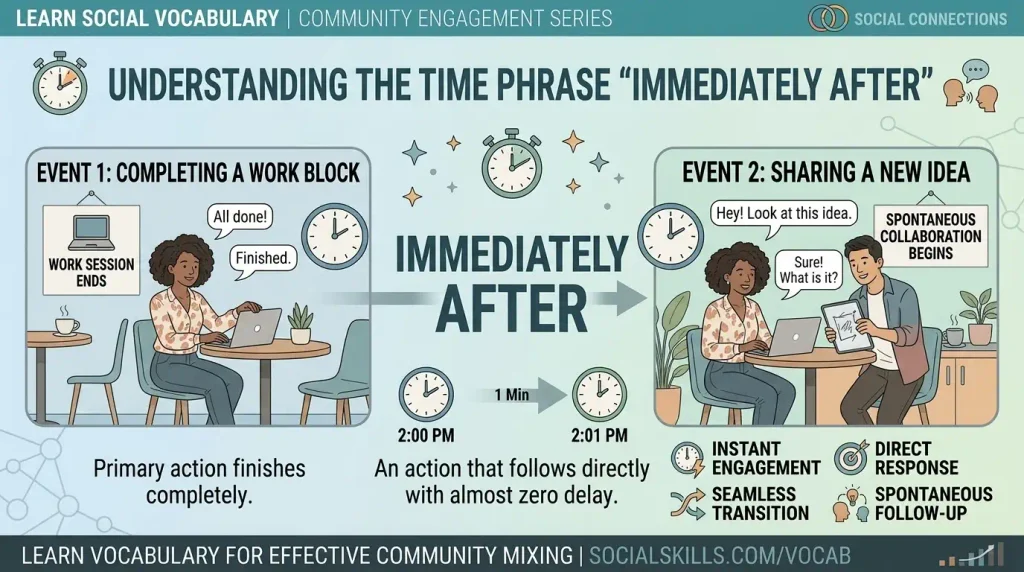
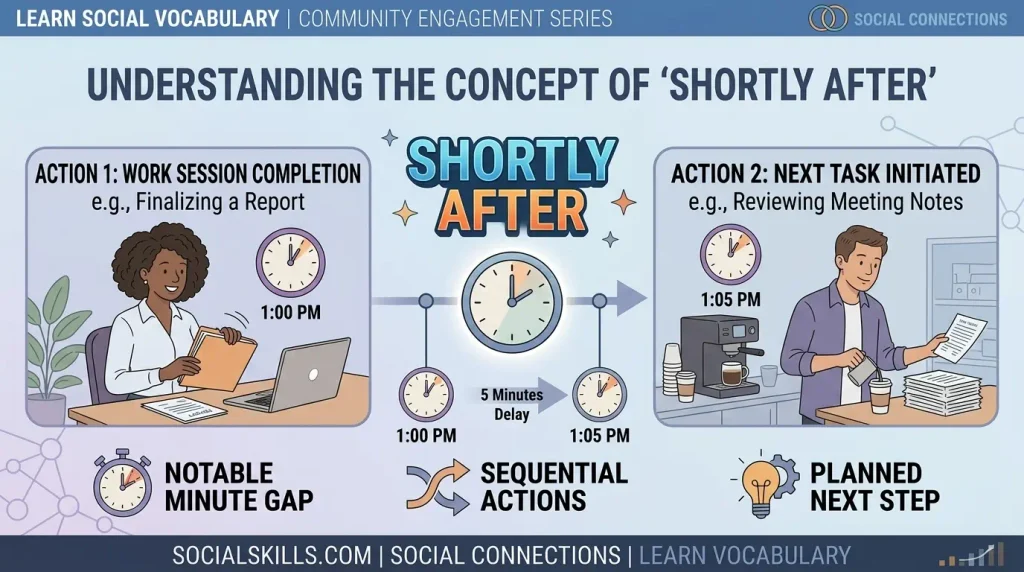
1. Shortly after (Adverbial Phrase) — US: /ˈʃɔːrt.li ˈæf.tɚ/ | UK: /ˈʃɔːt.li ˈɑːf.tə/
- Meaning: Happening a brief period of time following an event.
- Tone/Register: Neutral, Professional, Common
- Example 1: The team launched the product, and shortly after, customer orders flooded the site.
- Example 2: She finished her degree and shortly after landed her dream job.
2. Shortly thereafter (Adverbial Phrase) — US: /ˈʃɔːrt.li ˌðɛrˈæf.tɚ/ | UK: /ˈʃɔːt.li ˌðeərˈɑːf.tə/
- Meaning: Occurring immediately following a previously mentioned point in time.
- Tone/Register: Formal, Academic, Business
- Example 1: The meeting adjourned, and shortly thereafter, the board released its statement.
- Example 2: He moved to Chicago and shortly thereafter bought his first house.
3. Immediately after (Adverbial Phrase) — US: /ɪˈmiː.di.ət.li ˈæf.tɚ/ | UK: /ɪˈmiː.di.ət.li ˈɑːf.tə/
- Meaning: Happening without any delay or intervening time.
- Tone/Register: Neutral, Direct, Clear
- Example 1: Wash your hands immediately after handling raw food.
- Example 2: She called her parents immediately after landing at the airport.
4. Right after (Adverbial Phrase) — US: /raɪt ˈæf.tɚ/ | UK: /raɪt ˈɑːf.tə/
- Meaning: Occurring directly following an action in a casual manner.
- Tone/Register: Informal, Conversational
- Example 1: We went out for ice cream right after the movie ended.
- Example 2: I will text you right after I finish this call.
5. Directly after (Adverbial Phrase) — US: /daɪˈrɛkt.li ˈæf.tɚ/ | UK: /daɪˈrɛkt.li ˈɑːf.tə/
- Meaning: Following instantly without any intervening events or spaces.
- Tone/Register: Formal, Precise
- Example 1: The speaker took questions directly after her presentation.
- Example 2: Turn right directly after passing the old library.
6. Soon afterward (Adverbial Phrase) — US: /suːn ˈæf.tɚ.wɚd/ | UK: /suːn ˈɑːf.tə.wəd/
- Meaning: Following a specific event within a short timeframe.
- Tone/Register: Neutral, Standard
- Example 1: They arrived at the park, and soon afterward, the sun came out.
- Example 2: The power went out, but soon afterward, the generator kicked in.
7. Promptly after (Adverbial Phrase) — US: /ˈprɑːmpt.li ˈæf.tɚ/ | UK: /ˈprɒmpt.li ˈɑːf.tə/
- Meaning: Happening without delay and with notable punctuality.
- Tone/Register: Professional, Formal
- Example 1: The bus left promptly after the final passenger boarded.
- Example 2: She replied to the email promptly after receiving it.
8. Straight after (Adverbial Phrase) — US: /streɪt ˈæf.tɚ/ | UK: /streɪt ˈɑːf.tə/
- Meaning: Proceeding to an action with zero intermediate delay.
- Tone/Register: Informal, Chiefly British/Commonwealth
- Example 1: He went straight after work to pick up the groceries.
- Example 2: We can grab dinner straight after the game.
9. Almost immediately after (Adverbial Phrase) — US: /ˈɑːl.moʊst ɪˈmiː.di.ət.li ˈæf.tɚ/ | UK: /ˈɔːl.məʊst ɪˈmiː.di.ət.li ˈɑːf.tə/
- Meaning: Happening with only a microsecond of delay following an event.
- Tone/Register: Descriptive, Narrative
- Example 1: Almost immediately after taking the pill, he began to feel sleepy.
- Example 2: The crowd cheered almost immediately after the goal was scored.
10. Just after (Adverbial Phrase) — US: /dʒʌst ˈæf.tɚ/ | UK: /dʒʌst ˈɑːf.tə/
- Meaning: Following an event by a very small margin of time.
- Tone/Register: Conversational, Neutral
- Example 1: We stepped into the coffee shop just after the rain began.
- Example 2: The bell rang just after she submitted her test.
11. Following closely upon (Prepositional Phrase) — US: /ˈfɑː.loʊ.ɪŋ ˈkloʊs.li əˈpɑːn/ | UK: /ˈfɒl.əʊ.ɪŋ ˈkləʊs.li əˈpɒn/
- Meaning: Happening in rapid succession behind another event.
- Tone/Register: Literary, Formal
- Example 1: A second storm hit, following closely upon the first.
- Example 2: Success came quickly, following closely upon their rebranding strategy.
12. On the heels of (Idiomatic Phrase) — US: /ɑːn ðə hiːlz ʌv/ | UK: /ɒn ðə hiːlz ɒv/
- Meaning: Occurring very quickly or immediately after something else.
- Tone/Register: Journalistic, Dynamic
- Example 1: The novel was published on the heels of her famous interview.
- Example 2: Price increases came on the heels of higher shipping costs.
13. In the wake of (Idiomatic Phrase) — US: /ɪn ðə weɪk ʌv/ | UK: /ɪn ðə weɪk ɒv/
- Meaning: Occurring as a consequence or direct result soon after an event.
- Tone/Register: Serious, Journalistic, Formal
- Example 1: New safety regulations were introduced in the wake of the accident.
- Example 2: The town rebuilt its community center in the wake of the flood.
14. Hot on the heels of (Idiomatic Phrase) — US: /hɑːt ɑːn ðə hiːlz ʌv/ | UK: /hɒt ɒn ðə hiːlz ɒv/
- Meaning: Following another event with dramatic or intense speed.
- Tone/Register: Vivid, Informal, Media
- Example 1: The sequel arrived hot on the heels of the original film’s success.
- Example 2: A second scandal broke hot on the heels of the mayor’s speech.
15. A short time after (Prepositional Phrase) — US: /ə ʃɔːrt taɪm ˈæf.tɚ/ | UK: /ə ʃɔːt taɪm ˈɑːf.tə/
- Meaning: Separated from an earlier event by a brief duration.
- Tone/Register: Simple, Descriptive, Neutral
- Example 1: A short time after the show started, latecomers were seated.
- Example 2: They sat down to rest a short time after starting the hike.
16. A brief moment after (Prepositional Phrase) — US: /ə briːf ˈmoʊ.mənt ˈæf.tɚ/ | UK: /ə briːf ˈməʊ.mənt ˈɑːf.tə/
- Meaning: Occurring after an extremely short period.
- Tone/Register: Narrative, Storytelling
- Example 1: A brief moment after the lights flickered, the main power failed.
- Example 2: He paused, and a brief moment later, gave his final answer.
17. Minutes after (Prepositional Phrase) — US: /ˈmɪn.ɪts ˈæf.tɚ/ | UK: /ˈmɪn.ɪts ˈɑːf.tə/
- Meaning: Occurring within a few minutes following an action.
- Tone/Register: Specific, Conversational, Precise
- Example 1: Minutes after opening the doors, the store was packed with shoppers.
- Example 2: She checked her phone minutes after getting out of the cinema.
18. Moments after (Prepositional Phrase) — US: /ˈmoʊ.mənts ˈæf.tɚ/ | UK: /ˈməʊ.mənts ˈɑːf.tə/
- Meaning: Happening almost immediately, within seconds or brief moments.
- Tone/Register: Dramatic, Narrative
- Example 1: Moments after the announcement, tickets were entirely sold out.
- Example 2: The stage collapsed moments after the band stepped off.
19. Seconds after (Prepositional Phrase) — US: /ˈsɛk.əndz ˈæf.tɚ/ | UK: /ˈsɛk.əndz ˈɑːf.tə/
- Meaning: Occurring with extreme speed, just seconds following an event.
- Tone/Register: Precise, Fast-paced
- Example 1: Seconds after the signal turned green, the race began.
- Example 2: The fire alarm rang seconds after smoke reached the sensor.
20. Fast on the steps of (Idiomatic Phrase) — US: /fæst ɑːn ðə stɛps ʌv/ | UK: /fɑːst ɒn ðə stɛps ɒv/
- Meaning: Following another occurrence in rapid, continuous order.
- Tone/Register: Literary, Archaic
- Example 1: Economic recovery came fast on the steps of financial reform.
- Example 2: Innovations arrived fast on the steps of scientific discovery.
21. Hard upon (Prepositional Phrase) — US: /hɑːrd əˈpɑːn/ | UK: /hɑːd əˈpɒn/
- Meaning: Happening almost at the exact moment after something else.
- Tone/Register: Formal, Historical, Literary
- Example 1: Winter came hard upon the early autumn frost.
- Example 2: Bad news arrived hard upon their recent celebration.
22. Close upon (Prepositional Phrase) — US: /kloʊs əˈpɑːn/ | UK: /kləʊs əˈpɒn/
- Meaning: Near in time, immediately following an earlier event.
- Tone/Register: Literary, Traditional
- Example 1: Midnight was close upon us when we finally reached the cabin.
- Example 2: News of victory came close upon reports of the battle.
23. Swiftly following (Adjectival Phrase) — US: /ˈswɪft.li ˈfɑː.loʊ.ɪŋ/ | UK: /ˈswɪft.li ˈfɒl.əʊ.ɪŋ/
- Meaning: Moving or happening rapidly after a prior incident.
- Tone/Register: Academic, Professional
- Example 1: Swiftly following the launch, user feedback was compiled into a report.
- Example 2: Policy adjustments were implemented swiftly following the review.
24. Quick on the heels of (Idiomatic Phrase) — US: /kwɪk ɑːn ðə hiːlz ʌv/ | UK: /kwɪk ɒn ðə hiːlz ɒv/
- Meaning: Occurring with rapid speed right behind an event.
- Tone/Register: Expressive, Conversational
- Example 1: A new update was released, quick on the heels of the bug report.
- Example 2: Quick on the heels of her promotion came a transfer to Paris.
25. No sooner than (Conjunctional Phrase) — US: /noʊ ˈsuː.nɚ ðæn/ | UK: /nəʊ ˈsuː.nə ðæn/
- Meaning: Used to show that one action happens immediately after another.
- Tone/Register: Formal, Emphatic
- Example 1: No sooner had he left the house than it started pouring rain.
- Example 2: She had no sooner sat down than the telephone rang.
26. Barely had… when (Conjunctional Phrase) — US: /ˈbɛr.li hæd… wɛn/ | UK: /ˈbeə.li hæd… wɛn/
- Meaning: Expressing that a second event occurs at the exact instant of the first.
- Tone/Register: Dramatic, Written
- Example 1: Barely had the train stopped when passengers rushed toward the doors.
- Example 2: Barely had she finished her speech when the crowd erupted in applause.
27. Hardly had… when (Conjunctional Phrase) — US: /ˈhɑːrd.li hæd… wɛn/ | UK: /ˈhɑːd.li hæd… wɛn/
- Meaning: Indicating two actions happening in virtually simultaneous order.
- Tone/Register: Formal, Literary
- Example 1: Hardly had the sun risen when the farm work began.
- Example 2: Hardly had we walked inside when the electricity cut out.
28. Scarcely had… when (Conjunctional Phrase) — US: /ˈskɛrs.li hæd… wɛn/ | UK: /ˈskeəs.li hæd… wɛn/
- Meaning: Showing that an event followed an action with barely any elapsed time.
- Tone/Register: High Formal, Traditional
- Example 1: Scarcely had the plane touched down when the passengers stood up.
- Example 2: Scarcely had he closed his eyes when his alarm went off.
29. Instantaneously after (Adverbial Phrase) — US: ˌɪn.stənˈteɪ.ni.əs.li ˈæf.tɚ/ | UK: ˌɪn.stənˈteɪ.ni.əs.li ˈɑːf.tə/
- Meaning: Happening in an instant following an initial trigger.
- Tone/Register: Technical, Scientific
- Example 1: The airbag inflated instantaneously after the impact.
- Example 2: The screen lit up instantaneously after pressing the power button.
30. Near-simultaneously with (Prepositional Phrase) — US: /nɪr saɪ.məlˈteɪ.ni.əs.li wɪð/ | UK: /nɪə sɪm.əlˈteɪ.ni.əs.li wɪð/
- Meaning: Happening so closely in time that it feels almost at the same moment.
- Tone/Register: Analytical, Technical
- Example 1: The second explosion occurred near-simultaneously with the first.
- Example 2: Translation was provided near-simultaneously with the live speech.
31. Right on the back of (Idiomatic Phrase) — US: /raɪt ɑːn ðə bæk ʌv/ | UK: /raɪt ɒn ðə bæk ɒv/
- Meaning: Occurring immediately following another occurrence, often adding momentum.
- Tone/Register: Informal, Business Casual
- Example 1: We launched the new feature right on the back of our marketing campaign.
- Example 2: They won the championship right on the back of an undefeated season.
32. In short order after (Prepositional Phrase) — US: /ɪn ʃɔːrt ˈɔːr.dɚ ˈæf.tɚ/ | UK: /ɪn ʃɔːt ˈɔː.də ˈɑːf.tə/
- Meaning: Accomplished or occurring quickly and efficiently following something.
- Tone/Register: Idiomatic, Direct
- Example 1: In short order after taking charge, the new manager fixed the workflow.
- Example 2: The issue was resolved in short order after customer service intervened.
33. On the tail of (Idiomatic Phrase) — US: /ɑːn ðə teɪl ʌv/ | UK: /ɒn ðə teɪl ɒv/
- Meaning: Following directly behind another event or entity.
- Tone/Register: Visual, Informal
- Example 1: Cold weather arrived on the tail of the heavy autumn rains.
- Example 2: The second runner crossed the finish line on the tail of the winner.
34. Almost right away after (Adverbial Phrase) — US: /ˈɑːl.moʊst raɪt əˈweɪ ˈæf.tɚ/ | UK: /ˈɔːl.məʊst raɪt əˈweɪ ˈɑːf.tə/
- Meaning: Occurring with barely any noticeable delay.
- Tone/Register: Conversational, Everyday
- Example 1: Almost right away after ordering, our food arrived at the table.
- Example 2: She felt relief almost right away after taking a short break.
35. Swiftly thereafter (Adverbial Phrase) — US: /ˈswɪft.li ðɛrˈæf.tɚ/ | UK: /ˈswɪft.li ðeərˈɑːf.tə/
- Meaning: Moving forward in time rapidly following an initial point.
- Tone/Register: Formal, Writing
- Example 1: The agreement was signed, and swiftly thereafter, work began.
- Example 2: She raised her concerns, and swiftly thereafter, changes were made.
36. Without delay after (Prepositional Phrase) — US: /wɪˈðaʊt dɪˈleɪ ˈæf.tɚ/ | UK: /wɪˈðaʊt dɪˈleɪ ˈɑːf.tə/
- Meaning: Proceeding to the next action without wasting any time.
- Tone/Register: Direct, Instructional
- Example 1: Please exit the building without delay after hearing the alarm.
- Example 2: He began his assignment without delay after getting the guidelines.
37. At once following (Prepositional Phrase) — US: /æt wʌns ˈfɑː.loʊ.ɪŋ/ | UK: /æt wʌns ˈfɒl.əʊ.ɪŋ/
- Meaning: Taking place immediately as a subsequent event.
- Tone/Register: Formal, Precise
- Example 1: At once following the ceremony, guests gathered in the main hall.
- Example 2: At once following his call, the paramedics departed.
38. Immediately following (Prepositional Phrase) — US: /ɪˈmiː.di.ət.li ˈfɑː.loʊ.ɪŋ/ | UK: /ɪˈmiː.di.ət.li ˈfɒl.əʊ.ɪŋ/
- Meaning: Positioned directly next in chronological sequence.
- Tone/Register: Professional, Standard
- Example 1: Refreshments will be served immediately following the meeting.
- Example 2: Immediately following the concert, the band met with fans.
39. Directly following (Prepositional Phrase) — US: /daɪˈrɛkt.li ˈfɑː.loʊ.ɪŋ/ | UK: /daɪˈrɛkt.li ˈfɒl.əʊ.ɪŋ/
- Meaning: Coming next in time without any gap or intervening action.
- Tone/Register: Professional, Structural
- Example 1: Directly following the updates, we will take a quick break.
- Example 2: The Q&A session took place directly following the film screening.
40. Subsequencing swiftly (Adjectival Phrase) — US: /ˈsʌb.sə.kwɛnt.sɪŋ ˈswɪft.li/ | UK: /ˈsʌb.sɪ.kwəns.ɪŋ ˈswɪft.li/
- Meaning: Following rapidly as part of an organized chain of events.
- Tone/Register: Academic, Formal
- Example 1: The proposal was approved, subsequently moving swiftly into phase two.
- Example 2: Tests were conducted, subsequently swiftly into full production.
41. Shortly downstream of (Prepositional Phrase) — US: /ˈʃɔːrt.li ˌdaʊnˈstriːm ʌv/ | UK: /ˈʃɔːt.li ˌdaʊnˈstriːm ɒv/
- Meaning: Happening a short time later within a multi-step process.
- Tone/Register: Technical, Business, Metaphorical
- Example 1: Production delays surfaced shortly downstream of the supply shortage.
- Example 2: Software bugs were discovered shortly downstream of the main code release.
42. Fast on the heels of (Idiomatic Phrase) — US: /fæst ɑːn ðə hiːlz ʌv/ | UK: /fɑːst ɒn ðə hiːlz ɒv/
- Meaning: Following close behind with great speed or momentum.
- Tone/Register: Dynamic, Media
- Example 1: Fast on the heels of their first victory, the team won another game.
- Example 2: A second invention arrived fast on the heels of the first patent.
43. Directly in the wake of (Idiomatic Phrase) — US: /daɪˈrɛkt.li ɪn ðə weɪk ʌv/ | UK: /daɪˈrɛkt.li ɪn ðə weɪk ɒv/
- Meaning: Occurring as an immediate result right after a major incident.
- Tone/Register: Serious, Academic
- Example 1: Directly in the wake of the news, stock prices fluctuated wildly.
- Example 2: Security was updated directly in the wake of the system breach.
44. Close upon the heels of (Idiomatic Phrase) — US: /kloʊs əˈpɑːn ðə hiːlz ʌv/ | UK: /kləʊs əˈpɒn ðə hiːlz ɒv/
- Meaning: Happening almost synchronously or right after an event.
- Tone/Register: Literary, Formal
- Example 1: The autumn frost arrived close upon the heels of late summer.
- Example 2: Celebrations began close upon the heels of the official announcement.
45. In immediate succession to (Prepositional Phrase) — US: /ɪn ɪˈmiː.di.ət səkˈsɛʃ.ən tuː/ | UK: /ɪn ɪˈmiː.di.ət səkˈsɛʃ.ən tuː/
- Meaning: Following one after another in a tight continuous sequence.
- Tone/Register: Technical, Academic
- Example 1: The two goals were scored in immediate succession to each other.
- Example 2: Earthquakes occurred in immediate succession to the main tremor.
46. Quickly after (Adverbial Phrase) — US: /ˈkwɪk.li ˈæf.tɚ/ | UK: /ˈkwɪk.li ˈɑːf.tə/
- Meaning: Happening with fast speed after an event.
- Tone/Register: Simple, Casual
- Example 1: She called me quickly after getting home from work.
- Example 2: The ice melted quickly after we brought it outside.
47. Soon behind (Adverbial Phrase) — US: /suːn bɪˈhaɪnd/ | UK: /suːn bɪˈhaɪnd/
- Meaning: Trailing closely in time or position behind another.
- Tone/Register: Descriptive, Narrative
- Example 1: The rest of the hiking group arrived soon behind the leader.
- Example 2: Rain was expected soon behind the dark clouds.
48. Fast after (Adverbial Phrase) — US: /fæst ˈæf.tɚ/ | UK: /fɑːst ˈɑːf.tə/
- Meaning: Following rapidly without delay.
- Tone/Register: Informal, Narrative
- Example 1: Trouble followed fast after they made that risky choice.
- Example 2: Success came fast after years of quiet persistence.
49. In rapid order after (Prepositional Phrase) — US: /ɪn ˈræp.ɪd ˈɔːr.dɚ ˈæf.tɚ/ | UK: /ɪn ˈræp.ɪd ˈɔː.də ˈɑːf.tə/
- Meaning: Taking place in a swift, organized series right after an event.
- Tone/Register: Structured, Formal
- Example 1: Changes occurred in rapid order after the new CEO took over.
- Example 2: The dominoes fell in rapid order after the first was pushed.
50. Promptly thereafter (Adverbial Phrase) — US: /ˈprɑːmpt.li ðɛrˈæf.tɚ/ | UK: /ˈprɒmpt.li ðeərˈɑːf.tə/
- Meaning: Executed immediately following a prior action or time point.
- Tone/Register: Business, Official
- Example 1: The application was submitted, and promptly thereafter, approved.
- Example 2: Orders were processed promptly thereafter to ensure fast shipping.
51. Right on the tail of (Idiomatic Phrase) — US: /raɪt ɑːn ðə teɪl ʌv/ | UK: /raɪt ɒn ðə teɪl ɒv/
- Meaning: Following someone or something with extremely close timing.
- Tone/Register: Informal, Visual
- Example 1: The ambulance drove through traffic right on the tail of the police car.
- Example 2: Another customer walked in right on the tail of the first.
52. On the back of (Idiomatic Phrase) — US: /ɑːn ðə bæk ʌv/ | UK: /ɒn ðə bæk ɒv/
- Meaning: Happening as a direct result or follow-up to a recent event.
- Tone/Register: Business Casual, Common UK/US
- Example 1: Company profits grew on the back of strong international sales.
- Example 2: The band went on tour on the back of their hit record.
53. Immediately downstream from (Prepositional Phrase) — US: /ɪˈmiː.di.ət.li ˌdaʊnˈstriːm frʌm/ | UK: /ɪˈmiː.di.ət.li ˌdaʊnˈstriːm frɒm/
- Meaning: Sequential execution where step B depends directly on step A.
- Tone/Register: Technical, Process-oriented
- Example 1: Quality checks occur immediately downstream from assembly.
- Example 2: Data processing begins immediately downstream from collection.
54. Directly on the heels of (Idiomatic Phrase) — US: /daɪˈrɛkt.li ɑːn ðə hiːlz ʌv/ | UK: /daɪˈrɛkt.li ɒn ðə hiːlz ɒv/
- Meaning: Occurring immediately after an action with high momentum.
- Tone/Register: Dynamic, Journalism
- Example 1: The tax reform passed directly on the heels of the debate.
- Example 2: A second storm formed directly on the heels of the hurricane.
55. In swift succession after (Prepositional Phrase) — US: /ɪn swɪft səkˈsɛʃ.ən ˈæf.tɚ/ | UK: /ɪn swɪft səkˈsɛʃ.ən ˈɑːf.tə/
- Meaning: Unfolding rapidly in a chain reaction following an initial event.
- Tone/Register: Formal, Narrative
- Example 1: Three updates were rolled out in swift succession after the bug report.
- Example 2: Goals were scored in swift succession after halftime.
56. Following hard upon (Prepositional Phrase) — US: /ˈfɑː.loʊ.ɪŋ hɑːrd əˈpɑːn/ | UK: /ˈfɒl.əʊ.ɪŋ hɑːd əˈpɒn/
- Meaning: Closely following an event with heavy impact or force.
- Tone/Register: Literary, Dramatic
- Example 1: Economic troubles mounted, following hard upon the war.
- Example 2: The second disaster hit, following hard upon the earthquake.
57. Rapidly following (Adjectival Phrase) — US: /ˈræp.ɪd.li ˈfɑː.loʊ.ɪŋ/ | UK: /ˈræp.ɪd.li ˈfɒl.əʊ.ɪŋ/
- Meaning: Moving or taking place quickly behind another occurrence.
- Tone/Register: Technical, Professional
- Example 1: Rapidly following the merger, corporate policies were updated.
- Example 2: System recovery was completed rapidly following the crash.
58. Speedy after (Adjectival Phrase) — US: /ˈspiː.di ˈæf.tɚ/ | UK: /ˈspiː.di ˈɑːf.tə/
- Meaning: Characterized by swiftness following an action.
- Tone/Register: Informal, Rare
- Example 1: Speedy after his arrival, the meeting got under way.
- Example 2: A speedy recovery followed after the minor operation.
59. Swiftly after (Adverbial Phrase) — US: /ˈswɪft.li ˈæf.tɚ/ | UK: /ˈswɪft.li ˈɑːf.tə/
- Meaning: Occurring with smooth, rapid motion or action after an event.
- Tone/Register: Elegant, Writing
- Example 1: Swiftly after setting sail, the ship encountered calm waters.
- Example 2: She responded swiftly after reading the message.
60. Instant upon (Prepositional Phrase) — US: /ˈɪn.stənt əˈpɑːn/ | UK: /ˈɪn.stənt əˈpɒn/
- Meaning: Happening the instant an action takes place.
- Tone/Register: Literary, Archaic
- Example 1: Instant upon his arrival, the crowd cheered wildly.
- Example 2: Silence fell, instant upon the conductor raising his baton.
61. Directly thereafter (Adverbial Phrase) — US: /daɪˈrɛkt.li ðɛrˈæf.tɚ/ | UK: /daɪˈrɛkt.li ðeərˈɑːf.tə/
- Meaning: Happening right at that exact point in time following an event.
- Tone/Register: Legal, Formal, Academic
- Example 1: The document was signed, and directly thereafter, archived.
- Example 2: The verdict was read, and directly thereafter, the court adjourned.
62. Immediately thereafter (Adverbial Phrase) — US: /ɪˈmiː.di.ət.li ðɛrˈæf.tɚ/ | UK: /ɪˈmiː.di.ət.li ðeərˈɑːf.tə/
- Meaning: Happening without any pause after a stated milestone.
- Tone/Register: Academic, Formal
- Example 1: The trial ended, and immediately thereafter, the prisoner was released.
- Example 2: The contract expired, and immediately thereafter, negotiations paused.
63. Fast upon (Prepositional Phrase) — US: /fæst əˈpɑːn/ | UK: /fɑːst əˈpɒn/
- Meaning: Following with zero noticeable gap.
- Tone/Register: Literary, Dramatic
- Example 1: Winter came fast upon the heels of autumn.
- Example 2: The news spread fast upon her public statement.
64. Hard on (Prepositional Phrase) — US: /hɑːrd ɑːn/ | UK: /hɑːd ɒn/
- Meaning: Occurring right after, often carrying heavy momentum or press.
- Tone/Register: Idiomatic, Traditional
- Example 1: Hard on the news of inflation came interest rate hikes.
- Example 2: The second storm followed hard on the first one.
65. Close after (Adverbial Phrase) — US: /kloʊs ˈæf.tɚ/ | UK: /kləʊs ˈɑːf.tə/
- Meaning: Following behind within a short distance or time frame.
- Tone/Register: Descriptive, Informal
- Example 1: The dog ran close after its owner down the path.
- Example 2: The second car arrived close after the winner.
66. Near after (Adverbial Phrase) — US: /nɪr ˈæf.tɚ/ | UK: /nɪə ˈɑːf.tə/
- Meaning: Occurring close in temporal proximity to an action.
- Tone/Register: Dialectal, Archaic
- Example 1: Near after the harvest, the community held a feast.
- Example 2: They arrived near after the sun set over the ridge.
67. Shortly after that (Adverbial Phrase) — US: /ˈʃɔːrt.li ˈæf.tɚ ðæt/ | UK: /ˈʃɔːt.li ˈɑːf.tə ðæt/
- Meaning: Occurring a small amount of time following that explicit point.
- Tone/Register: Everyday, Conversational
- Example 1: He finished college, and shortly after that, moved west.
- Example 2: We had lunch, and shortly after that, took a long walk.
68. Minutes thereafter (Adverbial Phrase) — US: /ˈmɪn.ɪts ðɛrˈæf.tɚ/ | UK: /ˈmɪn.ɪts ðeərˈɑːf.tə/
- Meaning: A specific sequence in which a few minutes pass before the next action.
- Tone/Register: Precise, Reporting
- Example 1: The alarm sounded, and minutes thereafter, firefighters arrived.
- Example 2: She sent the message, and minutes thereafter, received a reply.
69. Immediately on the back of (Idiomatic Phrase) — US: /ɪˈmiː.di.ət.li ɑːn ðə bæk ʌv/ | UK: /ɪˈmiː.di.ət.li ɒn ðə bæk ɒv/
- Meaning: Directly following a major event, capitalizing on its timing.
- Tone/Register: Corporate, Dynamic
- Example 1: The product launch succeeded immediately on the back of the ad campaign.
- Example 2: Hiring increased immediately on the back of securing funding.
70. Fresh on the heels of (Idiomatic Phrase) — US: /frɛʃ ɑːn ðə hiːlz ʌv/ | UK: /frɛʃ ɒn ðə hiːlz ɒv/
- Meaning: Occurring while the previous event is still recent and memorable.
- Tone/Register: Journalistic, Energetic
- Example 1: Fresh on the heels of her award win, she released a new book.
- Example 2: The company announced a new project fresh on the heels of its record profits.
Synonyms by Tone
Tone Matters in Word Choice
Selecting the right tone prevents misunderstandings and aligns your writing style with your target audience. Using a formal term in casual text sounds stiff, while casual slang in an academic essay weakens your credibility.
Positive Tone
- Fresh on the heels of
- Hot on the heels of
- On the back of
- In short order after
Neutral Tone
- Shortly after
- Soon afterward
- Just after
- A short time after
- Following closely upon
Negative Tone
- In the wake of
- Directly in the wake of
- Hard upon
- Following hard upon
Formal / Business Tone
- Shortly thereafter
- Immediately following
- Directly thereafter
- Promptly after
- In swift succession after
Mini Comparison
“Soon After” vs. “Shortly Thereafter” vs. “In the Wake Of”
| Feature | Soon After | Shortly Thereafter | In the Wake Of |
| Primary Meaning | Happening a brief time after an action | Happening right after a specific point | Happening as a direct result or aftermath |
| Tone & Register | Neutral, Flexible, Everyday | Formal, Professional, Academic | Serious, Journalistic, Somber |
| Best Use Case | Casual storytelling, general writing | Legal contracts, business reports, essays | Reporting on major events, crises, or changes |
Context-Based Usage
Daily Conversation
In everyday speech, people prefer quick, natural phrases like “right after,” “just after,” or “shortly after.” These keep conversations fluid without sounding overly academic.
Writing or Blogging
Bloggers and creative writers use vivid idioms such as “hot on the heels of” or “fresh on the heels of” to build momentum and maintain narrative speed.
Professional or Academic Tone
In business reports, legal papers, and scholarly journals, phrases like “shortly thereafter,” “immediately following,” and “directly thereafter” offer precision without emotional bias.
Common Mistakes & Native Usage
Common Mistakes Learners Make
- Overusing “Soon After”: Repeating this phrase multiple times in a single paragraph makes writing feel monotonous.
- Confusing “Thereafter” with “After”: “Thereafter” stands alone as an adverb, whereas “after” requires a noun or object clause following it.
- Using Heavy Idioms in Neutral Contexts: Writing “In the wake of my morning coffee…” exaggerates minor daily events unnaturally.
Register Notes
Stick to spoken transitions like “right after” when chatting with friends. Switch to written alternatives like “promptly thereafter” for executive communication.
For more tips on improving your descriptive writing, explore our guide on [transition words for narrative essays].
Real-Life Mini Scenarios
- Workplace: “The team reviewed the project metrics, and shortly thereafter, the manager approved the extra budget.”
- Social Situations: “We finished dinner, and right after, everyone went outside to watch the fireworks.”
- Media / Pop Culture: “Fresh on the heels of her album drop, the pop star announced a massive world tour.”
- Writing / Storytelling: “Barely had the detective entered the room when he noticed the hidden compartment.”
Interactive Practice Quiz
Test your understanding of these temporal transitions by choosing the best option for each scenario.
1. Which synonym best fits a formal business report?
A) Right after
B) Shortly thereafter
C) Hot on the heels of
D) Fast after
2. Which phrase carries a serious tone often used for consequences?
A) In the wake of
B) Just after
C) Straight after
D) Speedy after
3. Fill in the blank: “No sooner had he left the office ______ it began to snow.”
A) when
B) than
C) after
D) then
4. Which option works best in casual conversation with a friend?
A) In immediate succession to
B) Immediately downstream from
C) Right after
D) Directly thereafter
5. “Fresh on the heels of” is ideal for which genre?
A) Academic research
B) Legal contracts
C) Dynamic news and blogging
D) Medical manuals
6. Which phrase implies extreme speed within seconds?
A) A short time after
B) Moments after
C) Soon afterward
D) Following closely upon
7. Select the best match for a step-by-step technical process:
A) Hot on the heels of
B) Immediately downstream from
C) Right on the back of
D) Near after
8. What is the main issue with repeating “soon after” in writing?
A) It is grammatically incorrect.
B) It makes the text repetitive and dull.
C) It changes the sentence meaning.
D) It sounds too formal.
9. Which term works best for punctuality?
A) Promptly after
B) In the wake of
C) Near after
D) Fast upon
10. “In swift succession after” implies that events happened:
A) Slowly over several months
B) Rapidly one after another
C) At the exact same microsecond
D) In reverse order
Answer Key:
1: B | 2: A | 3: B | 4: C | 5: C | 6: B | 7: B | 8: B | 9: A | 10: B
Reflection Task
Write a short, two-sentence story about a personal milestone or daily event. Use one formal synonym and one idiomatic synonym from this guide to show how tone changes your narrative speed.
FAQs
1. What is the most common formal synonym for soon after?
The most widely accepted formal synonym is “shortly thereafter.” It is extensively used in business reports, academic papers, and legal documentation to show chronological sequence clearly without sounding casual.
2. Can I use “right after” in academic writing?
While “right after” is grammatically correct, it is generally considered too informal for academic writing. Instead, opt for precise transitions such as “immediately following” or “directly after.”
3. How does “in the wake of” differ from standard time phrases?
“In the wake of” implies both time and causation. It suggests that an event happened after a major prior incident and occurred as a direct result or aftermath of that initial event.
4. What is the difference between “afterward” and “thereafter”?
“Afterward” means simply “at a later time,” whereas “thereafter” specifically means “after that specified time or event.” “Thereafter” carries a higher level of formality in written English.
5. Why should writers vary their temporal transitions?
Varying temporal transitions prevents narrative monotony, establishes precise timing, matches the desired tone, and keeps readers fully engaged across long articles or essays.
Conclusion
Expanding your range of time transitions improves your vocabulary and allows you to communicate ideas with precision. Choosing the right temporal phrase transforms simple sentences into clear, persuasive prose.
Practicing different word choices refines your writing voice, whether you are drafting emails, blog posts, or academic assignments. Swapping out repetitive phrases keeps your readers attentive and focused on your message.
Start integrating these dynamic options into your daily communication today. Experiment with new terms in your next writing project to make your storytelling sharp, precise, and effortlessly engaging. Check out our detailed list of synonyms for soon after to master every nuance of time-based language.

Samia Noor is the founder and lead writer at SynonymGenius.com, where she creates accurate, reader-focused English language content that helps people communicate with clarity and confidence. She specializes in synonyms, antonyms, word meanings, idioms, and practical vocabulary guides that make complex language concepts simple and easy to understand. Every article is thoroughly researched, carefully fact-checked, and written in clear, accessible language using reliable sources and real-world examples. Her mission is to provide trustworthy, high-quality content that supports students, writers, educators, professionals, and English learners at every stage of their language journey.
Her editorial approach emphasizes accuracy, transparency, and genuine value for readers while following modern E-E-A-T and content quality standards. She regularly reviews and updates published content to ensure it remains current, reliable, and easy to understand. Through SynonymGenius.com, Samia Noor is committed to publishing dependable language resources that help readers expand their vocabulary, strengthen their writing skills, improve communication, and build confidence in academic, professional, and everyday English.