
Synonyms for squalor include words such as filth, dirt, grime, wretchedness, misery, neglect, shabbiness, and degradation. These alternatives describe extremely dirty, unpleasant, or neglected living conditions with different levels of emotional intensity and formality.
Synonyms for squalor can make your writing more precise when describing an unpleasant environment, especially in stories, reports, or essays.
Imagine entering a neglected room with broken furniture, dirty floors, and piles of rubbish. The word squalor immediately captures its harsh condition.
Learning synonyms for squalor helps students, bloggers, writers, and daily English users describe difficult environments naturally.
Different alternatives also reveal whether you want to sound neutral, formal, emotional, or strongly critical in your writing.
What Does “Squalor” Really Mean?
Squalor is a noun that means a condition of extreme dirtiness, neglect, poverty, or unpleasant living conditions.
It often describes places where cleanliness and basic care have seriously deteriorated.
For example:
The family was living in squalor after years of neglect.
The word can describe a physical environment, but it can also suggest hardship and poor living conditions.
Simple Definition
Squalor: A very dirty, neglected, and unpleasant condition, especially in a place where people live.
Part of Speech
Squalor is primarily a noun.
It commonly appears in phrases such as:
- living in squalor
- conditions of squalor
- extreme squalor
- urban squalor
- poverty and squalor
- filthy squalor
Native speakers usually associate the word with conditions that are considerably worse than ordinary untidiness.
🧠 Connotative Meaning of Squalor
Connotation (the emotional or cultural feeling associated with a word beyond its basic dictionary meaning) matters when using squalor.
Positive Tone
Squalor itself normally does not carry a positive tone. However, writing about someone escaping squalor can create a hopeful context.
Example:
She eventually escaped the squalor of her childhood home.
Negative Tone
The word strongly suggests dirt, neglect, poverty, discomfort, and poor living conditions.
Example:
The report described the building as a place of shocking squalor.
Neutral Tone
In factual reporting, squalor can describe conditions without directly attacking the people involved.
Example:
Inspectors documented severe squalor inside the abandoned property.
📖 Etymology of Squalor
The word squalor comes from Latin squalor, meaning dirt, filth, or a rough and neglected condition. It is related to the Latin verb squalēre, meaning “to be rough, dirty, or neglected.”
The word entered English through French and Latin influence and developed its modern association with extreme dirtiness and miserable conditions.
Historical Development
Old English (450–1100):
The modern word squalor was not established in Old English. English speakers used other vocabulary to describe dirt, filth, poverty, and unpleasant conditions.
Middle English (1100–1500):
Latin and French influence introduced many learned terms into English. Vocabulary connected with dirtiness and poor conditions gradually expanded.
Modern English (1500–Present):
Squalor became established as a literary and descriptive noun for extreme dirtiness, neglect, and miserable living conditions.
Syllables
Squalor: squal-or
Affixation Pattern
Root: Latin squalēre
Prefix: None
Suffix: No productive English suffix is normally identified in the modern word.
📚 40 Synonyms for Squalor
The following alternatives cover different shades of meaning. Some emphasize physical dirt, while others focus on neglect, poverty, misery, or unpleasant surroundings.
1. Filth (Noun)
Meaning: Extreme dirt or something that is covered with unpleasant waste or impurities.
Tone/Register: Neutral to strongly negative.
Examples:
The workers removed years of filth from the abandoned room.
The old kitchen was covered in filth.
2. Dirt (Noun)
Meaning: Unwanted soil, dust, or unclean matter found on a surface or place.
Tone/Register: Common and informal.
Examples:
There was dirt all over the floor.
She cleaned the dirt from the windows.
3. Grime (Noun)
Meaning: A layer of dirt that builds up through prolonged neglect or use.
Tone/Register: Neutral.
Examples:
Grime covered the walls near the stove.
He scrubbed the grime from the bathroom tiles.
4. Nastiness (Noun)
Meaning: A condition or quality that feels extremely unpleasant, dirty, or offensive.
Tone/Register: Informal.
Examples:
The basement was full of dampness and nastiness.
Nobody wanted to enter the filthy storage room.
5. Wretchedness (Noun)
Meaning: A state of extreme misery, poor conditions, or suffering.
Tone/Register: Formal or literary.
Examples:
The novel portrays the wretchedness of life in the neglected district.
His writing captured the wretchedness of the settlement.
6. Misery (Noun)
Meaning: Severe unhappiness or suffering, sometimes connected with terrible living conditions.
Tone/Register: Common.
Examples:
The family struggled through years of misery.
The story describes poverty, hunger, and misery.
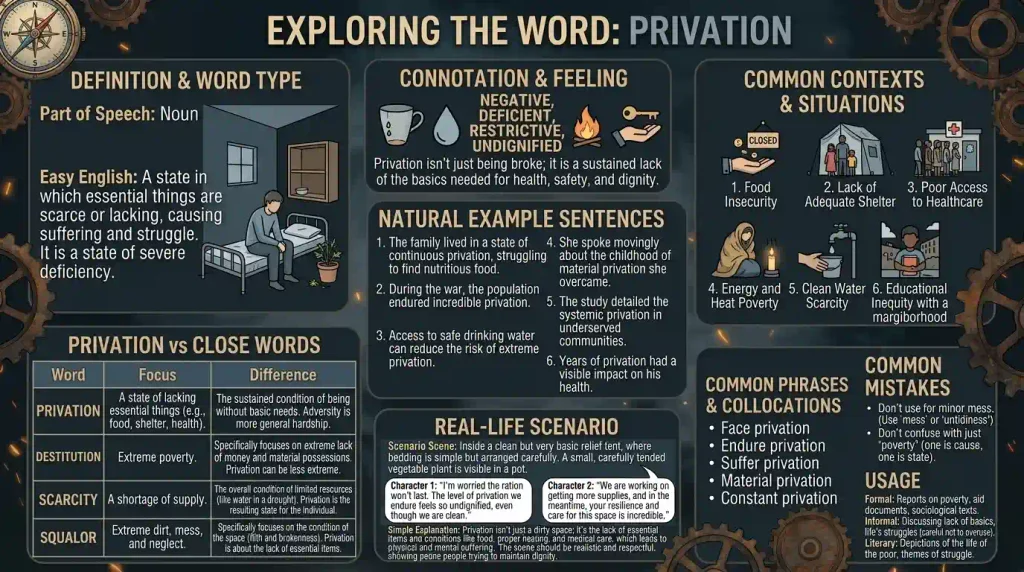
7. Deprivation (Noun)
Meaning: A lack of necessities, comfort, or resources.
Tone/Register: Formal and academic.
Examples:
The study examined childhood deprivation.
Long-term deprivation affected the community deeply.
8. Neglect (Noun)
Meaning: A failure to care properly for a person, place, or property.
Tone/Register: Neutral and widely used.
Examples:
Years of neglect damaged the old house.
The garden became overgrown through neglect.
9. Degradation (Noun)
Meaning: A serious decline in quality, condition, dignity, or surroundings.
Tone/Register: Formal.
Examples:
The neighborhood suffered from environmental degradation.
The building showed obvious signs of degradation.
10. Shabbiness (Noun)
Meaning: A worn, untidy, or poorly maintained condition.
Tone/Register: Neutral.
Examples:
The room had an air of shabbiness.
The furniture showed years of shabbiness and wear.
11. Untidiness (Noun)
Meaning: A lack of order or cleanliness.
Tone/Register: Neutral and mild.
Examples:
The landlord complained about the apartment’s untidiness.
A little untidiness can make a room feel uncomfortable.
12. Uncleanliness (Noun)
Meaning: A condition of being dirty or lacking proper cleanliness.
Tone/Register: Formal.
Example:
The inspection revealed serious uncleanliness.
The restaurant received a warning about uncleanliness.
13. Impurity (Noun)
Meaning: The presence of something unwanted or unclean within a substance or environment.
Tone/Register: Formal.
Examples:
The water contained several impurities.
The laboratory tested the sample for impurities.
14. Sordidness (Noun)
Meaning: A condition marked by dirtiness, unpleasantness, or morally degrading circumstances.
Tone/Register: Formal or literary.
Examples:
The journalist described the sordidness of the neglected building.
The story explores the sordidness of urban poverty.
15. Squalidness (Noun)
Meaning: The quality of being extremely dirty, neglected, or unpleasant.
Tone/Register: Formal.
Example:
The inspector was shocked by the squalidness of the apartment.
The report documented the squalor of the housing.
16. Disrepair (Noun)
Meaning: A poor physical condition caused by lack of maintenance.
Tone/Register: Neutral and formal.
Examples:
The abandoned house had fallen into disrepair.
The bridge showed years of disrepair.
17. Dilapidation (Noun)
Meaning: A state in which a building or structure has become badly damaged or neglected.
Tone/Register: Formal.
Examples:
The mansion stood in complete dilapidation.
Years of neglect caused severe dilapidation.
18. Ruin (Noun)
Meaning: A severely damaged or destroyed condition.
Tone/Register: Common.
Examples:
The old factory had fallen into ruin.
Neglect eventually reduced the property to ruin.
19. Poverty (Noun)
Meaning: A lack of sufficient money or resources for basic needs.
Tone/Register: Neutral.
Examples:
The documentary examined poverty in rural communities.
Many families struggled with poverty.
20. Destitution (Noun)
Meaning: Extreme poverty in which a person lacks necessities.
Tone/Register: Formal.
Examples:
The charity worked with people facing destitution.
The novel describes hunger and destitution.
21. Hardship (Noun)
Meaning: Difficult conditions that cause suffering or serious problems.
Tone/Register: Neutral.
Examples:
The family experienced financial hardship.
Years of hardship changed the community.
22. Suffering (Noun)
Meaning: Physical or emotional pain caused by difficult circumstances.
Tone/Register: Common.
Examples:
The article focuses on human suffering.
The photographs revealed widespread suffering.
23. Misfortune (Noun)
Meaning: An unfortunate situation or event that causes difficulty or suffering.
Tone/Register: Neutral to formal.
Examples:
The family faced repeated misfortune.
The story follows a character dealing with misfortune.
24. Woe (Noun)
Meaning: Great trouble, sadness, or distress.
Tone/Register: Literary.
Examples:
The poem reflects the woes of poverty.
The character speaks openly about his many woes.
25. Distress (Noun)
Meaning: Severe discomfort, anxiety, or suffering caused by difficult circumstances.
Tone/Register: Neutral to formal.
Examples:
The poor conditions caused considerable distress.
The report recorded signs of emotional distress.
26. Sordidness (Noun)
Meaning: An unpleasant state involving dirt, neglect, or morally unpleasant circumstances.
Tone/Register: Formal or literary.
Examples:
The novel exposes the sordidness of the district.
The writer uses sordidness to create a bleak atmosphere.
27. Filthiness (Noun)
Meaning: The state of being extremely dirty or covered with filth.
Tone/Register: Common.
Examples:
The inspector noted the filthiness of the kitchen.
The room’s filthiness made it difficult to stay inside.
28. Foulness (Noun)
Meaning: A condition of being dirty, offensive, polluted, or unpleasant.
Tone/Register: Formal or literary.
Examples:
The foulness of the air was immediately noticeable.
The workers complained about the foulness inside the building.
29. Mess (Noun)
Meaning: A dirty, disorganized, or untidy condition.
Tone/Register: Informal.
Examples:
The apartment was a complete mess.
He spent the morning cleaning the mess.
30. Disorder (Noun)
Meaning: A lack of organization, cleanliness, or proper arrangement.
Tone/Register: Neutral.
Examples:
The house was left in disorder.
The office became difficult to use because of the disorder.
31. Dereliction (Noun)
Meaning: A state of serious neglect, especially involving buildings or responsibilities.
Tone/Register: Formal.
Examples:
The area contained several derelict buildings.
The report criticized years of official dereliction.
32. Abandonment (Noun)
Meaning: The act or condition of leaving something without care or maintenance.
Tone/Register: Neutral to formal.
Examples:
The building deteriorated after years of abandonment.
Abandonment left the property exposed to weather damage.
33. Decay (Noun)
Meaning: A gradual decline or deterioration in physical condition.
Tone/Register: Neutral and literary.
Examples:
The building showed signs of decay.
Moisture accelerated the decay of the wooden structure.
34. Deterioration (Noun)
Meaning: A gradual process in which something becomes worse in condition or quality.
Tone/Register: Formal and academic.
Examples:
The report documented the deterioration of the housing.
Poor maintenance caused rapid deterioration.
35. Desolation (Noun)
Meaning: A bleak, empty, and depressing condition or environment.
Tone/Register: Literary.
Examples:
The abandoned street had an atmosphere of desolation.
The writer uses desolation to create a bleak mood.
36. Bleakness (Noun)
Meaning: A quality that makes a place or situation feel gloomy, hopeless, or depressing.
Tone/Register: Literary and neutral.
Examples:
The photographs captured the bleakness of the settlement.
The winter landscape added to the scene’s bleakness.
37. Wretched Conditions (Noun Phrase)
Meaning: Extremely poor, uncomfortable, or unpleasant circumstances.
Tone/Register: Neutral to formal.
Examples:
Workers complained about the wretched conditions.
The article describes their wretched conditions in detail.
38. Poor Living Conditions (Noun Phrase)
Meaning: Housing circumstances that fail to provide adequate comfort, cleanliness, safety, or basic needs.
Tone/Register: Neutral and professional.
Examples:
The report highlighted poor living conditions.
Several families requested help with poor living conditions.
39. Filthy Conditions (Noun Phrase)
Meaning: Circumstances characterized by extreme dirt or lack of cleanliness.
Tone/Register: Direct and strongly negative.
Examples:
The inspection found filthy conditions inside the property.
The tenants complained about filthy conditions.
40. Miserable Conditions (Noun Phrase)
Meaning: Very unpleasant circumstances that cause discomfort, hardship, or suffering.
Tone/Register: Emotional but common.
Examples:
The workers described the camp as having miserable conditions.
The story focuses on people living in miserable conditions.
🔍 Synonyms for Squalor by Tone
Positive or Hopeful Context
Squalor itself is negative, but some alternatives can appear in hopeful contexts:
- hardship
- deprivation
- poverty
- suffering
These words can describe difficult circumstances without directly emphasizing dirt.
Neutral Tone
For factual writing, these choices often work well:
- neglect
- disrepair
- deterioration
- untidiness
- poor living conditions
- disorder
They are useful in reports, essays, articles, and educational writing.
Negative Tone
For stronger descriptions, consider:
- filth
- filthiness
- grime
- squalidness
- sordidness
- foulness
- degradation
These words create a stronger emotional reaction.
Playful or Informal Tone
In casual conversation, speakers may use:
- mess
- dirt
- nastiness
- shabbiness
These words usually sound less formal than squalor.
Why Does Tone Matter?
Choosing the right synonym prevents your writing from sounding exaggerated.
For example, mess is appropriate for an untidy bedroom, while squalor suggests much more serious neglect or poor conditions.
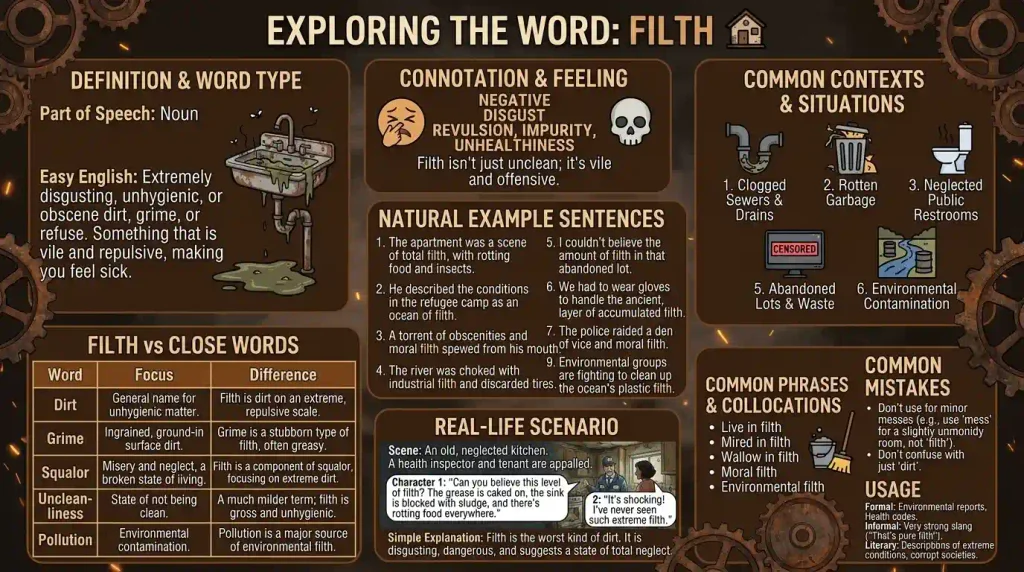
⚖️ Squalor vs Close Alternatives
Squalor vs Filth
Squalor describes a broader condition involving dirt, neglect, and miserable surroundings.
Filth focuses more directly on extreme dirt or disgusting material.
Use squalor for living conditions and filth for dirty substances or surfaces.
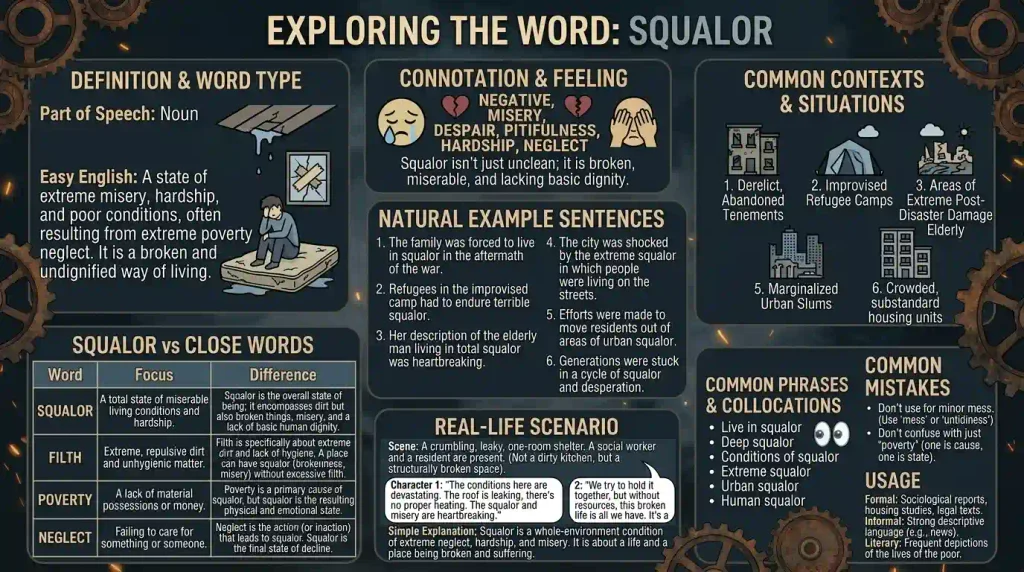
Squalor vs Poverty
Poverty means lacking sufficient financial resources.
Squalor describes the unpleasant physical or social conditions that may accompany severe poverty.
A person can experience poverty without living in squalor.
Squalor vs Neglect
Neglect means failing to provide proper care.
Squalor describes the severely unpleasant condition that can result from prolonged neglect.
🧠 How Squalor Changes by Context
Daily Conversation
In casual speech, squalor sounds fairly strong.
A person might say:
“I can’t believe people are living in this kind of squalor.”
For a mildly untidy room, mess or untidiness sounds more natural.
Writing and Blogging
Bloggers can use squalor when discussing housing, social issues, abandoned buildings, or difficult living environments.
It gives descriptions more precision than simply using dirt or mess.
Professional or Academic Writing
Academic writing often benefits from alternatives such as deprivation, neglect, disrepair, and deterioration.
These words can describe specific aspects of a difficult environment without relying on emotional language.
Creative Writing
Authors may choose squalor, desolation, bleakness, or sordidness to create a strong atmosphere.
These words help readers imagine an environment and understand its emotional effect.
⚠️ Common Mistakes Learners Make
Mistake 1: Using Squalor for Every Mess
A messy desk does not automatically qualify as squalor.
Use mess or untidiness for ordinary disorder.
Mistake 2: Treating Squalor as a Direct Synonym for Poverty
Squalor and poverty can occur together, but they are not identical.
Poverty concerns financial resources, while squalor emphasizes extremely poor physical conditions.
Mistake 3: Using Strong Words Too Often
Words such as filth, sordidness, and squalor have strong negative associations.
Overusing them can make ordinary situations sound unnecessarily dramatic.
Mistake 4: Ignoring Context
Choose a word based on what you actually want to describe.
Use disrepair for damaged buildings, deprivation for missing necessities, and grime for accumulated dirt.
📝 Register Notes
Squalor works in both speech and writing, but it often sounds more serious than everyday words such as mess or dirt.
For formal writing, deprivation, disrepair, deterioration, and neglect can offer greater precision.
Informal conversations, mess, dirt, and grime may sound more natural.
For creative writing, squalor, desolation, bleakness, and sordidness can create a stronger atmosphere.
🧩 Real-Life Mini Scenarios
Workplace
A company inspector discovers that an unused storage area has accumulated rubbish, grime, and damaged materials.
A report might describe the area as being in serious disrepair.
Social Situation
Someone visits an apartment that has not been cleaned or maintained for years.
They might describe the environment as squalor rather than simply calling it messy.
Media and Pop Culture
A documentary about neglected neighborhoods may use words such as poverty, deprivation, neglect, and poor living conditions.
Each word highlights a different part of the situation.
Writing and Storytelling
A novelist describing an abandoned building might choose bleakness, desolation, or sordidness to create a darker atmosphere.
🔗 Helpful External Reference
For an additional dictionary definition and usage information, readers can consult Merriam-Webster’s definition of “squalor”.
🧩 Practice Exercises: Choose the Best Word
Choose the word that best fits each situation.
1.
The abandoned apartment had broken furniture, rotting food, and years of accumulated waste. Which word fits best?
A. Neatness
B. Squalor
C. Comfort
D. Freshness
2.
The kitchen floor had a thin layer of sticky dirt built up over time.
A. Grime
B. Poverty
C. Woe
D. Misfortune
3.
The old building had cracked walls and had not received maintenance for decades.
A. Disrepair
B. Happiness
C. Purity
D. Success
4.
The report focused on families who lacked adequate food, housing, and other necessities.
A. Deprivation
B. Shabbiness
C. Mess
D. Decay
5.
Which word best describes an ordinary untidy bedroom?
A. Squalor
B. Untidiness
C. Destitution
D. Degradation
6.
A journalist wants a formal word for the failure to maintain an old property.
A. Neglect
B. Fun
C. Comfort
D. Cleanliness
7.
Which word mainly refers to a lack of financial resources?
A. Poverty
B. Grime
C. Foulness
D. Disorder
8.
A writer wants to create a gloomy, empty atmosphere around an abandoned town.
A. Desolation
B. Tidiness
C. Comfort
D. Cleanliness
9.
Which word describes accumulated dirt on a frequently used surface?
A. Grime
B. Misery
C. Poverty
D. Hardship
10.
A formal report describes a gradual decline in the condition of a building.
A. Deterioration
B. Happiness
C. Neatness
D. Celebration
11.
Which word describes extreme poverty in which someone lacks necessities?
A. Destitution
B. Untidiness
C. Shabbiness
D. Grime
12.
Someone casually describes a room as being very dirty and disorganized.
A. Mess
B. Deprivation
C. Destitution
D. Dereliction
13.
A writer wants a literary word for a bleak and depressing environment.
A. Bleakness
B. Neatness
C. Purity
D. Comfort
14.
Which phrase best describes housing that lacks adequate cleanliness, safety, or comfort?
A. Poor living conditions
B. Perfect conditions
C. Luxury conditions
D. Ideal surroundings
15.
Which word is most appropriate for a seriously neglected building?
A. Dereliction
B. Cheerfulness
C. Freshness
D. Order
Reflection Task: Write one sentence using squalor, filth, neglect, disrepair, or deprivation.
Answer Key: 1-B, 2-A, 3-A, 4-A, 5-B, 6-A, 7-A, 8-A, 9-A, 10-A, 11-A, 12-A, 13-A, 14-A, 15-A
❓ Frequently Asked Questions
1. What is the closest synonym for squalor?
The closest synonym depends on the context. Filth, squalor, and filthiness are close when the focus is extreme dirt. Neglect works when poor maintenance causes the condition. Poverty is related but does not directly mean squalor.
2. What is the difference between squalor and filth?
Squalor usually describes an overall condition of extremely poor, dirty, or neglected living circumstances. Filth focuses more specifically on dirt, waste, or something extremely unclean. A room can contain filth, while the overall environment may be described as squalor.
3. Can squalor be used to describe a person?
Usually, squalor describes a condition or environment rather than a person. It is more natural to say that someone lives in squalor than to call the person “squalor.” This distinction helps learners use the noun naturally.
4. Is squalor a formal word?
Squalor is suitable for both serious conversation and formal writing, but it carries a strong negative meaning. In academic or professional contexts, words such as deprivation, neglect, disrepair, and deterioration may provide more specific descriptions.
5. What is a softer word for squalor?
Depending on the situation, softer alternatives include untidiness, shabbiness, disorder, neglect, or poor living conditions. These choices can describe an unpleasant environment without creating the same strong emotional effect as squalor or filth.
6. What is the opposite of squalor?
Possible opposites include cleanliness, hygiene, orderliness, comfort, and well-maintained conditions. The best opposite depends on what aspect of squalor you want to contrast. For physical dirt, cleanliness is especially direct.
7. How can I use squalor in an English sentence?
You can use squalor as a noun, often after phrases such as “living in,” “conditions of,” or “extreme.” For example: “The family had been living in squalor for several years.” The word usually describes serious environmental neglect.
8. Which synonym for squalor is best for academic writing?
There is no single choice for every academic context. Deprivation works for a lack of basic resources, neglect for inadequate care, disrepair for damaged property, and deterioration for declining conditions. Selecting the specific word makes academic writing more accurate.
🎯 Conclusion
Learning synonyms for squalor helps you describe dirty, neglected, and difficult environments with greater accuracy and variety in everyday English.
Words such as filth, grime, neglect, and disrepair highlight different details, making your writing clearer and more precise.
For students, bloggers, and writers, stronger vocabulary makes essays, articles, stories, and conversations more expressive without unnecessary repetition.
Practice these words in your emails, essays, and daily conversations, and gradually choose the synonym that best matches the situation.

Samia Noor is the founder and lead writer at SynonymGenius.com, where she creates accurate, reader-focused English language content that helps people communicate with clarity and confidence. She specializes in synonyms, antonyms, word meanings, idioms, and practical vocabulary guides that make complex language concepts simple and easy to understand. Every article is thoroughly researched, carefully fact-checked, and written in clear, accessible language using reliable sources and real-world examples. Her mission is to provide trustworthy, high-quality content that supports students, writers, educators, professionals, and English learners at every stage of their language journey.
Her editorial approach emphasizes accuracy, transparency, and genuine value for readers while following modern E-E-A-T and content quality standards. She regularly reviews and updates published content to ensure it remains current, reliable, and easy to understand. Through SynonymGenius.com, Samia Noor is committed to publishing dependable language resources that help readers expand their vocabulary, strengthen their writing skills, improve communication, and build confidence in academic, professional, and everyday English.