
Synonyms for tempestuous include stormy, turbulent, tumultuous, turbulent, volatile, wild, fierce, turbulent, unruly, and turbulent. The best choice depends on whether you are describing intense weather, strong emotions, conflict, a difficult relationship, or a highly unsettled period.]
Synonyms for tempestuous include words such as stormy, turbulent, tumultuous, volatile, and unsettled. The best choice depends on whether you are describing severe weather, intense emotions, conflict, a difficult relationship, or an unstable situation.
Synonyms for tempestuous can make your English more precise and expressive. Imagine describing a relationship filled with arguments and passion. Calling it “stormy” sounds natural, while “tempestuous” gives the situation a more dramatic feel.
For students, bloggers, and content writers, synonyms for tempestuous provide useful alternatives when one word feels repetitive. Each synonym adds a slightly different shade of meaning, helping your writing sound clearer and more engaging.
In daily English, understanding these alternatives also makes reading and conversation easier. Once you know the differences between stormy, volatile, turbulent, and tumultuous, you can choose the word that best matches the situation.
What Does “Tempestuous” Really Mean?
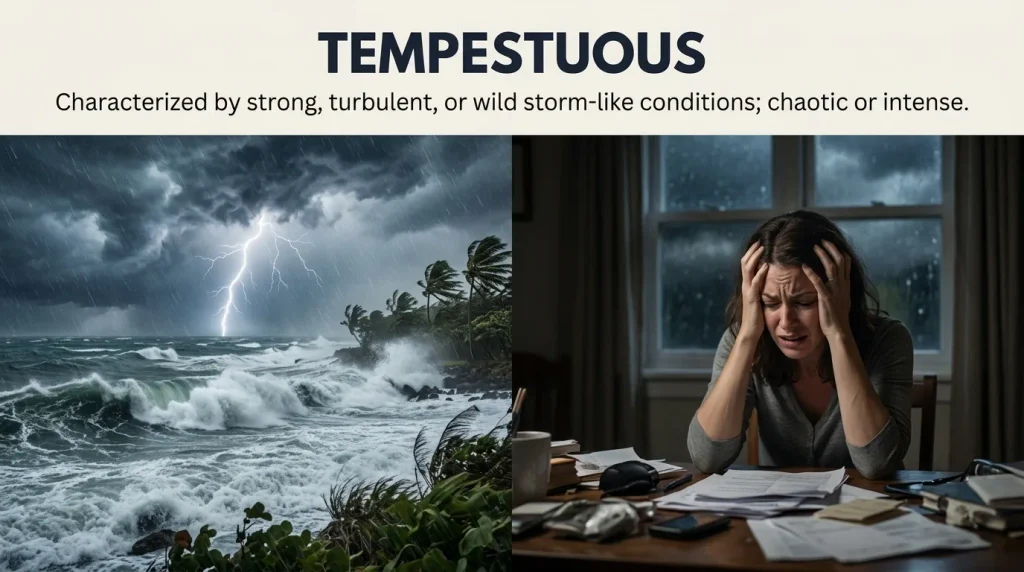
Tempestuous describes something marked by powerful disturbance, strong emotion, violent movement, or storm-like conditions. It can describe weather, relationships, arguments, political periods, emotions, or other situations that lack calmness and stability.
The word is an adjective. In everyday English, native speakers often use it when ordinary words such as “stormy” or “chaotic” do not fully capture the intensity of a situation.
For example, a couple may have a tempestuous relationship if their relationship repeatedly moves between intense affection, arguments, conflict, and reconciliation.
The word can also describe nature. A tempestuous sea suggests rough, violent, storm-driven water rather than a mildly windy sea.
In figurative writing, tempestuous often creates a dramatic image. It makes emotional or social turmoil feel almost like a physical storm.
Connotative Meaning
Connotation means the feeling, attitude, or emotional association that a word suggests beyond its basic dictionary meaning.
Positive Tone
In some contexts, tempestuous can suggest passion, energy, intensity, or emotional depth. A writer may describe a passionate artistic career as tempestuous without suggesting that every part of it was negative.
Negative Tone
More commonly, the word carries a negative or unsettling feeling. It can suggest conflict, instability, anger, disorder, or emotional turmoil.
Neutral Tone
When describing weather or a historical period, the word can be more descriptive than judgmental. A tempestuous sea simply means a stormy or violently unsettled sea.
Etymology of Tempestuous
The word tempestuous entered English in the late 14th century. It came through Late Latin tempestuosus, meaning stormy or turbulent, from Latin tempestas, meaning storm, disturbance, season, or period of time.
The deeper Latin connection is tempus, meaning “time” or “season.” The meaning gradually developed from a period or condition of weather toward bad weather and eventually a storm.
Old English: 450–1100
Tempestuous was not an Old English word in its present form. Its Latin ancestry existed before the word entered English, but Old English speakers used other native vocabulary to describe storms, rough conditions, and emotional disturbance.
Middle English: 1100–1500
The adjective entered English during the late Middle English period. Historical forms included tempestuous, tempestious, and tempestous. Its early meaning focused on powerful, turbulent, storm-like conditions.
Modern English: 1500–Present
By the early Modern English period, the literal weather-related sense was established. The figurative meaning also developed strongly, allowing the word to describe intense emotions, relationships, conflicts, and unsettled periods.
Pronunciation
US: /temˈpes.tʃu.əs/
UK: /temˈpes.tʃu.əs/
Syllables
tem-pes-tu-ous
Affixation Pattern of Tempestuous
Root/Base: tempest
Prefix: none
Suffix: -uous
The English form can be understood as tempest + -uous, although the word ultimately comes through Latin tempestuosus.
Synonyms List
The following alternatives are useful because they cover different shades of storminess, emotional intensity, conflict, instability, and disorder. Not every synonym works in every sentence, so context matters.
1. Stormy (Adjective) — US / UK: /ˈstɔr.mi/ /ˈstɔː.mi/
Meaning: Marked by storms, conflict, emotional difficulty, or instability.
Tone/Register: Neutral; very common.
Example:
Their marriage had a stormy beginning.
The boat struggled through stormy waters.
2. Turbulent (Adjective) — US / UK: /ˈtɝː.bjə.lənt/ /ˈtɜː.bjə.lənt/
Meaning: Characterized by severe disturbance, change, conflict, or agitation.
Tone/Register: Formal; academic and journalistic.
Example:
The country went through a turbulent decade.
She experienced turbulent emotions after the breakup.
3. Tumultuous (Adjective) — US / UK: /tuːˈmʌl.tʃu.əs/ /tjuːˈmʌl.tʃu.əs/
Meaning: Full of loud excitement, disorder, confusion, or strong emotion.
Tone/Register: Formal.
Example:
The crowd gave the singer a tumultuous welcome.
The movement began during a tumultuous period.
4. Volatile (Adjective) — US / UK: /ˈvɑːl.ə.təl/ /ˈvɒl.ə.taɪl/
Meaning: Likely to change suddenly and become dangerous, emotional, or unstable.
Tone/Register: Formal; professional.
Example:
The negotiations entered a volatile stage.
His volatile temper made meetings difficult.
5. Tempestuous (Adjective) — US / UK: /temˈpes.tʃu.əs/ /temˈpes.tʃu.əs/
Meaning: Extremely stormy, turbulent, emotional, or unsettled.
Tone/Register: Literary; formal.
Example:
They had a tempestuous friendship.
The ship disappeared into a tempestuous sea.
6. Storm-tossed (Adjective) — US / UK: /ˈstɔrmˌtɔːst/ /ˈstɔːmˌtɒst/
Meaning: Strongly affected or disturbed by storms or difficult circumstances.
Tone/Register: Literary.
Example:
The storm-tossed vessel finally reached the harbor.
He looked back on his storm-tossed career.
7. Wild (Adjective) — US / UK: /waɪld/ /waɪld/
Meaning: Extremely uncontrolled, energetic, violent, or difficult to predict.
Tone/Register: Informal to neutral.
Example:
The meeting became wild after the announcement.
They spent a wild weekend arguing and celebrating.
8. Fierce (Adjective) — US / UK: /fɪrs/ /fɪəs/
Meaning: Extremely intense, forceful, aggressive, or passionate.
Tone/Register: Neutral.
Example:
The two teams had a fierce rivalry.
She felt fierce anger after hearing the news.
9. Violent (Adjective) — US / UK: /ˈvaɪə.lənt/ /ˈvaɪə.lənt/
Meaning: Involving powerful force, aggression, or extreme disturbance.
Tone/Register: Strong; direct.
Example:
A violent storm damaged several roads.
The argument became violent within minutes.
10. Unsettled (Adjective) — US / UK: /ʌnˈset̬.əld/ /ʌnˈset.əld/
Meaning: Lacking calmness, certainty, stability, or peace.
Tone/Register: Neutral.
Example:
The region remained unsettled after the election.
She felt unsettled by the sudden change.
11. Chaotic (Adjective) — US / UK: /keɪˈɑː.tɪk/ /keɪˈɒt.ɪk/
Meaning: Completely disorganized, confused, or difficult to control.
Tone/Register: Neutral; common.
Example:
The office became chaotic before the deadline.
Their travel plans turned chaotic.
12. Unruly (Adjective) — US / UK: /ʌnˈruː.li/ /ʌnˈruː.li/
Meaning: Difficult to control because of disorderly or disruptive behavior.
Tone/Register: Neutral to formal.
Example:
The unruly crowd blocked the entrance.
The discussion became unruly after midnight.
13. Agitated (Adjective) — US / UK: /ˈædʒ.ə.teɪ.tɪd/ /ˈædʒ.ɪ.teɪ.tɪd/
Meaning: Nervous, upset, restless, or emotionally disturbed.
Tone/Register: Neutral.
Example:
He became agitated during the interview.
The agitated crowd demanded answers.
14. Frantic (Adjective) — US / UK: /ˈfræn.tɪk/ /ˈfræn.tɪk/
Meaning: Extremely anxious, hurried, excited, or uncontrolled.
Tone/Register: Informal to neutral.
Example:
The office was frantic before the launch.
She made a frantic attempt to find her passport.
15. Frenzied (Adjective) — US / UK: /ˈfren.zid/ /ˈfren.ziːd/
Meaning: Extremely excited, hurried, emotional, or uncontrolled.
Tone/Register: Neutral; vivid.
Example:
Fans created a frenzied atmosphere outside the stadium.
The newsroom became frenzied as the story developed.
16. Hectic (Adjective) — US / UK: /ˈhek.tɪk/ /ˈhek.tɪk/
Meaning: Extremely busy, active, and difficult to manage calmly.
Tone/Register: Informal; common in daily English.
Example:
It was a hectic morning at work.
The final week of the project was hectic.
17. Explosive (Adjective) — US / UK: /ɪkˈsploʊ.sɪv/ /ɪkˈspləʊ.sɪv/
Meaning: Likely to produce a sudden and powerful emotional, social, or physical reaction.
Tone/Register: Neutral; dramatic.
Example:
The interview revealed an explosive conflict.
Their argument had an explosive ending.
18. Fiery (Adjective) — US / UK: /ˈfaɪə.ri/ /ˈfaɪə.ri/
Meaning: Full of strong emotion, passion, energy, or anger.
Tone/Register: Informal to literary.
Example:
She gave a fiery speech to the audience.
Their fiery romance attracted constant attention.
19. Passionate (Adjective) — US / UK: /ˈpæʃ.ən.ət/ /ˈpæʃ.ən.ət/
Meaning: Filled with powerful feelings, enthusiasm, love, or commitment.
Tone/Register: Neutral; often positive.
Example:
He is passionate about environmental education.
Their passionate relationship was difficult to predict.
20. Impassioned (Adjective) — US / UK: /ɪmˈpæʃ.ənd/ /ɪmˈpæʃ.ənd/
Meaning: Showing very strong feeling or emotional involvement.
Tone/Register: Formal; literary.
Example:
She delivered an impassioned speech.
His impassioned response surprised everyone.
21. Emotional (Adjective) — US / UK: /ɪˈmoʊ.ʃən.əl/ /ɪˈməʊ.ʃən.əl/
Meaning: Strongly influenced by or expressing feelings.
Tone/Register: Neutral; very common.
Example:
The reunion was deeply emotional.
They had an emotional conversation after years apart.
22. Dramatic (Adjective) — US / UK: /drəˈmæt̬.ɪk/ /drəˈmæt.ɪk/
Meaning: Full of striking events, strong reactions, or sudden changes.
Tone/Register: Neutral.
Example:
The company went through a dramatic transformation.
Their friendship had a dramatic turning point.
23. Intense (Adjective) — US / UK: /ɪnˈtens/ /ɪnˈtens/
Meaning: Extremely strong in feeling, activity, pressure, or effect.
Tone/Register: Neutral; highly versatile.
Example:
The debate became intense.
She experienced intense emotions during the crisis.
24. Heated (Adjective) — US / UK: /ˈhiː.t̬ɪd/ /ˈhiː.tɪd/
Meaning: Marked by strong anger, disagreement, or emotion.
Tone/Register: Informal to neutral.
Example:
The two managers had a heated discussion.
A heated debate followed the announcement.
25. Combative (Adjective) — US / UK: /kəmˈbæt̬.ɪv/ /kəmˈbæt.ɪv/
Meaning: Eager to argue, challenge, oppose, or fight.
Tone/Register: Formal.
Example:
The interviewer took a combative approach.
His combative style created tension.
26. Contentious (Adjective) — US / UK: /kənˈten.ʃəs/ /kənˈten.ʃəs/
Meaning: Likely to cause disagreement, argument, or controversy.
Tone/Register: Formal; academic and professional.
Example:
The proposal remains contentious.
They discussed several contentious issues.
27. Conflict-ridden (Adjective) — US / UK: /ˈkɑːn.flɪkt ˌrɪdən/ /ˈkɒn.flɪkt ˌrɪdən/
Meaning: Filled with repeated disagreements, disputes, or struggles.
Tone/Register: Formal; journalistic.
Example:
The conflict-ridden region needs long-term stability.
He described his childhood as conflict-ridden.
28. Disorderly (Adjective) — US / UK: /dɪˈsɔːr.dɚ.li/ /dɪˈsɔː.də.li/

Meaning: Lacking order, discipline, or proper organization.
Tone/Register: Formal to neutral.
Example:
The protest became disorderly.
The room was left disorderly after the event.
29. Turbulent-minded (Adjective) — US / UK: /ˈtɝː.bjə.lənt ˈmaɪn.dɪd/ /ˈtɜː.bjə.lənt ˈmaɪn.dɪd/
Meaning: Characterized by inner emotional disturbance or mental unrest.
Tone/Register: Literary; uncommon.
Example:
The novel follows a turbulent-minded artist.
His turbulent-minded character drives the story.
30. Restless (Adjective) — US / UK: /ˈrest.ləs/ /ˈrest.ləs/
Meaning: Unable to remain calm, still, settled, or satisfied.
Tone/Register: Neutral.
Example:
The restless crowd waited for the result.
She had a restless night before the exam.
31. Unstable (Adjective) — US / UK: /ʌnˈsteɪ.bəl/ /ʌnˈsteɪ.bəl/
Meaning: Not steady, secure, calm, or predictable.
Tone/Register: Neutral; professional.
Example:
The political situation remains unstable.
Their unstable relationship caused stress.
32. Unpredictable (Adjective) — US / UK: /ˌʌn.prɪˈdɪk.tə.bəl/ /ˌʌn.prɪˈdɪk.tə.bəl/
Meaning: Difficult to know or anticipate because conditions change suddenly.
Tone/Register: Neutral.
Example:
The weather is unpredictable this month.
His unpredictable reactions made communication difficult.
33. Boisterous (Adjective) — US / UK: /ˈbɔɪ.stər.əs/ /ˈbɔɪ.stər.əs/
Meaning: Noisy, energetic, lively, and sometimes difficult to control.
Tone/Register: Informal to neutral.
Example:
The boisterous fans filled the stadium.
The children became boisterous after lunch.
34. Storm-driven (Adjective) — US / UK: /ˈstɔrm ˌdrɪvən/ /ˈstɔːm ˌdrɪvən/
Meaning: Strongly affected or propelled by storm-like forces or conditions.
Tone/Register: Literary; descriptive.
Example:
Storm-driven waves hit the rocky coast.
The story follows a storm-driven journey.
35. Blustery (Adjective) — US / UK: /ˈblʌs.tɚ.i/ /ˈblʌs.tər.i/
Meaning: Characterized by strong, gusty wind and rough weather.
Tone/Register: Neutral; commonly used for weather.
Example:
It was a cold and blustery afternoon.
We canceled the picnic because of the blustery weather.
36. Squally (Adjective) — US / UK: /ˈskwɔː.li/ /ˈskwɒl.i/
Meaning: Marked by sudden strong winds and brief periods of heavy rain.
Tone/Register: Weather-specific.
Example:
The sailors prepared for squally conditions.
Squally weather made the crossing dangerous.
37. Boiling (Adjective) — US / UK: /ˈbɔɪ.lɪŋ/ /ˈbɔɪ.lɪŋ/
Meaning: Extremely angry or emotionally agitated.
Tone/Register: Informal.
Example:
She was boiling after hearing the accusation.
He left the room boiling with anger.
38. Seething (Adjective) — US / UK: /ˈsiː.ðɪŋ/ /ˈsiː.ðɪŋ/
Meaning: Filled with intense anger that may be controlled outwardly.
Tone/Register: Vivid; literary to neutral.
Example:
He was seething after the unfair decision.
She gave a calm reply while seething inside.
39. Raging (Adjective) — US / UK: /ˈreɪ.dʒɪŋ/ /ˈreɪ.dʒɪŋ/
Meaning: Extremely strong, violent, or uncontrolled.
Tone/Register: Neutral; vivid.
Example:
A raging storm closed the airport.
He tried to calm the raging argument.
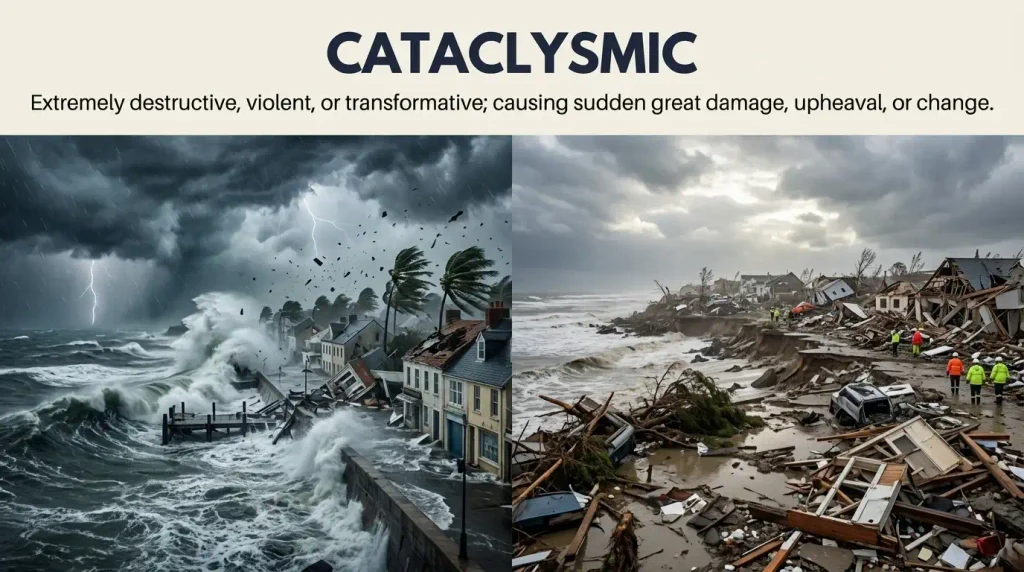
40. Cataclysmic (Adjective) — US / UK: /ˌkæt̬.əˈklɪz.mɪk/ /ˌkæt.əˈklɪz.mɪk/
Meaning: Involving an extremely destructive or transformative event.
Tone/Register: Formal; dramatic.
Example:
The novel describes a cataclysmic conflict.
The region faced cataclysmic flooding.
Synonyms for Tempestuous by Tone
Positive
Some alternatives can describe intensity without being strongly negative. Passionate, fiery, impassioned, and sometimes dramatic can work when strong emotion creates energy or excitement.
Neutral
Stormy, turbulent, intense, unsettled, unpredictable, unstable, restless, and dramatic are useful when you want to describe conditions without making the judgment too strong.
Negative
Volatile, chaotic, violent, explosive, combative, contentious, conflict-ridden, seething, and raging usually carry a stronger negative association.
Playful or Informal
For casual conversations, wild, hectic, boiling, and fiery may sound more natural than the formal word tempestuous.
Why Tone Matters
Choosing a synonym is not only about replacing one word with another. The replacement changes the feeling of the sentence.
Calling a relationship passionate can sound positive. Calling the same relationship volatile highlights risk and instability.
That difference matters in essays, blogs, workplace writing, storytelling, and everyday conversations.
Tempestuous vs Close Alternatives
Tempestuous vs Stormy
It sounds more literary and intense. It often works well for emotional relationships, historical periods, and dramatic writing.
Stormy is much more common in everyday English. It can describe both actual weather and difficult relationships.
Use stormy for natural, conversational writing. Choose tempestuous when you want a stronger or more dramatic effect.
Tempestuous vs Turbulent
- Turbulent emphasizes disturbance, instability, or continuous change.
- Tempestuous emphasizes storm-like intensity and strong emotional or physical force.
- A turbulent economy sounds natural. A tempestuous relationship sounds especially expressive.
Tempestuous vs Tumultuous
- Tumultuous often suggests noise, confusion, crowds, social disorder, or emotional upheaval.
- Tempestuous has a stronger connection with storms and passionate emotional conflict.
- A tumultuous crowd is natural. A tempestuous sea is natural and vivid.
How Tempestuous Changes by Context
Daily Conversation
In casual speech, tempestuous is less common than stormy, intense, chaotic, heated, or wild.
You might say, “Their relationship is stormy” rather than “Their relationship is tempestuous.”
The longer word works when you want your speech to sound expressive or literary.
Writing or Blogging
Bloggers can use tempestuous when describing dramatic relationships, difficult journeys, social change, or powerful emotions.
It creates a strong mental picture and can make descriptive writing more engaging.
Still, a simpler synonym may improve readability when the audience prefers everyday English.
Professional or Academic Writing
In formal writing, turbulent, volatile, contentious, unstable, and tumultuous can be useful.
For example, “The industry experienced a turbulent period” sounds professional and precise.
Avoid choosing tempestuous merely because it sounds sophisticated. Precision should come first.
Creative or Informal Use
Creative writers have more freedom. Tempestuous, fiery, raging, storm-tossed, seething, and explosive can create vivid imagery.
These choices work particularly well in fiction, poetry, reviews, biographies, and dramatic storytelling.
Common Mistakes Learners Make
Using Every Synonym in Every Context
Not every alternative means the same thing.
For example, blustery mainly describes weather, while contentious usually describes subjects or situations that cause disagreement.
Using Tempestuous for Mild Conditions
A light disagreement is not necessarily tempestuous.
The word suggests considerable intensity, disturbance, or emotional force.
Confusing Passion With Conflict
Passionate can be positive, while volatile usually suggests instability.
A passionate discussion may be energetic but respectful. A volatile discussion may suddenly become hostile.
Overusing the Word
Because tempestuous sounds sophisticated, learners may use it too often.
Native speakers normally switch between simpler alternatives according to context. Strong vocabulary is most effective when it is precise.
Register Notes
Tempestuous is generally more literary and formal than stormy.
It appears frequently in descriptive writing, journalism, biographies, literature, and discussions of relationships or historical periods.
- For everyday speech, alternatives such as stormy, intense, heated, chaotic, wild, or hectic may sound more natural.
- For academic writing, turbulent, volatile, contentious, and unstable often provide greater precision.
- For additional vocabulary practice, you can connect this topic with related synonym articles on your site.
Real-Life Examples Using Tempestuous
Workplace
A manager may describe a difficult project as tempestuous when it has faced repeated disputes, sudden changes, and emotional meetings.
Social Situations
A friendship may be called tempestuous when two people repeatedly move between closeness and serious disagreements.
Media and Pop Culture
Entertainment writers often use tempestuous to describe celebrity relationships, dramatic careers, public feuds, or periods of intense change.
Writing and Storytelling
A novelist may describe a tempestuous journey to suggest that the characters face emotional struggles as well as external obstacles.
How to Choose the Right Synonym
- Start by asking what kind of disturbance you mean.
- If you mean bad weather, try stormy, blustery, squally, or raging.
- If you mean emotional instability, consider volatile, intense, fiery, seething, or passionate.
- If you mean social disorder, choose tumultuous, chaotic, unruly, disorderly, or conflict-ridden.
- If you mean political or economic instability, turbulent, volatile, unstable, or unsettled may be more precise.
- If you mean strong disagreement, heated, contentious, combative, or explosive can work well.
- The best synonym is the one that communicates the exact kind of intensity you want.
External Reference: Cambridge Dictionary provides the current definition and US/UK pronunciation of tempestuous, while the Online Etymology Dictionary traces its historical development from Late Latin through English. dictionary.cambridge.org
Cambridge Dictionary — Tempestuous
Online Etymology Dictionary — Tempestuous
Practice Exercises
1. The couple’s relationship was full of arguments, reconciliations, and powerful emotions. Which word fits best?
A. Blustery
B. Tempestuous
C. Hectic
D. Unruly
2. The country experienced years of political instability and rapid change. Which word is most suitable?
A. Turbulent
B. Boisterous
C. Blustery
D. Playful
3. The children became very noisy and energetic during the celebration. Which word fits best?
A. Contentious
B. Boisterous
C. Volatile
D. Seething
4. The managers had an angry disagreement about the new policy. Which synonym is most natural?
A. Heated
B. Squally
C. Storm-tossed
D. Blustery
5. The weather brought sudden strong winds and heavy rain. Which word is most precise?
A. Passionate
B. Squally
C. Contentious
D. Combative
6. His mood could change suddenly and become dangerous. Which word fits best?
A. Volatile
B. Hectic
C. Dramatic
D. Restless
7. The speech showed powerful emotion and deep commitment. Which word is most appropriate?
A. Impassioned
B. Disorderly
C. Unstable
D. Squally
8. The protest became difficult to control and poorly organized. Which word fits best?
A. Passionate
B. Disorderly
C. Fiery
D. Seething
9. She was extremely angry but remained quiet during the meeting. Which word best describes her emotional state?
A. Seething
B. Blustery
C. Hectic
D. Tumultuous
10. The airport closed because of a powerful storm. Which synonym works best?
A. Raging
B. Contentious
C. Combative
D. Passionate
Part Two
11. A discussion that may quickly turn into an argument can be described as:
A. Contentious
B. Sunny
C. Gentle
D. Orderly
12. Which word is most suitable for an extremely busy workday?
A. Hectic
B. Squally
C. Seething
D. Cataclysmic
13. Which synonym emphasizes sudden, unpredictable change?
A. Volatile
B. Boisterous
C. Passionate
D. Blustery
14. Which word is especially suitable for literary descriptions of powerful emotional or storm-like conditions?
A. Tempestuous
B. Hectic
C. Busy
D. Ordinary
15. Which synonym suggests an extremely destructive event?
A. Cataclysmic
B. Restless
C. Heated
D. Unsettled
Reflection Task
Choose one synonym from the list and write your own sentence. Then explain why that word fits better than tempestuous in your chosen context.
Answer Key: 1-B | 2-A | 3-B | 4-A | 5-B | 6-A | 7-A | 8-B | 9-A | 10-A | 11-A | 12-A | 13-A | 14-A | 15-A
Frequently Asked Questions
1. What is the best synonym for tempestuous in a relationship?
Stormy is usually the most natural everyday synonym for a difficult relationship. Volatile works when the relationship can change suddenly or become emotionally dangerous. Passionate is better when you want to emphasize strong romantic feelings without making the relationship sound entirely negative.
2. What is a simple word for tempestuous?
A simple alternative is stormy. Depending on the sentence, you can also use turbulent, intense, chaotic, heated, or unstable. The best choice depends on whether you are describing weather, emotions, conflict, relationships, or a period of social change.
3. Is tempestuous a positive or negative word?
Tempestuous is usually negative or dramatic because it suggests disturbance, conflict, or instability. However, it can sometimes describe intense passion or energy without being completely negative. The surrounding context determines whether the reader sees the intensity as exciting, difficult, or destructive.
4. Can tempestuous describe a person?
Yes, but it is usually more natural to describe a person’s behavior, emotions, personality, or relationships rather than simply labeling the person. For example, “He had a tempestuous temper” or “She led a tempestuous career” can work in descriptive writing.
5. What is the difference between tempestuous and turbulent?
Both words suggest disturbance, but tempestuous has a stronger storm-like and emotional quality. Turbulent is broader and works especially well for politics, economies, social conditions, journeys, and periods of change. Choose tempestuous when you want a more vivid sense of emotional or storm-like intensity.
6. Is tempestuous formal English?
Yes. Tempestuous is more formal or literary than common alternatives such as stormy, heated, wild, or chaotic. It is especially useful in essays, descriptive writing, journalism, literature, and discussions involving dramatic relationships or historical periods.
7. Can tempestuous describe weather?
Yes. The original literal sense relates to storms and rough weather. You can describe a tempestuous sea, tempestuous winds, or tempestuous weather when conditions are powerful and storm-like. In modern writing, the word is also widely used figuratively for emotions and relationships.
Conclusion
Learning synonyms for tempestuous helps you express intensity with greater accuracy. Instead of repeating one word, you can choose alternatives that match emotion, weather, conflict, or instability.
Words such as stormy, turbulent, volatile, tumultuous, passionate, and heated each add a different shade of meaning. That makes your writing clearer and more expressive.
For students, bloggers, writers, and everyday English users, these distinctions make communication stronger. The right synonym can make an essay precise or make a story more vivid.
Keep practicing these words in emails, essays, conversations, and creative writing. Try one new synonym today and notice how it changes the feeling of your sentence.

Samia Noor is the founder and lead writer at SynonymGenius.com, where she creates accurate, reader-focused English language content that helps people communicate with clarity and confidence. She specializes in synonyms, antonyms, word meanings, idioms, and practical vocabulary guides that make complex language concepts simple and easy to understand. Every article is thoroughly researched, carefully fact-checked, and written in clear, accessible language using reliable sources and real-world examples. Her mission is to provide trustworthy, high-quality content that supports students, writers, educators, professionals, and English learners at every stage of their language journey.
Her editorial approach emphasizes accuracy, transparency, and genuine value for readers while following modern E-E-A-T and content quality standards. She regularly reviews and updates published content to ensure it remains current, reliable, and easy to understand. Through SynonymGenius.com, Samia Noor is committed to publishing dependable language resources that help readers expand their vocabulary, strengthen their writing skills, improve communication, and build confidence in academic, professional, and everyday English.