
Synonyms for touchstone include benchmark, standard, criterion, measure, yardstick, test, reference point, and litmus test. These words describe something used to judge quality, value, truth, or performance. The best alternative depends on the context and the kind of judgment you want to express.
Synonyms for touchstone help you express how people evaluate ideas, products, achievements, and decisions. Choosing the right word makes your writing clearer and more precise.
Imagine comparing two schools before choosing where to study. You might use teaching quality as a benchmark. In this situation, teaching quality becomes your touchstone for making a decision.
Writers, students, bloggers, and professionals often use this word when discussing standards or meaningful tests. Learning synonyms for touchstone helps you avoid repetition and explain your ideas more naturally.
What Does “Touchstone” Really Mean?
A touchstone is a standard, test, or reference point that people use to judge the quality, value, or truth of something. It helps them decide whether an idea, action, product, or achievement meets expectations.
For example, customer satisfaction can serve as a touchstone for a successful business. A teacher may use critical thinking as a touchstone when evaluating a student’s work.
Part of speech: Noun.
The word usually has a neutral or positive tone. It often suggests a reliable way to evaluate something, although the usefulness of the standard depends on the situation.
Native English speakers commonly use touchstone in academic writing, business discussions, journalism, literature, and conversations about personal values. It can refer to a practical measure or an important principle that guides judgment.
Connotative Meaning
Connotation (the emotional or cultural associations a word carries beyond its basic dictionary definition) helps explain the tone of touchstone.
- Positive tone: A trusted standard that supports fair judgment or meaningful progress.
- Negative tone: A rigid or unsuitable standard that limits judgment when applied without considering context.
- Neutral tone: A reference point used to compare, assess, or evaluate something.
The word itself is not inherently negative. Its connotation depends on how the speaker presents the standard and its effects.
Etymology of Touchstone
The word touchstone combines touch and stone. Historically, a touchstone was a dark, fine-grained stone used to test the purity of gold and other precious metals. Rubbing metal against the stone left a mark that helped an expert assess its quality.
Over time, this physical test developed into a figurative meaning. People began using touchstone for anything that could reveal the quality, reliability, or true character of something.
Old English Period (450–1100)
The modern compound word did not have its established figurative meaning throughout this entire period. Its component words have Old English roots, including tācn for a sign or token and stān for stone, while the history of touch involves French influence.
Middle English Period (1100–1500)
During Middle English, forms related to touch and stone developed through contact with French and other language influences. The physical idea of testing precious metals provided the foundation for the compound’s later use.
Modern English Period (1500–Present)
The word became established as both a literal term for testing metals and a figurative term for a standard of judgment. Today, people use it to discuss quality, integrity, success, and the principles by which they evaluate ideas or behavior.
Pronunciation, Syllables, and Word Structure
Pronunciation (US and UK)
- US: /ˈtʌtʃˌstoʊn/
- UK: /ˈtʌtʃ.stəʊn/
Syllables
touch-stone — two syllables.
Affixation Pattern
- Root elements: touch + stone
- Prefix: None.
- Suffix: None.
- Word formation: Compound noun.
The word joins two existing words rather than adding a conventional prefix or suffix. Its literal meaning connects touching or testing with a stone, while its figurative meaning refers to a method of judgment.
Synonyms List
The following alternatives cover the main meanings of touchstone. Some emphasize a standard, while others describe a test or a point of comparison. Choose the word that best fits your sentence rather than treating every alternative as interchangeable.
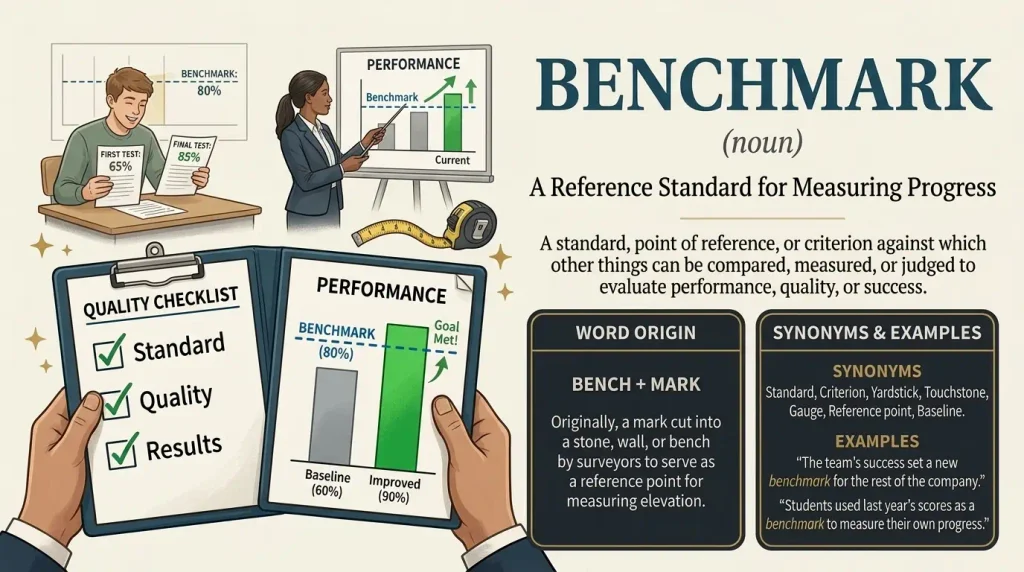
1. Benchmark (Noun) — US /ˈbentʃˌmɑːrk/ · UK /ˈbentʃ.mɑːk/
Meaning: A benchmark is a reference standard used to compare performance, quality, or progress.
Tone/Register: Neutral, professional, academic.
Example:
Our latest results set a new benchmark for customer service.
The school uses national scores as a benchmark for student progress.
2. Standard (Noun) — US /ˈstændərd/ · UK /ˈstændəd/
Meaning: A standard is an accepted level of quality or behavior used for evaluation.
Tone/Register: Neutral, formal, everyday.
Example:
Honesty remains the standard by which I judge a leader.
This restaurant maintains a high standard of service.
3. Criterion (Noun) — US /kraɪˈtɪriən/ · UK /kraɪˈtɪəriən/
Meaning: A criterion is a specific requirement or principle used to make a judgment.
Tone/Register: Formal, academic, professional.
Example:
Accuracy is the main criterion for selecting the winning entry.
Your writing must meet every criterion on the assessment sheet.
4. Measure (Noun) — US /ˈmeʒər/ · UK /ˈmeʒə/
Meaning: A measure is a way to assess the quality, extent, or success of something.
Tone/Register: Neutral, professional.
Example:
Customer feedback provides a useful measure of service quality.
We need a better measure of the team’s progress.
5. Yardstick (Noun) — US /ˈjɑːrdˌstɪk/ · UK /ˈjɑːd.stɪk/
Meaning: A yardstick is a practical standard used to compare or evaluate different things.
Tone/Register: Neutral, conversational.
Example:
For many parents, safety is the yardstick for choosing a school.
Profit alone should not be the yardstick for business success.
6. Test (Noun) — US /test/ · UK /test/
Meaning: A test is a process or situation that reveals whether something meets a requirement or proves reliable.
Tone/Register: Neutral, everyday, academic.
Example:
The emergency drill was a test of the team’s readiness.
A difficult decision can become a test of personal values.
7. Litmus Test (Noun) — US /ˈlɪtməs test/ · UK /ˈlɪtməs test/
Meaning: A litmus test is a decisive check that reveals an important quality, belief, or difference.
Tone/Register: Neutral, analytical, journalistic.
Example:
Her response to criticism became a litmus test of her leadership.
For this role, practical experience is the real litmus test.
8. Reference Point (Noun) — US /ˈrefərəns pɔɪnt/ · UK /ˈrefərəns pɔɪnt/
Meaning: A reference point is a known example or position used to make comparisons.
Tone/Register: Neutral, academic, professional.
Example:
Last year’s results provide a reference point for this year’s goals.
Use the original design as a reference point when reviewing changes.
9. Gauge (Noun) — US /ɡeɪdʒ/ · UK /ɡeɪdʒ/
Meaning: A gauge is a means of estimating or judging the condition, quality, or extent of something.
Tone/Register: Neutral, everyday, professional.
Example:
Attendance is one gauge of interest in the workshop.
We used reader comments to gauge the article’s usefulness.
10. Barometer (Noun) — US /bəˈrɑːmətər/ · UK /bəˈrɒmɪtə/
Meaning: A barometer is an indicator that reveals changes in a situation or the general mood.
Tone/Register: Analytical, journalistic, professional.
Example:
Consumer confidence can be a barometer of economic health.
Online reviews often serve as a barometer of public opinion.
11. Indicator (Noun) — US /ˈɪndɪˌkeɪtər/ · UK /ˈɪndɪkeɪtə/
Meaning: An indicator is a sign or piece of evidence that suggests a particular condition or result.
Tone/Register: Neutral, academic, business.
Example:
Regular attendance is an indicator of student engagement.
A rise in complaints may indicate a problem with the service.
12. Metric (Noun) — US /ˈmetrɪk/ · UK /ˈmetrɪk/
Meaning: A metric is a measurable value used to assess performance, progress, or success.
Tone/Register: Technical, business, analytical.
Example:
We track reading time as one metric of audience engagement.
The team selected a clear metric for measuring monthly progress.
13. Point of Reference (Noun) — US /pɔɪnt əv ˈrefərəns/ · UK /pɔɪnt əv ˈrefərəns/
Meaning: A point of reference is a known fact, example, or standard that helps people make judgments.
Tone/Register: Neutral, formal.
Example:
The first draft gives us a point of reference for future revisions.
Her previous experience became a point of reference during the discussion.
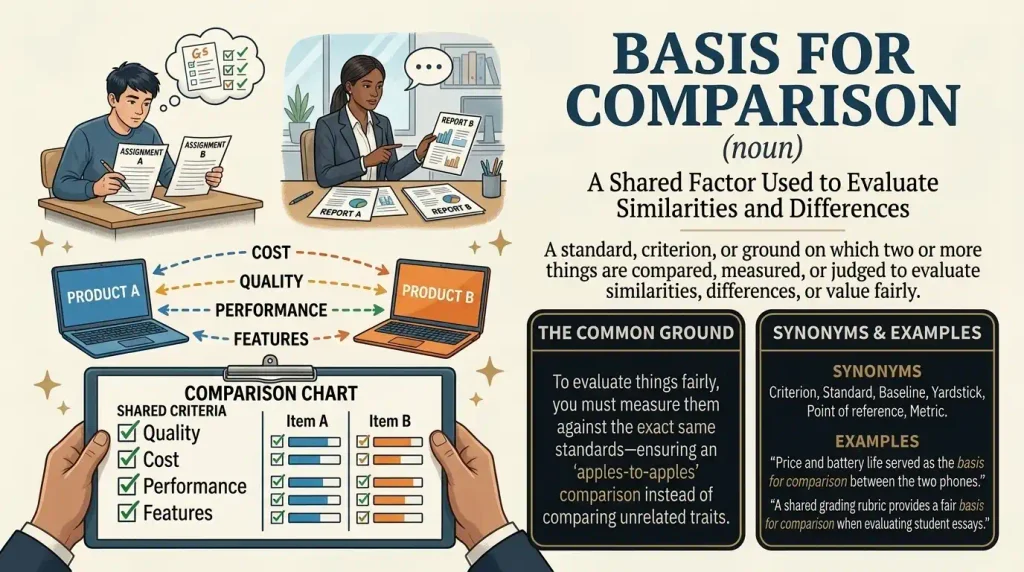
14. Basis for Comparison (Noun Phrase) — US /ˈbeɪsɪs fər kəmˈpærɪsən/ · UK /ˈbeɪsɪs fə kəmˈpærɪsən/
Meaning: A basis for comparison is a shared factor used to evaluate similarities and differences.
Tone/Register: Academic, analytical, professional.
Example:
We used the same test as a basis for comparison.
Price alone is not a fair basis for comparison between these schools.
15. Norm (Noun) — US /nɔːrm/ · UK /nɔːm/
Meaning: A norm is an accepted or usual level of behavior, quality, or performance.
Tone/Register: Neutral, academic, social.
Example:
Respectful communication is the norm in this office.
The company compares its practices with industry norms.
16. Rule (Noun) — US /ruːl/ · UK /ruːl/
Meaning: A rule is an established instruction or principle that guides decisions or behavior.
Tone/Register: Neutral, everyday, formal.
Example:
Fairness is the rule we follow when resolving disputes.
The team uses a simple rule to check every submission.
17. Principle (Noun) — US /ˈprɪnsəpəl/ · UK /ˈprɪnsəpəl/
Meaning: A principle is a fundamental belief or value that guides judgment and action.
Tone/Register: Formal, ethical, academic.
Example:
Integrity is the principle behind every decision she makes.
The project follows the principle of equal access.
18. Guide (Noun) — US /ɡaɪd/ · UK /ɡaɪd/
Meaning: A guide is a source of advice or direction that helps someone make a decision.
Tone/Register: Neutral, everyday, professional.
Example:
Our values serve as a guide when choices become difficult.
Use the marking criteria as a guide when revising your essay.
19. Benchmark Standard (Noun Phrase) — US /ˈbentʃˌmɑːrk ˈstændərd/ · UK /ˈbentʃ.mɑːk ˈstændəd/
Meaning: A benchmark standard is an established level used to compare performance or quality.
Tone/Register: Formal, business, technical.
Example:
The laboratory follows a benchmark standard for accuracy.
This model gives the team a benchmark standard for future designs.
20. Touchstone Test (Noun Phrase) — US /ˈtʌtʃˌstoʊn test/ · UK /ˈtʌtʃ.stəʊn test/
Meaning: A touchstone test is a decisive evaluation that reveals whether something meets an important standard.
Tone/Register: Formal, analytical.
Example:
The final review served as a touchstone test for the proposal.
Public trust became the touchstone test of the new policy.
21. Yardstick Measure (Noun Phrase) — US /ˈjɑːrdˌstɪk ˈmeʒər/ · UK /ˈjɑːd.stɪk ˈmeʒə/
Meaning: A yardstick measure is a specific standard used to judge or compare results.
Tone/Register: Neutral, analytical.
Example:
Completion rates provide a yardstick measure of student progress.
The team needed a consistent yardstick measure for quality.
22. Litmus Test Standard (Noun Phrase) — US /ˈlɪtməs test ˈstændərd/ · UK /ˈlɪtməs test ˈstændəd/
Meaning: A litmus test standard is a decisive requirement used to reveal whether an option meets a key condition.
Tone/Register: Formal, analytical.
Example:
Data security became the litmus test standard for approving the system.
The committee treated fairness as its litmus test standard.
23. Touchstone Principle (Noun Phrase) — US /ˈtʌtʃˌstoʊn ˈprɪnsəpəl/ · UK /ˈtʌtʃ.stəʊn ˈprɪnsəpəl/
Meaning: A touchstone principle is a central value used to evaluate decisions and behavior.
Tone/Register: Formal, ethical, academic.
Example:
Transparency is the touchstone principle behind the organization.
The writer uses compassion as a touchstone principle for every character.
24. Evaluative Standard (Noun Phrase) — US /ɪˈvæljuˌeɪtɪv ˈstændərd/ · UK /ɪˈvæljuətɪv ˈstændəd/
Meaning: An evaluative standard is a defined requirement used to assess quality or performance.
Tone/Register: Academic, formal, technical.
Example:
The panel agreed on an evaluative standard before reviewing applications.
Clear evaluative standards help teachers grade work consistently.
25. Quality Standard (Noun Phrase) — US /ˈkwɑːləti ˈstændərd/ · UK /ˈkwɒləti ˈstændəd/
Meaning: A quality standard is a level of excellence that a product, service, or task should meet.
Tone/Register: Business, professional, neutral.
Example:
Every batch must meet the company’s quality standard.
The editor checks each article against a clear quality standard.
26. Measure of Merit (Noun Phrase) — US /ˈmeʒər əv ˈmerɪt/ · UK /ˈmeʒə əv ˈmerɪt/
Meaning: A measure of merit is a factor used to judge the value, worth, or achievement of something.
Tone/Register: Formal, academic.
Example:
Original thinking is an important measure of merit in this competition.
Popularity alone is a poor measure of merit.
27. Test of Character (Noun Phrase) — US /test əv ˈkærəktər/ · UK /test əv ˈkærəktə/
Meaning: A test of character is a difficult situation that reveals someone’s values or integrity.
Tone/Register: Neutral, ethical, conversational.
Example:
Admitting the mistake was a test of character.
The crisis became a test of character for the entire team.
28. Proof (Noun) — US /pruːf/ · UK /pruːf/
Meaning: Proof is evidence that establishes whether a claim or belief is true.
Tone/Register: Neutral, academic, legal.
Example:
The results offered proof that the new method worked.
A confident claim is not proof of its accuracy.
29. Evidence (Noun) — US /ˈevɪdəns/ · UK /ˈevɪdəns/
Meaning: Evidence consists of facts or information that help establish the truth or quality of a claim.
Tone/Register: Neutral, academic, professional.
Example:
The researcher used reliable evidence to assess the theory.
We need stronger evidence before accepting that conclusion.
30. Touchstone of Excellence (Noun Phrase) — US /ˈtʌtʃˌstoʊn əv ˈeksələns/ · UK /ˈtʌtʃ.stəʊn əv ˈeksələns/
Meaning: A touchstone of excellence is a respected example or standard that represents outstanding quality.
Tone/Register: Formal, positive, literary.
Example:
The library became a touchstone of excellence in public education.
Readers regard the book as a touchstone of excellence in historical writing.
31. Model (Noun) — US /ˈmɑːdəl/ · UK /ˈmɒdəl/
Meaning: A model is an example that people use to guide or evaluate their own work.
Tone/Register: Neutral, academic, professional.
Example:
Her clear essay serves as a model for new students.
The organization offers a model of responsible leadership.
32. Ideal (Noun) — US /aɪˈdiːəl/ · UK /aɪˈdɪəl/
Meaning: An ideal is a desired level of quality or behavior against which reality can be judged.
Tone/Register: Positive, formal, conversational.
Example:
Equal opportunity remains our ideal for education.
The finished design comes close to the team’s ideal.
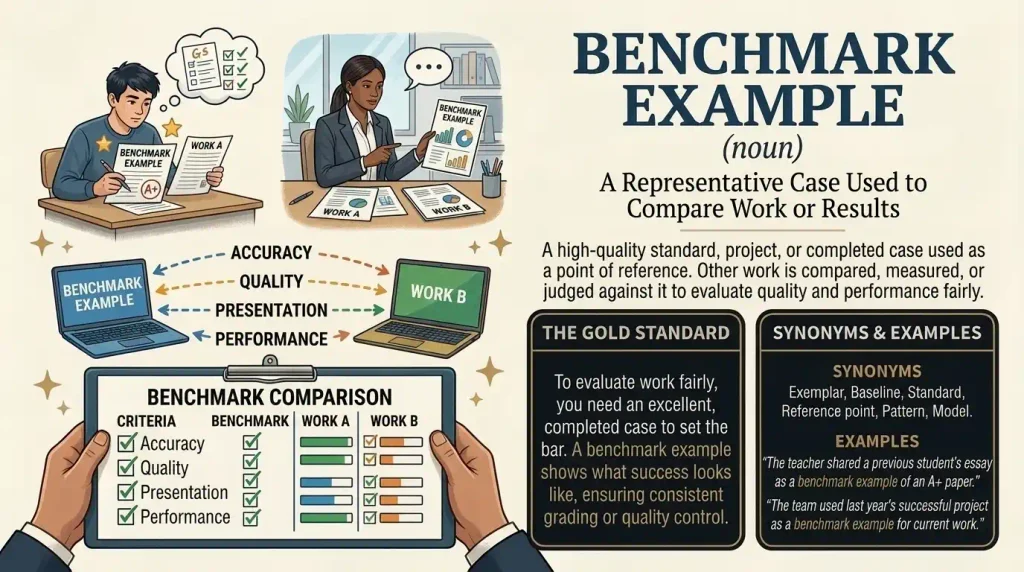
33. Benchmark Example (Noun Phrase) — US /ˈbentʃˌmɑːrk ɪɡˈzæmpəl/ · UK /ˈbentʃ.mɑːk ɪɡˈzɑːmpəl/
Meaning: A benchmark example is a representative case used to compare other work or results.
Tone/Register: Academic, professional.
Example:
The teacher shared a benchmark example before the assignment began.
Review the benchmark example to understand the expected level of detail.
34. Reference Standard (Noun) — US /ˈrefərəns ˈstændərd/ · UK /ˈrefərəns ˈstændəd/
Meaning: A reference standard is an agreed or verified standard used to check accuracy or quality.
Tone/Register: Technical, formal, scientific.
Example:
The technician checked the readings against a reference standard.
Researchers used a reference standard to validate the results.
35. Yardstick for Success (Noun Phrase) — US /ˈjɑːrdˌstɪk fər səkˈses/ · UK /ˈjɑːd.stɪk fə səkˈses/
Meaning: A yardstick for success is a factor used to decide whether an effort has achieved its goals.
Tone/Register: Neutral, business, conversational.
Example:
Long-term learning is our yardstick for success.
The team chose reader satisfaction as its yardstick for success.
36. Litmus Test for Quality (Noun Phrase) — US /ˈlɪtməs test fər ˈkwɑːləti/ · UK /ˈlɪtməs test fə ˈkwɒləti/
Meaning: A litmus test for quality is a decisive check that exposes whether something meets an important quality requirement.
Tone/Register: Professional, analytical.
Example:
Reliable sourcing is a litmus test for quality in educational articles.
The final inspection became a litmus test for quality.
37. Touchstone of Truth (Noun Phrase) — US /ˈtʌtʃˌstoʊn əv truːθ/ · UK /ˈtʌtʃ.stəʊn əv truːθ/
Meaning: A touchstone of truth is a trusted basis for distinguishing accurate claims from misleading ones.
Tone/Register: Formal, philosophical, literary.
Example:
Verifiable facts serve as a touchstone of truth in investigative reporting.
The historian treated original documents as a touchstone of truth.
38. Standard of Judgment (Noun Phrase) — US /ˈstændərd əv ˈdʒʌdʒmənt/ · UK /ˈstændəd əv ˈdʒʌdʒmənt/
Meaning: A standard of judgment is a principle or requirement used to assess decisions, conduct, or results.
Tone/Register: Formal, academic, ethical.
Example:
Consistency is an important standard of judgment in the review process.
The committee established a standard of judgment for all candidates.
39. Measure of Success (Noun Phrase) — US /ˈmeʒər əv səkˈses/ · UK /ˈmeʒə əv səkˈses/
Meaning: A measure of success is a factor that shows whether a person, project, or organization has achieved its goals.
Tone/Register: Neutral, professional, everyday.
Example:
Improved reading skills are a better measure of success than test scores alone.
The team uses repeat customers as one measure of success.
40. Test of Reliability (Noun Phrase) — US /test əv rɪˌlaɪəˈbɪləti/ · UK /test əv rɪˌlaɪəˈbɪləti/
Meaning: A test of reliability is an assessment that checks whether someone or something can be trusted to perform consistently.
Tone/Register: Neutral, technical, professional.
Example:
The repeated trial served as a test of reliability.
Meeting deadlines became a test of reliability for the new supplier.
Synonyms for Touchstone by Tone
Tone matters because a word can make your writing sound conversational, analytical, formal, or strongly judgmental. Choose an alternative that suits your audience and purpose.
Positive
- Ideal: Emphasizes an aspiration or desired level of excellence.
- Model: Highlights an example worth following.
- Principle: Suggests a meaningful value that guides action.
- Touchstone of excellence: Emphasizes outstanding quality.
Neutral
- Benchmark: Works well for comparing performance.
- Standard: Refers to an accepted level of quality.
- Measure: Focuses on evaluation.
- Reference point: Helps readers understand comparisons.
- Indicator: Points to evidence of a condition.
- Metric: Works for measurable results.
Negative or Critical
- Rigid standard: Suggests an inflexible requirement.
- Unfair yardstick: Describes a standard that disadvantages people or groups.
- Flawed criterion: Highlights a weakness in the basis for judgment.
- Misleading measure: Warns that a method may produce an inaccurate impression.
These critical expressions are context-based alternatives, not exact synonyms for touchstone. They describe problems with the standard rather than simply replacing the word.
Playful or Informal
- Yardstick: A natural choice in everyday conversation.
- Test: Simple and flexible in casual speech.
- Measure: Useful when discussing whether something works.
Touchstone vs. Close Alternatives
Touchstone vs. Benchmark
A touchstone often represents a deeper principle or a decisive way to judge quality. A benchmark usually provides a comparison point, such as a previous result or an industry target.
Use touchstone when discussing values or defining examples. Choose benchmark when comparing measurable progress or performance.
Touchstone vs. Criterion
A touchstone is a broad standard or test of value. A criterion is one specific condition used to make a decision.
For example, fairness may be the touchstone of a hiring process, while relevant experience is one criterion for selecting a candidate.
Touchstone vs. Yardstick
A touchstone can carry philosophical or symbolic meaning. A yardstick generally suggests a practical method of comparison.
Use yardstick in everyday explanations. Choose touchstone when the standard represents a central value or an especially revealing test.
How Touchstone Changes by Context
Daily Conversation
In everyday English, yardstick, standard, and measure often sound more natural than touchstone. For example, someone might say, “Friendship is my standard for judging a good relationship,” rather than using the more literary term.
Writing and Blogging
Bloggers can use benchmark, reference point, and indicator when discussing progress, audience engagement, or content quality. Reserve touchstone for a defining principle or a trusted test.
Professional and Academic Writing
Criterion, reference standard, and benchmark fit research reports, performance reviews, and business discussions. These terms help readers understand exactly how a decision or comparison works.
Creative and Informal Writing
Touchstone can add depth to essays, speeches, and stories about identity or personal values. Ideal and model work well when you want a warmer or more inspirational tone.
Common Mistakes Learners Make
Treating Every Alternative as an Exact Synonym
A metric measures something, while a principle guides behavior. Both may serve as a touchstone in certain situations, but they do not have identical meanings.
Using Technical Language in Casual Speech
A sentence such as “This is our evaluative standard for dinner” sounds unnecessarily formal. “This is how we decide whether dinner was good” sounds more natural.
Confusing Evidence with a Standard
Evidence supports a conclusion. A touchstone provides a basis for evaluating it. A piece of evidence may help apply a standard, but the two words describe different roles.
Overusing Touchstone
Repeating touchstone in every paragraph can make writing feel stiff. Switch to benchmark, standard, or reference point when the meaning remains accurate.
Register Notes
Formal vs. informal: Criterion, reference standard, and evaluative standard suit formal writing. Yardstick, test, and measure work in more conversational settings.
Spoken vs. written English: Speakers often prefer short, familiar terms. Writers can use touchstone when they want to emphasize a defining value or a revealing test.
For related vocabulary practice, explore an internal article about synonyms for benchmark to understand how standards and comparison points differ.
Real-Life Examples Using Touchstone
Workplace
A manager uses fairness as a touchstone when evaluating staff performance. The team also compares its results with last quarter’s benchmark.
Social Situations
A person may treat honesty as a touchstone when deciding whom to trust. Reliability becomes another measure of a healthy friendship.
Media and Pop Culture
Film critics may use originality as a touchstone when reviewing a new movie. Audience response can serve as an indicator of its wider appeal.
Writing and Storytelling
An author may use a character’s loyalty as a touchstone for moral choices. A recurring object can also serve as a symbolic reference point throughout a story.
Conclusion
Synonyms for touchstone help you describe standards, principles, and tests with greater accuracy. Words such as benchmark, criterion, and yardstick each bring a different shade of meaning to your writing.
Learning these alternatives strengthens essays, blog posts, professional emails, and everyday conversations. The right word helps readers understand exactly how you evaluate a decision or idea.
You do not need to memorize every alternative at once. Start with three familiar choices, then practice using each one in a sentence that matches its meaning.
Try writing your own examples using touchstone, benchmark, and standard. With regular practice, you can build a more flexible vocabulary and communicate with greater confidence.
Suggested external source:
Merriam-Webster Dictionary — for the definition and history of touchstone.
Practice Exercises
Choose the best answer for each situation. Do not look at the answer key until you finish.
1. A company compares its current sales with last year’s results. Which word fits best?
A. Ideal
B. Benchmark
C. Principle
D. Proof
2. A teacher evaluates essays using a specific requirement. Which word is most suitable?
A. Criterion
B. Barometer
C. Model
D. Yardstick
3. A journalist wants to describe a sign of public opinion. Which word works best?
A. Rule
B. Guide
C. Barometer
D. Ideal
4. A student wants a simple word for a way to compare two choices. Which is the best option?
A. Yardstick
B. Evidence
C. Principle
D. Proof
5. A researcher records a numerical value to track progress. Which term fits best?
A. Ideal
B. Metric
C. Touchstone of truth
D. Norm
6. A difficult situation reveals whether someone acts honestly. Which phrase is most suitable?
A. Reference point
B. Quality standard
C. Test of character
D. Benchmark example
7. A writer describes a central belief that guides a leader’s decisions. Which word is the strongest choice?
A. Principle
B. Gauge
C. Indicator
D. Metric
8. A reviewer wants to check whether a claim is supported by facts. Which word should the reviewer use?
A. Norm
B. Ideal
C. Evidence
D. Yardstick
9. A team needs an example of excellent work to follow. Which word fits best?
A. Model
B. Barometer
C. Criterion
D. Test
10. A manager wants a broad word for an accepted level of quality. Which option works best?
A. Proof
B. Standard
C. Indicator
D. Guide
Reflection Task
Write two original sentences. Use touchstone in one and benchmark or criterion in the other. Explain how their meanings differ.
Answer Key: 1-B, 2-A, 3-C, 4-A, 5-B, 6-C, 7-A, 8-C, 9-A, 10-B,
FAQs
1. What is the best synonym for touchstone in academic writing?
Benchmark, criterion, and standard can all work in academic writing, but the best choice depends on your meaning. Use criterion for a specific requirement, benchmark for comparison, and standard for an accepted level of quality. Use touchstone when you want to emphasize a defining principle or a particularly revealing test.
2. Can touchstone describe a person?
Yes. A person can serve as a touchstone when their actions, values, or achievements provide a standard for judging others. For example, a respected teacher may become a touchstone for professional integrity. The word does not mean that the person is literally a test; it describes their symbolic role as a reference for judgment.
3. Is touchstone a positive or negative word?
Touchstone is generally neutral and often carries a positive association because it suggests a reliable standard. However, the context determines its effect. A fair standard may help people make sound decisions, while an unsuitable touchstone can lead to biased or misleading judgments.
4. What is the difference between a touchstone and a litmus test?
A touchstone is a general standard or reference used to evaluate quality, value, or truth. A litmus test usually refers to a decisive check that quickly reveals an important quality or difference. Both can describe evaluation, but litmus test often emphasizes a revealing decision or a clear dividing line.
5. How do you use touchstone in a sentence naturally?
Use touchstone when a principle, example, or test helps you judge something important. For example, “Trust is the touchstone of our partnership.” The sentence means that trust provides a central standard for evaluating the relationship. In casual conversations, standard or yardstick may sound more natural.
6. What are some alternatives to touchstone in business communication?
Useful alternatives include benchmark, performance standard, metric, criterion, and measure of success. Choose benchmark when comparing results, metric for a measurable value, and criterion for a decision requirement. These words help business readers understand the specific method used to assess progress or performance.
7. Is touchstone appropriate for everyday English?
Yes, but touchstone sounds somewhat more formal or literary than words such as standard, test, and measure. It works naturally when discussing important values or defining principles. In relaxed conversation, a simpler alternative may communicate the same idea more directly.
8. Where can I learn more about the historical meaning of touchstone?
A reliable starting point is the Merriam-Webster Dictionary, which explains the word’s definitions and historical development. You can also consult the Oxford English Dictionary for deeper etymological research. Compare dictionary definitions with real examples to understand how the literal meaning developed into its modern figurative use.

Samia Noor is the founder and lead writer at SynonymGenius.com, where she creates accurate, reader-focused English language content that helps people communicate with clarity and confidence. She specializes in synonyms, antonyms, word meanings, idioms, and practical vocabulary guides that make complex language concepts simple and easy to understand. Every article is thoroughly researched, carefully fact-checked, and written in clear, accessible language using reliable sources and real-world examples. Her mission is to provide trustworthy, high-quality content that supports students, writers, educators, professionals, and English learners at every stage of their language journey.
Her editorial approach emphasizes accuracy, transparency, and genuine value for readers while following modern E-E-A-T and content quality standards. She regularly reviews and updates published content to ensure it remains current, reliable, and easy to understand. Through SynonymGenius.com, Samia Noor is committed to publishing dependable language resources that help readers expand their vocabulary, strengthen their writing skills, improve communication, and build confidence in academic, professional, and everyday English.