
Synonyms for sleepily can transform your writing from dull and repetitive to vibrant, precise, and highly engaging for your readers. Imagine waking up early for a Monday morning class, rubbing your eyes, and answering your teacher with a soft, slow murmur. You are acting sleepy, but repeating the same adverbs can make your essays and blog posts feel flat.
A tired student might drag their feet into a classroom, answering questions with a warm and lazy drawl. Content creators, bloggers, and ESL learners often rely on basic vocabulary to describe fatigue. Replacing overused terms with richer alternatives instantly elevates your natural communication.
Learning diverse adverbs gives writers the exact precision needed to set a specific mood or tone. Master these vocabulary variations to sound more natural, expressive, and confident in every written piece.
What Does “Sleepily” Really Mean?
The word “sleepily” describes doing an action in a tired, dazed, or slow manner because you need rest or have just woken up. It reveals a physical state of drowsiness that influences how a person speaks, blinks, moves, or reacts to their surroundings. Native English speakers understand it as an authentic, relatable human state that blends low physical energy with a calm or unfocused mind.
You will frequently spot this word in fictional stories, bedtime routines, morning conversations, and descriptive blog posts.
- Part of Speech: Adverb
- Simple Definition: In a tired, sleepy, or slow manner.
Connotative Meaning
Connotation is the emotional tone or cultural association that a specific word carries beyond its literal definition.
- Positive tone: Suggests a cozy, peaceful, and relaxed state of restfulness (e.g., a baby smiling peacefully after a nap).
- Negative tone: Implies lethargy, laziness, slowness, or an annoying lack of alertness during critical tasks.
- Neutral tone: Simply reports physical tiredness or morning grogginess without passing judgment.
(Connotation refers to the emotional feeling or cultural idea attached to a word alongside its literal meaning.)
Etymology and Language History
The word “sleepily” combines the ancient root sleep with the adjectival suffix -y and the adverbial suffix -ly. Its roots trace back through centuries of Germanic linguistic history.
- Old English (450–1100): Rooted in the Old English verb slāpan and noun slæp, meaning to be dormant or at rest.
- Middle English (1100–1500): Developed into slepi or slepily, used in classic literature to describe physical tiredness and slumber.
- Modern English (1500–Present): Settled into the modern adverbial form “sleepily,” widely used across literature, casual dialogue, and formal writing.
Pronunciation and Syllable Structure
- US IPA: /ˈsliː.pə.li/
- UK IPA: /ˈsliː.pɪ.li/
Syllables
sleep-i-ly (3 syllables)
Affixation Pattern
- Root: Sleep
- Prefix: None
- Suffix: -y (creates adjective sleepy), -ly (creates adverb sleepily)
Synonyms List
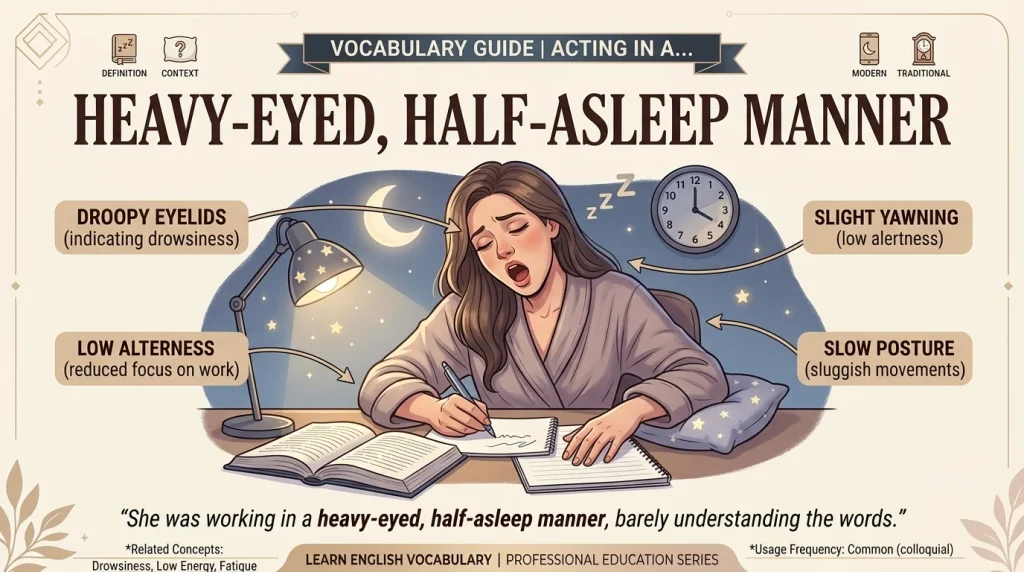
1. Drowsily (Adverb) — US: /ˈdraʊ.zə.li/ | UK: /ˈdraʊ.zɪ.li/
- Meaning: Doing something in a heavy-eyed, half-asleep manner.
- Tone/Register: Neutral / Conversational
- Example 1: She nodded drowsily as the warm fire crackled in the fireplace.
- Example 2: The sleepy toddler leaned drowsily against his mother’s shoulder.
2. Lethargically (Adverb) — US: /ləˈθɑːr.dʒə.kə.li/ | UK: /ləˈθɑː.dʒɪ.kə.li/
- Meaning: Moving or acting with extreme lack of energy, speed, or vitality.
- Tone/Register: Formal / Academic
- Example 1: The hot afternoon sun made everyone move lethargically across the field.
- Example 2: He answered the phone lethargically after staying up all night studying.
3. Sluggishly (Adverb) — US: /ˈslʌɡ.ɪʃ.li/ | UK: /ˈslʌɡ.ɪʃ.li/
- Meaning: Acting or moving far slower than normal due to fatigue or apathy.
- Tone/Register: Neutral / Business / Casual
- Example 1: Traffic moved sluggishly through the thick morning fog.
- Example 2: My brain worked sluggishly before I drank my first cup of coffee.
4. Wearily (Adverb) — US: /ˈwɪr.ə.li/ | UK: /ˈwɪə.rə.li/
- Meaning: Doing an action in a manner that shows deep physical or mental exhaustion.
- Tone/Register: Literary / Expressive
- Example 1: The tired traveler sighed wearily and dropped his heavy bags.
- Example 2: She smiled wearily at her team after finishing the ten-hour shift.
5. Somnolently (Adverb) — US: /ˈsɑːm.nə.lənt.li/ | UK: /ˈsɒm.nə.lənt.li/
- Meaning: Acting in a way that naturally induces or expresses heavy sleepiness.
- Tone/Register: Formal / Literary
- Example 1: The professor spoke somnolently, causing several students to nod off.
- Example 2: The cat stretched somnolently on the warm windowsill.
6. Groggily (Adverb) — US: /ˈɡrɑː.ɡə.li/ | UK: /ˈɡrɒɡ.ɪ.li/
- Meaning: Moving or speaking in a dazed, unsteady way right after waking up.
- Tone/Register: Informal / Conversational
- Example 1: He groggily reached out to turn off his buzzing alarm clock.
- Example 2: She stumbled groggily into the kitchen to make hot tea.
7. Heavy-eyed (Adverb) — US: /ˈhev.i.aɪd.li/ | UK: /ˈhev.i.aɪd.li/
- Meaning: Looking or acting with eyes almost closed from pure exhaustion.
- Tone/Register: Descriptive / Informal
- Example 1: The boy stared heavy-eyed at the television screen late at night.
- Example 2: She looked heavy-eyed at her notes during the midnight study session.
8. Lazily (Adverb) — US: /ˈleɪ.zə.li/ | UK: /ˈleɪ.zɪ.li/
- Meaning: Doing something in a slow, relaxed, and unhurried manner.
- Tone/Register: Casual / Relaxed
- Example 1: The river flowed lazily through the green valley.
- Example 2: He lazily waved to his neighbors while lying in the hammock.
9. Languidly (Adverb) — US: /ˈlæŋ.ɡwɪd.li/ | UK: /ˈlæŋ.ɡwɪd.li/
- Meaning: Moving with slow, graceful, and effortless tiredness.
- Tone/Register: Literary / Elegant
- Example 1: She fan-folded her paper and waved it languidly in the summer heat.
- Example 2: The swimmer moved languidly through the warm pool water.
10. Torpidly (Adverb) — US: /ˈtɔːr.pɪd.li/ | UK: /ˈtɔː.pɪd.li/
- Meaning: Acting in a state of physical or mental inactivity and numbness.
- Tone/Register: Formal / Academic
- Example 1: The hibernating bear moved torpidly inside its dark cave.
- Example 2: The staff worked torpidly during the sultry, humid afternoon.
11. Dreamily (Adverb) — US: /ˈdriː.mə.li/ | UK: /ˈdriː.mɪ.li/
- Meaning: Acting in a pleasant, peaceful, and distracted trance-like state.
- Tone/Register: Literary / Gentle
- Example 1: She gazed dreamily out the window at the falling snow.
- Example 2: The child hummed dreamily while holding her favorite teddy bear.
12. Dazedly (Adverb) — US: /ˈdeɪ.zəd.li/ | UK: /ˈdeɪ.zɪd.li/
- Meaning: Acting in a confused, stunned state caused by fatigue or shock.
- Tone/Register: Neutral / Descriptive
- Example 1: He looked around dazedly after waking up from a long nap.
- Example 2: She stumbled dazedly out of the bright movie theater into the light.
13. Slumberously (Adverb) — US: /ˈslʌm.bər.əs.li/ | UK: /ˈslʌm.bər.əs.li/
- Meaning: Acting in a quiet, heavy manner that suggests deep sleep.
- Tone/Register: Poetic / Literary
- Example 1: The music played slumberously in the background of the quiet room.
- Example 2: He breathed slumberously as he drifted into a peaceful night’s rest.
14. Inactively (Adverb) — US: /ɪnˈæk.tɪv.li/ | UK: /ɪnˈæk.tɪv.li/
- Meaning: Doing something without physical movement, vigor, or dynamic energy.
- Tone/Register: Technical / Neutral
- Example 1: The guard sat inactively at his desk during the slow night shift.
- Example 2: The patient lay inactively in bed waiting for the doctor’s visit.
15. Indolently (Adverb) — US: /ˈɪn.də.lənt.li/ | UK: /ˈɪn.də.lənt.li/
- Meaning: Acting in an excessively lazy, effort-avoiding manner.
- Tone/Register: Literary / Critical
- Example 1: He stretched indolently across the sofa while his roommates cleaned.
- Example 2: The cat groomed itself indolently under the bright morning sun.
16. Listlessly (Adverb) — US: /ˈlɪst.ləs.li/ | UK: /ˈlɪst.ləs.li/
- Meaning: Lacking interest, energy, or enthusiasm for any nearby activity.
- Tone/Register: Emotional / Descriptive
- Example 1: The sick child picked listlessly at his breakfast plate.
- Example 2: She flipped listlessly through the pages of the magazine.
17. Stuporously (Adverb) — US: /ˈstuː.pər.əs.li/ | UK: /ˈstjuː.pər.əs.li/
- Meaning: Acting in a state of near-unconsciousness or extremely dulled senses.
- Tone/Register: Medical / Literary
- Example 1: The exhausted hiker sat stuporously beside the trail to catch his breath.
- Example 2: He answered the doctor’s routine questions stuporously late last night.
18. Slowly (Adverb) — US: /ˈsloʊ.li/ | UK: /ˈsləʊ.li/
- Meaning: Moving or performing an action at a low, deliberate speed.
- Tone/Register: Common / Conversational
- Example 1: She slowly walked toward the door to greet her unexpected visitors.
- Example 2: The old clock ticked slowly in the silent, dark hallway.
19. Unenthusiastically (Adverb) — US: /ˌʌn.ɪn.θuː.ziˈæs.tɪ.kəl.i/ | UK: /ˌʌn.ɪn.θjuː.ziˈæs.tɪ.kəl.i/
- Meaning: Performing a task without genuine interest, joy, or excitement.
- Tone/Register: Professional / Daily
- Example 1: He clapped unenthusiastically after the long speech ended.
- Example 2: The team agreed unenthusiastically to work over the weekend.
20. Passive-like (Adverbial Phrase) — US: /ˈpæs.ɪv.laɪk/ | UK: /ˈpæs.ɪv.laɪk/
- Meaning: Responding to events without offering active physical or mental resistance.
- Tone/Register: Informal / Analytical
- Example 1: She accepted the late schedule changes in a passive-like manner.
- Example 2: The crowd reacted in a passive-like state during the dull presentation.
21. Soporifically (Adverb) — US: /ˌsɑː.pəˈrɪf.ɪ.kəl.i/ | UK: /ˌsɒp.ərˈɪf.ɪ.kəl.i/
- Meaning: In a calm manner that naturally causes heavy boredom or sleepiness.
- Tone/Register: Academic / Formal
- Example 1: The rain tapped soporifically against the bedroom window glass.
- Example 2: The speaker droned on soporifically during the afternoon seminar.
22. Dully (Adverb) — US: /ˈdʌl.li/ | UK: /ˈdʌl.li/
- Meaning: Responding without mental sharpness, brightness, or quick reactions.
- Tone/Register: Neutral / General
- Example 1: His eyes stared dully at the computer monitor after midnight.
- Example 2: She answered the reporter’s questions dully after the long flight.
23. Stolidly (Adverb) — US: /ˈstɑː.lɪd.li/ | UK: /ˈstɒl.ɪd.li/
- Meaning: Showing little to no emotion or physical reaction because of fatigue.
- Tone/Register: Formal / Literary
- Example 1: The guard stood stolidly at his post despite his heavy eyelids.
- Example 2: She listened stolidly to the bad news without blinking an eye.
24. Unawares (Adverb) — US: /ˌʌn.əˈwerz/ | UK: /ˌʌn.əˈweəz/
- Meaning: Caught off guard or in a state of lowered alertness.
- Tone/Register: Literary / Classic
- Example 1: Sleep overtook the tired guard completely unawares.
- Example 2: The sudden noise startled the dazed worker unawares.
25. Comatosely (Adverb) — US: /ˌkoʊ.məˈtoʊs.li/ | UK: /ˌkəʊ.məˈtəʊs.li/
- Meaning: Sleeping so deeply or acting so tiredly that it resembles a coma.
- Tone/Register: Informal / Hyperbolic
- Example 1: He slept comatosely for twelve straight hours after the marathon.
- Example 2: She lay comatosely on the sofa after completing her final exams.
26. Vacantly (Adverb) — US: /ˈveɪ.kənt.li/ | UK: /ˈveɪ.kənt.li/
- Meaning: Staring or acting without any focused thought or mental awareness.
- Tone/Register: Descriptive / Neutral
- Example 1: He stared vacantly out the train window as he fought back sleep.
- Example 2: She smiled vacantly at her colleague, clearly lost in thought.
27. Blankly (Adverb) — US: /ˈblæŋk.li/ | UK: /ˈblæŋk.li/
- Meaning: Looking or responding without showing any expression or understanding.
- Tone/Register: Common / Conversational
- Example 1: The exhausted student stared blankly at the complex math equation.
- Example 2: He blinked blankly when his mom asked him where his shoes were.
28. Noddingly (Adverb) — US: /ˈnɑː.dɪŋ.li/ | UK: /ˈnɒd.ɪŋ.li/
- Meaning: Moving your head up and down repeatedly due to drifting off to sleep.
- Tone/Register: Descriptive / Informal
- Example 1: She sat noddingly in the armchair as the movie played.
- Example 2: The commuter rested noddingly against the window of the bus.
29. Restfully (Adverb) — US: /ˈrest.fəl.i/ | UK: /ˈrest.fəl.i/
- Meaning: Acting in a peaceful, serene, and restorative manner.
- Tone/Register: Positive / Gentle
- Example 1: The baby breathed restfully in her wooden crib.
- Example 2: They spent the Sunday afternoon restfully reading in the garden.
30. Unhurriedly (Adverb) — US: /ʌnˈhɝː.id.li/ | UK: /ʌnˈhʌr.id.li/
- Meaning: Doing something without any rush, anxiety, or stress.
- Tone/Register: Positive / Casual
- Example 1: He walked unhurriedly down the quiet seaside path.
- Example 2: She poured her coffee unhurriedly while watching the sunrise.
31. Brain-foggedly (Adverb) — US: /ˈbreɪn.fɑːɡd.li/ | UK: /ˈbreɪn.fɒɡd.li/
- Meaning: Acting with a confused, unclear mind brought on by lack of sleep.
- Tone/Register: Modern / Casual
- Example 1: He brain-foggedly typed the wrong address into the search bar.
- Example 2: She brain-foggedly poured milk into her cabinet instead of the fridge.
32. Haltingly (Adverb) — US: /ˈhɑːl.tɪŋ.li/ | UK: /ˈhɔːl.tɪŋ.li/
- Meaning: Speaking or moving with frequent pauses due to extreme fatigue.
- Tone/Register: Descriptive / Literary
- Example 1: The weary boy spoke haltingly as he tried to explain his dream.
- Example 2: She walked haltingly across the dark bedroom to find her glasses.
33. Creepily-slow (Adverbial Phrase) — US: /ˈkriː.pə.li.sloʊ/ | UK: /ˈkriː.pɪ.li.sləʊ/
- Meaning: Moving with an unusually eerie, quiet, and sluggish pace.
- Tone/Register: Informal / Narrative
- Example 1: The shadow moved creepily-slow across the dimly lit corridor.
- Example 2: He raised his hand creepily-slow after being awakened suddenly.
34. Yawny (Adjective/Adverbial Context) — US: /ˈjɑː.ni/ | UK: /ˈjɔː.ni/
- Meaning: Showing a strong physical tendency to yawn repeatedly.
- Tone/Register: Informal / Playful
- Example 1: The yawny child rubbed his eyes and asked for a bedtime story.
- Example 2: She gave a yawny response before turning off her bedside lamp.
35. Half-asleep (Adverbial Use) — US: /ˌhæf.əˈsliːp/ | UK: /ˌhɑːf.əˈsliːp/
- Meaning: Being in a state between conscious waking and light sleep.
- Tone/Register: Common / Conversational
- Example 1: He answered his phone half-asleep and barely remembered the call later.
- Example 2: She walked half-asleep down the hall to check on the noise.
36. Half-consciously (Adverb) — US: /ˌhæfˈkɑːn.ʃəs.li/ | UK: /ˌhɑːfˈkɒn.ʃəs.li/
- Meaning: Performing actions with only partial awareness of your surroundings.
- Tone/Register: Neutral / Formal
- Example 1: She half-consciously pulled the blanket over her chilly shoulders.
- Example 2: He half-consciously agreed to the plan before falling back asleep.
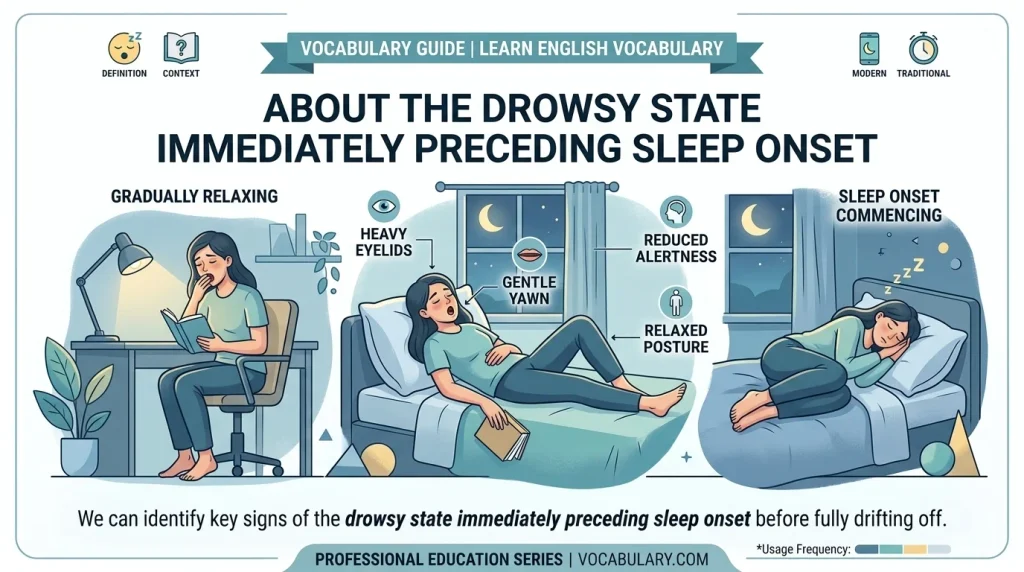
37. Hypnagogically (Adverb) — US: /ˌhɪp.nəˈɡɑː.dʒɪ.kəl.i/ | UK: /ˌhɪp.nəˈɡɒdʒ.ɪ.kəl.i/
- Meaning: About the drowsy state immediately preceding sleep onset.
- Tone/Register: Technical / Academic
- Example 1: She experienced vivid imagery hypnagogically as she drifted off.
- Example 2: He twitched hypnagogically right before falling into deep rest.
38. Dimbly (Adverb) — US: /ˈdɪm.bli/ | UK: /ˈdɪm.bli/
- Meaning: Perceiving or responding with low mental clarity or dim understanding.
- Tone/Register: Literary / Rare
- Example 1: He dimbly remembered leaving his house keys on the kitchen table.
- Example 2: She dimly recognized the song playing softly in the background.
39. Heavy-headed (Adverbial Context) — US: /ˈhev.i.hed.ɪd/ | UK: /ˈhev.i.hed.ɪd/
- Meaning: Feeling physically weighed down by severe tiredness or sinus pressure.
- Tone/Register: Casual / Descriptive
- Example 1: She sat heavy-headed at her desk after catching a sudden cold.
- Example 2: He leaned heavy-headed against the cold glass of the train window.
40. Leadendly (Adverb) — US: /ˈled.ən.li/ | UK: /ˈled.ən.li/
- Meaning: Moving with heavy, slow, and burdensome physical effort.
- Tone/Register: Literary / Dramatic
- Example 1: His feet dragged leadenly across the dirt path after the hike.
- Example 2: She lifted her arms leadenly to fold the remaining laundry.
41. Muzzy-headedly (Adverb) — US: /ˈmʌz.i.hed.ɪd.li/ | UK: /ˈmʌz.i.hed.ɪd.li/
- Meaning: Acting with a confused, muddled brain due to lack of rest.
- Tone/Register: Informal / British
- Example 1: He muzzy-headedly searched for his missing shoe under the bed.
- Example 2: She walked muzzy-headedly into the office after the night flight.
42. Unawakingly (Adverb) — US: /ˌʌn.əˈweɪ.kɪŋ.li/ | UK: /ˌʌn.əˈweɪ.kɪŋ.li/
- Meaning: Remaining in a deep sleep state while performing minor physical movements.
- Tone/Register: Literary / Descriptive
- Example 1: The child rolled over unawakingly when his father entered the room.
- Example 2: She mumbled unawakingly during her midnight dream cycle.
43. Slumberingly (Adverb) — US: /ˈslʌm.bər.ɪŋ.li/ | UK: /ˈslʌm.bər.ɪŋ.li/
- Meaning: Resting or breathing in a state of quiet and deep sleep.
- Tone/Register: Poetic / Formal
- Example 1: The village lay slumberingly under the blanket of fresh white snow.
- Example 2: He rested slumberingly through the thunderstorm last night.
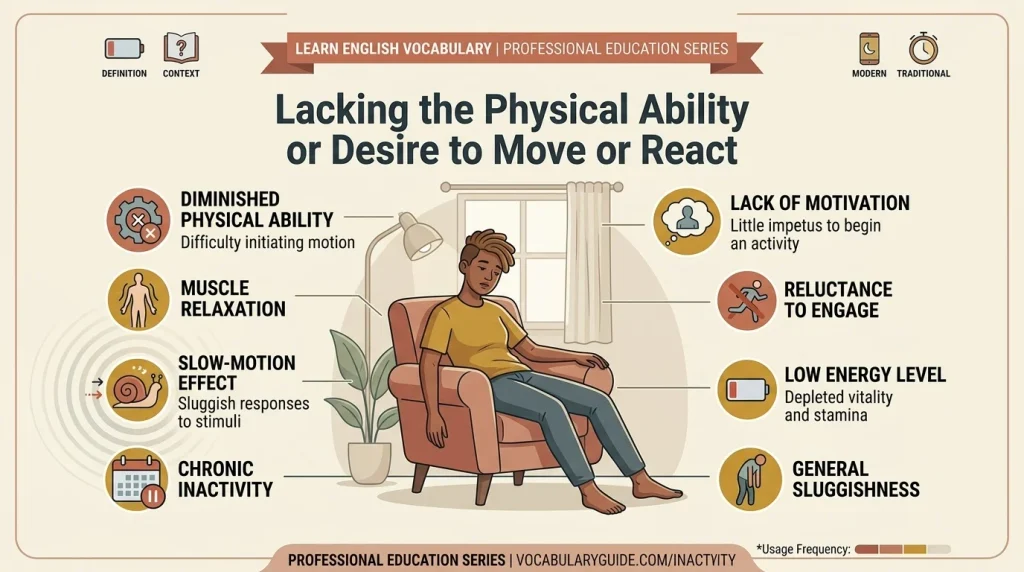
44. Inertly (Adverb) — US: /ɪˈnɝːt.li/ | UK: /ɪˈnɜːt.li/
- Meaning: Lacking the physical ability or desire to move or react.
- Tone/Register: Formal / Objective
- Example 1: He lay inertly on the bed, too exhausted to take off his coat.
- Example 2: The sleepy dog sat inertly beside the quiet fireplace.
45. Dreamfully (Adverb) — US: /ˈdriːm.fəl.i/ | UK: /ˈdriːm.fəl.i/
- Meaning: Acting with a mind full of pleasant imagery and relaxed thoughts.
- Tone/Register: Literary / Positive
- Example 1: She smiled dreamfully while listening to the soft piano music.
- Example 2: He looked out at the ocean waves dreamfully during sunset.
46. Softly (Adverb) — US: /ˈsɑːft.li/ | UK: /ˈsɒft.li/
- Meaning: Speaking or acting with gentle, low, and quiet energy.
- Tone/Register: General / Positive
- Example 1: She spoke softly so she wouldn’t wake her sleeping roommate.
- Example 2: The night breeze blew softly through the open balcony door.
47. Placidly (Adverb) — US: /ˈplæs.ɪd.li/ | UK: /ˈplæs.ɪd.li/
- Meaning: Performing an action in a calm, peaceful, and undisturbed manner.
- Tone/Register: Neutral / Formal
- Example 1: The newborn rested placidly in her mother’s warm arms.
- Example 2: He stared placidly at the quiet lake during his morning walk.
48. Quietly (Adverb) — US: /ˈkwaɪ.ət.li/ | UK: /ˈkwaɪ.ət.li/
- Meaning: Doing something with minimal sound, noise, or disturbance.
- Tone/Register: Common / Everyday
- Example 1: He quietly closed the wooden door behind him as he left.
- Example 2: She quietly read her textbook while waiting for her appointment.
49. Wearisomely (Adverb) — US: /ˈwɪr.i.səm.li/ | UK: /ˈwɪə.rɪ.səm.li/
- Meaning: Acting in a manner that shows or causes exhausting physical boredom.
- Tone/Register: Literary / Formal
- Example 1: He dragged his feet wearisomely along the long dusty highway.
- Example 2: She organized the old paper files wearisomely late in the evening.
50. Relaxedly (Adverb) — US: /rɪˈlæk.səd.li/ | UK: /rɪˈlæks.tli/
- Meaning: Acting free from tension, anxiety, or physical stiffness.
- Tone/Register: Informal / Casual
- Example 1: He sat relaxedly on the porch drinking fresh homemade lemonade.
- Example 2: She chatted relaxedly with her best friends over brunch.
Synonyms for “Sleepily” by Tone
Tone plays a vital role in vocabulary selection. Choosing the correct tone ensures your writing fits your intended audience and context.
Positive Tone
- Restfully, dreamily, placidly, softly, unhurriedly, dreamfully, relaxedly.
- These words create cozy, peaceful, and warm images of rest and comfort.
Neutral Tone
- Drowsily, slowly, half-asleep, groggily, inactively, vacantly, blankly.
- These terms report tiredness objectively without adding praise or criticism.
Negative Tone
- Lethargically, sluggishly, torpidly, indolently, listlessly, wearisomely, stuporously.
- These terms highlight unpleasant slowness, annoying laziness, or severe physical exhaustion.
Playful / Informal Tone
- Muzzy-headedly, brain-foggedly, heavy-eyed, yawny, comatosely.
- These words add personality, humor, and vivid imagery to everyday conversations and casual blog posts.
Mini Comparison
| Feature | Sleepily | Groggily | Lethargically |
| Core Meaning | In a tired or half-asleep state. | Dazed and unsteady right after waking up. | Lacking energy or moving extremely slowly. |
| Tone | Neutral and general. | Informal and conversational. | Formal, medical, or academic. |
| Best Context | Fiction, bedtime stories, daily life. | Morning routines, post-nap confusion. | Sickness, hot weather, extreme fatigue. |
How “Sleepily” Changes by Context
- Daily Conversation: Friends typically use terms like groggily or half-asleep to describe early mornings.
- Blogging & Creative Writing: Authors prefer rich descriptive words like drowsily, languidly, or wearily to set vivid scenes.
- Professional & Academic Tone: Technical reports and formal papers use precise terms such as lethargically, torpidly, or somnolently.
- Casual Storytelling: Humorous posts often use terms like brain-foggedly or comatosely to emphasize fatigue.
Common Mistakes & Native Usage
Misuse Scenarios
- Confusing groggily with sleepily: Use groggily specifically when someone is dazed right after waking up. Use sleepily before sleeping or during general tiredness.
- Using formal terms in casual talk: Saying “I walked torpidly to get cereal” sounds unnatural in modern dialogue. Stick to groggily or sluggishly.
- Overusing basic adverbs: Overusing “sleepily” in fiction makes descriptive writing feel repetitive. Vary your choice using semantic alternatives.
Real-Life Mini Scenarios
- Workplace: Arriving at a 7:00 AM meeting and answering questions sluggishly before your morning coffee takes effect.
- Social Situations: Waving groggily to your roommate while brewing tea in your pajamas.
- Media & Storytelling: A narrator describing a tired puppy blinking drowsily next to a roaring fireplace.
- Writing & Essays: Describing historical troops marching wearily across muddy fields after a grueling battle.
Interactive Practice Quiz
Test your understanding of these vocabulary nuances with the following practical scenarios.
MCQs 1–10
- Which word is closest in meaning to sleepily?
A) Drowsily
B) Energetically
C) Quickly
D) Loudly - What does sleepily mean?
A) In a tired or drowsy manner
B) In an excited manner
C) In an angry manner
D) In a cheerful manner - Which synonym best fits “She spoke sleepily”?
A) Drowsily
B) Excitedly
C) Confidently
D) Rapidly - Which word can replace sleepily in “He looked sleepily at the clock”?
A) Lazily
B) Energetically
C) Eagerly
D) Carefully - Which synonym describes someone who feels ready to sleep?
A) Drowsily
B) Actively
C) Briskly
D) Cheerfully - Which word is closest to sleepily?
A) Wearily
B) Vigorously
C) Happily
D) Suddenly - In “The child answered sleepily,” the child answered:
A) In a drowsy way
B) In an excited way
C) In a noisy way
D) In a confident way - Which word is least similar to sleepily?
A) Drowsily
B) Wearily
C) Groggily
D) Energetically - Which synonym best describes a person acting with little energy because they feel tired?
A) Languidly
B) Excitedly
C) Vigorously
D) Swiftly - Which word can describe speaking in a tired, sleepy manner?
A) Drowsily
B) Forcefully
C) Enthusiastically
D) Cheerfully
MCQs 11–20
- Which synonym for sleepily means “in a groggy manner”?
A) Groggily
B) Briskly
C) Sharply
D) Actively - What is the best synonym for sleepily in “He yawned sleepily”?
A) Drowsily
B) Excitedly
C) Nervously
D) Quickly - Which word suggests tiredness and a lack of energy?
A) Wearily
B) Energetically
C) Eagerly
D) Lively - Which sentence uses sleepily correctly?
A) She sleepily rubbed her eyes.
B) She sleepily ran a marathon with great energy.
C) He sleepily shouted with excitement.
D) They sleepily celebrated with great enthusiasm. - Which word is closest to sleepily when someone has just woken up?
A) Groggily
B) Briskly
C) Cheerfully
D) Rapidly - Which synonym means “in a tired and relaxed manner”?
A) Languidly
B) Energetically
C) Hastily
D) Excitedly - “He walked sleepily toward the bedroom” suggests that he walked:
A) In a drowsy manner
B) With great excitement
C) Very aggressively
D) With complete confidence - Which option is a suitable synonym for sleepily?
A) Drowsily
B) Vigorously
C) Enthusiastically
D) Alertly - Which word best describes someone who is barely awake?
A) Sleepy
B) Energetic
C) Alert
D) Lively - Which pair contains synonyms related to sleepily?
A) Drowsily — Groggily
B) Quickly — Rapidly
C) Happily — Joyfully
D) Angrily — Furiously
Answer Key
- A
- A
- A
- A
- A
- A
- A
- D
- A
- A
- A
- A
- A
- A
- A
- A
- A
- A
- A
- A
Frequently Asked Questions
1. What is the most common synonym for sleepily in daily English?
The most common everyday synonyms for sleepily are drowsily and groggily. Drowsily works best when describing someone about to fall asleep, while groggily best describes someone who has just woken up and still feels dazed.
2. Is there a distinction between groggily and sleepily?
Yes, there is a subtle difference. Sleepily is a general term for being tired or ready for rest. Groggily specifically implies a dazed, clumsy state experienced right after waking up unexpectedly or sleeping poorly.
3. Can I use lethargically instead of sleepily in formal essays?
Yes, lethargically is an excellent formal alternative. It describes a slow, energy-depleted state suitable for academic writing, professional reports, and scientific contexts where “sleepily” might sound too informal.
4. Which synonym for sleepily best fits creative fiction writing?
Descriptive words like languidly, somnolently, and wearily work wonderfully in fiction. They allow authors to set mood, convey deep physical tiredness, and build atmospheric narrative scenes smoothly.
5. How does expanding my vocabulary with adverbs improve SEO writing?
Using semantic variations prevents keyword stuffing, improves content readability, and aligns with Google AI search intent. It helps engines understand topic depth while providing a better user experience for human readers.
Conclusion
Expanding your vocabulary with precise adverbs elevates your daily communication, academic writing, and digital content creation. Replacing overused words with rich vocabulary options allows you to express exact emotions and vivid physical states effortlessly.
Applying these precise vocabulary choices in daily emails, personal essays, and blog posts will make your voice sound more natural and authoritative. Consistent practice turns unfamiliar vocabulary into a permanent part of your natural speaking style.
Start using these expressive options today in your creative writing to engage your audience and master natural English expression. Check out our comprehensive guide on synonyms for sleepily to continue strengthening your writing skills!

Samia Noor is the founder and lead writer at SynonymGenius.com, where she creates accurate, reader-focused English language content that helps people communicate with clarity and confidence. She specializes in synonyms, antonyms, word meanings, idioms, and practical vocabulary guides that make complex language concepts simple and easy to understand. Every article is thoroughly researched, carefully fact-checked, and written in clear, accessible language using reliable sources and real-world examples. Her mission is to provide trustworthy, high-quality content that supports students, writers, educators, professionals, and English learners at every stage of their language journey.
Her editorial approach emphasizes accuracy, transparency, and genuine value for readers while following modern E-E-A-T and content quality standards. She regularly reviews and updates published content to ensure it remains current, reliable, and easy to understand. Through SynonymGenius.com, Samia Noor is committed to publishing dependable language resources that help readers expand their vocabulary, strengthen their writing skills, improve communication, and build confidence in academic, professional, and everyday English.