
Synonyms for social interaction can instantly refresh your daily vocabulary. Imagine sitting at a networking event or a family dinner, trying to describe a lively chat without repeating the exact same phrase over and over again.
Using varied expressions makes your speaking and writing far more dynamic. For instance, replacing a basic phrase with terms like “networking” or “communion” gives your sentences precision and flair in every professional or personal setting.
Synonyms for social interaction are commonly used because human connection is central to daily life. Students, bloggers, content writers, and ESL learners rely on these variants to sound natural, avoid repetitive phrasing, and match exact emotional tones.
What Does “Social Interaction” Really Mean?
Social interaction refers to any direct or indirect communication, exchange, or shared activity between two or more people. Native English speakers understand it as an overarching concept covering everything from casual chit-chat on the street to formal corporate summits.
The phrase functions as a noun phrase. It carries a neutral emotional tone, meaning its exact sentiment depends on context.
Connotative Meaning
Connotation is the emotional feeling or cultural association attached to a word beyond its literal definition.
- Positive tone: Expresses warm connection, team bonding, or friendly engagement.
- Negative tone: Suggests unwelcome friction, awkward exchanges, or forced socializing.
- Neutral tone: Denotes plain communication or objective human contact without emotion.
Etymology
- Social: Derived from Latin socialis (“companionable” or “allied”), from socius (“companion”).
- Interaction: Formed from the Latin prefix inter- (“between”) and agere (“to do” or “to drive”).
- Old English (450–1100): Early Germanic terms like geferscipe described companionship, as Latin roots had not yet entered common speech.
- Middle English (1100–1500): French influence introduced words based on social, evolving into concepts of community and fellowship.
- Modern English (1500–Present): The specific combination emerged during the rise of sociology in the late 19th and early 20th centuries to describe interpersonal dynamics.
Pronunciation & Syllables
- US: /ˈsoʊ.ʃəl ˌɪn.tɚˈæk.ʃən/
- UK: /ˈsəʊ.ʃəl ˌɪn.tərˈæk.ʃən/
- Syllables: so-cial in-ter-ac-tion
Root & Affixation Pattern
- Social: Root = soci (companion); Suffix = -al (relating to).
- Interaction: Prefix = inter- (between); Root = act (do); Suffix = -ion (process/state).
Synonyms List
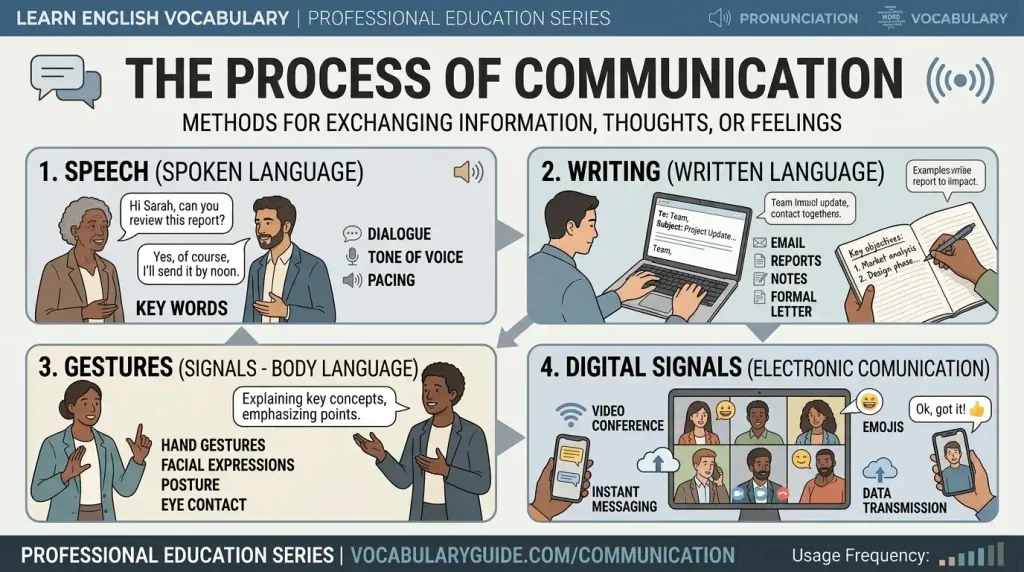
1. Communication (Noun) — US: /kəˌmjuː.nəˈkeɪ.ʃən/ | UK: /kəˌmjuː.nɪˈkeɪ.ʃən/
Meaning: The process of exchanging information, thoughts, or feelings through speech, writing, or signals.
Tone/Register: Neutral / General Professional
- Clear communication prevents misunderstandings among team members.
- Digital tools have altered daily communication between remote workers.
2. Conversation (Noun) — US: /ˌkɑːn.vɚˈseɪ.ʃən/ | UK: /ˌkɒn.vəˈseɪ.ʃən/
Meaning: An informal spoken exchange of news, ideas, and thoughts between people.
Tone/Register: Neutral / Conversational
- We had a long conversation about future career goals.
- A friendly conversation can brighten someone’s morning commute.
3. Contact (Noun) — US: /ˈkɑːn.tækt/ | UK: /ˈkɒn.tækt/
Meaning: Physical touching or state of communication between individuals or groups.
Tone/Register: Neutral / General
- Maintain regular contact with key clients throughout the month.
- Eye contact plays a vital role during job interviews.
4. Engagement (Noun) — US: /ɪnˈɡeɪdʒ.mənt/ | UK: /ɪnˈɡeɪdʒ.mənt/
Meaning: Active involvement or meaningful interaction with other people.
Tone/Register: Formal / Business
- Employee engagement increased after the new policy was implemented.
- Civic engagement strengthens community ties over time.
5. Dialogue (Noun) — US: /ˈdaɪ.ə.lɑːɡ/ | UK: /ˈdaɪ.ə.lɒɡ/
Meaning: A formal discussion between two or more people or political groups.
Tone/Register: Formal / Academic
- The leaders opened a constructive dialogue to resolve differences.
- Open dialogue is essential for resolving internal conflicts.
6. Fellowship (Noun) — US: /ˈfel.oʊ.ʃɪp/ | UK: /ˈfel.əʊ.ʃɪp/
Meaning: Friendly association among people who share common interests.
Tone/Register: Warm / Traditional
- Members enjoyed warm fellowship during the annual conference.
- Shared meals build strong fellowship within local clubs.
7. Intercourse (Noun) — US: /ˈɪn.t̬ɚ.kɔːrs/ | UK: /ˈɪn.tə.kɔːs/
Meaning: Formal communication or dealings between individuals, groups, or nations.
Tone/Register: Formal / Literary
- Commercial intercourse between the two nations expanded rapidly.
- Social intercourse requires mutual respect and understanding.
8. Networking (Noun) — US: /ˈnet.wɝː.kɪŋ/ | UK: /ˈnet.wɜː.kɪŋ/
Meaning: The act of meeting people to exchange information and form professional relationships.
Tone/Register: Professional / Business
- Effective networking helps professionals uncover hidden job openings.
- The conference provided excellent networking opportunities.
9. Association (Noun) — US: /əˌsoʊ.siˈeɪ.ʃən/ | UK: /əˌsəʊ.siˈeɪ.ʃən/
Meaning: A connection or cooperative partnership formed between people or organizations.
Tone/Register: Formal / General
- Long association with colleagues leads to lasting friendships.
- Close association with mentors accelerates professional growth.
10. Connection (Noun) — US: /kəˈnek.ʃən/ | UK: /kəˈnek.ʃən/
Meaning: A feeling of understanding, trust, and shared bond between individuals.
Tone/Register: Warm / Personal
- They felt an immediate connection during their first meeting.
- Strong human connection boosts personal mental health.
11. Relations (Noun) — US: /rɪˈleɪ.ʃənz/ | UK: /rɪˈleɪ.ʃənz/
Meaning: How two or more people or groups act toward each other.
Tone/Register: Formal / Official
- Diplomatic relations improved after the bilateral summit.
- Good employee relations build high workplace morale.
12. Exchange (Noun) — US: /ɪksˈtʃeɪndʒ/ | UK: /ɪksˈtʃeɪndʒ/
Meaning: A conversation or trade of ideas, comments, or information.
Tone/Register: Neutral / Academic
- We had a brief exchange of views after the presentation.
- Cultural exchange programs broaden students’ perspectives.
13. Rapport (Noun) — US: /ræpˈɔːr/ | UK: /ræpˈɔː/
Meaning: A close and harmonious relationship based on mutual understanding.
Tone/Register: Professional / Psychological
- Sales representatives must build quick rapport with clients.
- Teachers work hard to establish rapport with new classes.
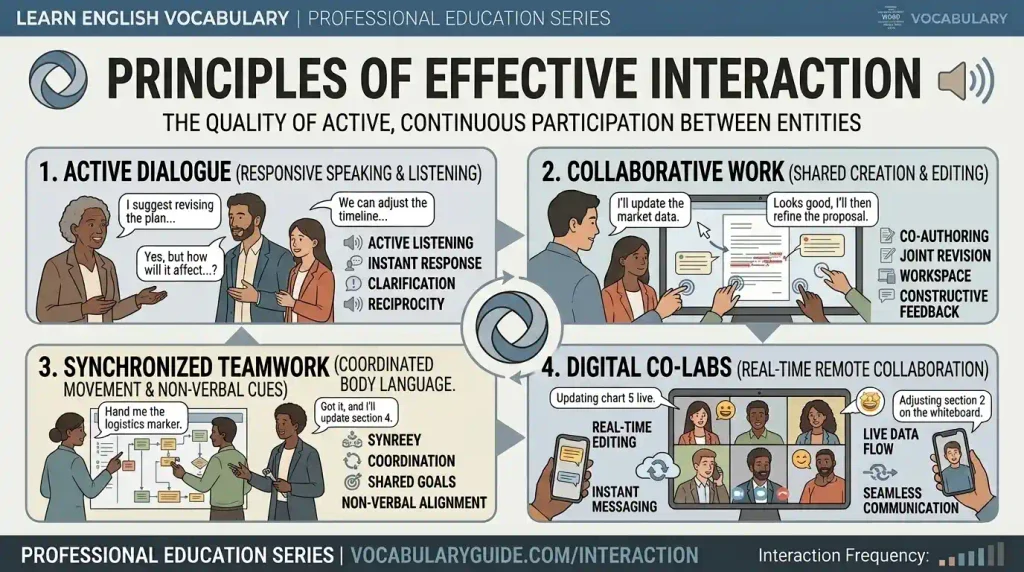
14. Interactivity (Noun) — US: /ˌɪn.t̬ɚ.ækˈtɪv.ə.t̬i/ | UK: /ˌɪn.tər.ækˈtɪv.ə.ti/
Meaning: The state or quality of involving active continuous participation between entities.
Tone/Register: Modern / Educational
- High interactivity makes online workshops far more engaging.
- Classroom interactivity improves student focus and retention.
15. Communion (Noun) — US: /kəˈmjuː.njən/ | UK: /kəˈmjuː.njən/
Meaning: The sharing of intimate thoughts and feelings at a deep spiritual or mental level.
Tone/Register: Elevated / Literary
- Quiet walks offer deep communion with nature and friends.
- They shared a moment of silent communion after the loss.
16. Discourse (Noun) — US: /ˈdɪs.kɔːrs/ | UK: /ˈdɪs.kɔːs/
Meaning: Written or spoken communication, debate, or discussion in academic or formal settings.
Tone/Register: Academic / Formal
- Public discourse should remain respectful and evidence-based.
- Scholarly discourse shapes future educational policy.
17. Collaboration (Noun) — US: /kəˌlæb.əˈreɪ.ʃən/ | UK: /kəˌlæb.əˈreɪ.ʃən/
Meaning: Working jointly with others to achieve a shared goal or create something.
Tone/Register: Business / Professional
- Cross-departmental collaboration produces innovative product ideas.
- Successful collaboration demands clear project responsibilities.
18. Socializing (Noun) — US: /ˈsoʊ.ʃə.laɪ.zɪŋ/ | UK: /ˈsəʊ.ʃə.laɪ.zɪŋ/
Meaning: Spending time enjoying informal recreational activities with other people.
Tone/Register: Informal / Casual
- Weekend socializing helps workers unwind after stressful shifts.
- Moderate socializing prevents feelings of isolation.
19. Camaraderie (Noun) — US: /ˌkɑːm.rɑːˈdɚ.i/ | UK: /ˌkæm.əˈrɑː.dər.i/
Meaning: Mutual trust and friendship built among people who spend significant time together.
Tone/Register: Warm / Informal
- Team sports foster strong camaraderie among players.
- Shared challenges create deep office camaraderie.
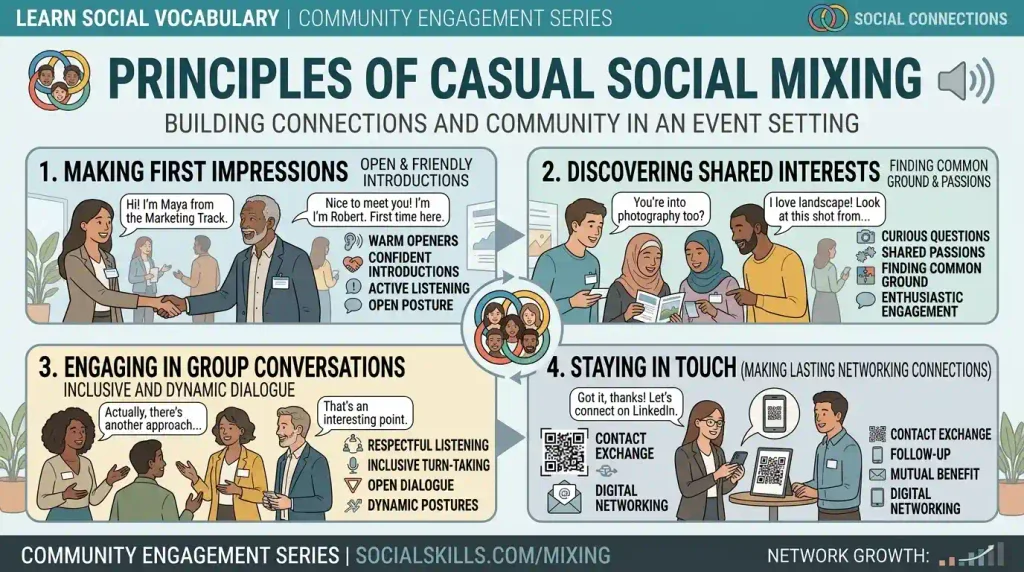
20. Mix (Noun) — US: /mɪks/ | UK: /mɪks/
Meaning: The process of gathering together, mingling, and interacting socially.
Tone/Register: Informal / Casual
- The evening event offered a pleasant mix of personalities.
- Holiday parties provide a good social mix for colleagues.
21. Mingling (Noun) — US: /ˈmɪŋ.ɡəl.ɪŋ/ | UK: /ˈmɪŋ.ɡəl.ɪŋ/
Meaning: Moving among people at a social gathering and conversing with them.
Tone/Register: Light / Social
- Event organizers encouraged active mingling during cocktail hour.
- Conscious mingling helps shy guests feel comfortable.
22. Interdependence (Noun) — US: /ˌɪn.t̬ɚ.dɪˈpen.dəns/ | UK: /ˌɪn.tər.dɪˈpen.dəns/
Meaning: Mutual reliance and shared interaction between two or more parties.
Tone/Register: Academic / Technical
- Modern economies display high global interdependence.
- Teamwork highlights the natural interdependence of workers.
23. Reciprocity (Noun) — US: /ˌres.əˈprɑː.sə.t̬i/ | UK: /ˌres.ɪˈprɒs.ə.ti/
Meaning: A mutual, balanced exchange of privileges, responses, or social actions.
Tone/Register: Academic / Formal
- Healthy friendships require emotional reciprocity over time.
- Social reciprocity encourages shared support networks.
24. Interactivity (Noun) — US: /ˌɪn.t̬ɚ.ækˈtɪv.ə.t̬i/ | UK: /ˌɪn.tər.ækˈtɪv.ə.ti/
Meaning: Direct dynamic participation between people in group settings.
Tone/Register: Modern / Technical
- Modern software design prioritizes user interactivity.
- Team interactivity keeps training sessions lively.
25. Togetherness (Noun) — US: /təˈɡeð.ɚ.nəs/ | UK: /təˈɡeð.ə.nəs/
Meaning: The warm state of being close and connected with other people.
Tone/Register: Warm / Emotional
- Family holidays celebrate love and togetherness.
- Community meals create a real sense of togetherness.
26. Companionship (Noun) — US: /kəmˈpæn.jən.ʃɪp/ | UK: /kəmˈpæn.jən.ʃɪp/
Meaning: The enjoyable state of having someone else near to share time with.
Tone/Register: Warm / Personal
- Older benefit greatly from regular companionship.
- Pets provide comfort and daily companionship.
27. Teamwork (Noun) — US: /ˈtiːm.wɝːk/ | UK: /ˈtiːm.wɜːk/
Meaning: The combined, interactive effort of a group to achieve a common purpose.
Tone/Register: Professional / General
- Exceptional teamwork delivered the project before the deadline.
- Great teamwork requires clear roles and honest communication.
28. Parley (Noun) — US: /ˈpɑːr.li/ | UK: /ˈpɑː.li/
Meaning: A meeting between opposing sides to discuss terms of agreement.
Tone/Register: Formal / Historical
- Leaders called a brief parley to pause active conflict.
- The union held a parley with executives today.
29. Colloquy (Noun) — US: /ˈkɑː.lə.kwi/ | UK: /ˈkɒl.ə.kwi/
Meaning: A high-level formal conversation or academic conference.
Tone/Register: Formal / Literary
- Legal scholars held a colloquy on privacy rights.
- The conference concluded with a debate colloquy.
30. Gathering (Noun) — US: /ˈɡæð.ɚ.ɪŋ/ | UK: /ˈɡæð.ər.ɪŋ/
Meaning: An assembly or collection of people for social or purpose-driven reasons.
Tone/Register: General / Casual
- The neighborhood is hosting a weekend gathering outdoors.
- Annual family gatherings keep cousins connected.
31. Assembly (Noun) — US: /əˈsem.bli/ | UK: /əˈsem.bli/
Meaning: A group of people gathered together in one place for a common purpose.
Tone/Register: Formal / Institutional
- Students entered the hall for the morning assembly.
- The general assembly voted on the proposed policy changes.
32. Meet-up (Noun) — US: /ˈmiːt.ʌp/ | UK: /ˈmiːt.ʌp/
Meaning: An informal social meeting organized for group discussion or shared interests.
Tone/Register: Informal / Modern
- Local developers organized a weekly coding meet-up.
- The outdoor meet-up attracted dozens of new members.
33. Conclave (Noun) — US: /ˈkɑːn.kleɪv/ | UK: /ˈkɒn.kleɪv/
Meaning: A private, confidential, or secret meeting of individuals.
Tone/Register: Formal / Official
- Corporate executives held a conclave to finalize the merger.
- The political party called an urgent conclave tonight.
34. Huddle (Noun) — US: /ˈhʌd.əl/ | UK: /ˈhʌd.əl/
Meaning: A quick, close gathering of people to confer or plan strategy.
Tone/Register: Business / Sports
- The software team joined a brief morning huddle.
- Players formed a tight huddle before the final play.
35. Convergence (Noun) — US: /kənˈvɝː.dʒəns/ | UK: /kənˈvɜː.dʒəns/
Meaning: The act of people coming together from different directions to meet.
Tone/Register: Academic / Formal
- The festival saw a convergence of artists worldwide.
- Industry leaders marked the convergence of tech standards.
36. Interplay (Noun) — US: /ˈɪn.t̬ɚ.pleɪ/ | UK: /ˈɪn.tə.pleɪ/
Meaning: The dynamic, reciprocal action and influence between distinct individuals or factors.
Tone/Register: Analytical / Academic
- Group dynamics depend on the interplay between members.
- The script shows dynamic interplay between two lead roles.
37. Union (Noun) — US: /ˈjuː.njən/ | UK: /ˈjuː.njən/
Meaning: The act of joining together or state of being united in a shared arrangement.
Tone/Register: Formal / Official
- The voluntary union of communities improved local infrastructure.
- Marriage represents a personal union between individuals.
38. Symbiosis (Noun) — US: /ˌsɪm.baɪˈoʊ.sɪs/ | UK: /ˌsɪm.baɪˈəʊ.sɪs/
Meaning: A mutually beneficial relationship or interaction between different people or groups.
Tone/Register: Academic / Metaphorical
- Mentors and apprentices share a productive symbiosis.
- Small businesses maintain an economic symbiosis in towns.
39. Coexistence (Noun) — US: /ˌkoʊ.ɪɡˈzɪs.təns/ | UK: /ˌkəʊ.ɪɡˈzɪs.təns/
Meaning: Living or existing peacefully together in the same space or time.
Tone/Register: Formal / Diplomatic
- Peaceful coexistence requires tolerance and mutual respect.
- Urban development depends on harmonious coexistence with nature.
40. Interactionism (Noun) — US: /ˌɪn.t̬ɚˈæk.ʃə.nɪz.əm/ | UK: /ˌɪn.tərˈæk.ʃən.ɪz.əm/
Meaning: A theoretical perspective focused on mutual social actions and individual behavior.
Tone/Register: Academic / Scientific
- Symbolic interactionism explains how society builds shared meaning.
- Researchers used interactionism to analyze workplace culture.
41. Interface (Noun) — US: /ˈɪn.t̬ɚ.feɪs/ | UK: /ˈɪn.tə.feɪs/
Meaning: A point where two independent groups or systems meet and interact.
Tone/Register: Technical / Professional
- Human-resource leaders interface directly with employees.
- Science acts as an interface between discovery and society.
42. Chit-chat (Noun) — US: /ˈtʃɪt.tʃæt/ | UK: /ˈtʃɪt.tʃæt/
Meaning: Inconsequential, lighthearted, or casual conversation.
Tone/Register: Informal / Casual
- They engaged in friendly chit-chat while waiting for the train.
- Cut the chit-chat and begin the agenda items.
43. Small Talk (Noun) — US: /ˈsmɑːl ˌtɑːk/ | UK: /ˈsmɔːl ˌtɔːk/
Meaning: Polite conversation about unimportant or everyday matters.
Tone/Register: Informal / Social
- Making small talk at parties helps break the ice.
- Weather is a popular topic for casual small talk.
44. Socializing (Noun) — US: /ˈsoʊ.ʃə.laɪ.zɪŋ/ | UK: /ˈsəʊ.ʃə.laɪ.zɪŋ/
Meaning: Participation in group events designed for recreational enjoyment.
Tone/Register: Informal / General
- Regular socializing boosts emotional health in adults.
- She schedules socializing time with friends weekly.
45. Palaver (Noun) — US: /pəˈlæv.ɚ/ | UK: /pəˈlɑː.və/
Meaning: A protracted, unnecessarily prolonged negotiation or discussion.
Tone/Register: Informal / Slightly Negative
- Avoid all the palaver and make a firm decision.
- Organizing the trip turned into a massive palaver.
46. Interview (Noun) — US: /ˈɪn.t̬ɚ.vjuː/ | UK: /ˈɪn.tə.vjuː/
Meaning: A structured, formal interaction where questions are asked and answered.
Tone/Register: Professional / Official
- She prepared thoroughly for her media interview.
- The exit interview provided clear operational insights.
47. Powwow (Noun) — US: /ˈpaʊ.waʊ/ | UK: /ˈpaʊ.waʊ/
Meaning: An informal meeting or conference for discussion or decision-making.
Tone/Register: Informal / Colloquial
- Managers held a quick powwow to reset priorities.
- We need a team powwow before the client presentation.
48. Consultation (Noun) — US: /ˌkɑːn.səlˈteɪ.ʃən/ | UK: /ˌkɒn.səlˈteɪ.ʃən/
Meaning: A formal meeting to seek expert advice, discuss plans, or exchange opinions.
Tone/Register: Formal / Professional
- The patient booked a specialist consultation.
- Public consultation preceded the new zoning law.
49. Round-table (Noun) — US: /ˈraʊndˌteɪ.bəl/ | UK: /ˈraʊndˌteɪ.bəl/
Meaning: An assembly where participants converse and deliberate on equal terms.
Tone/Register: Business / Academic
- Experts participated in a round-table on climate change.
- The round-table yielded actionable community solutions.
50. Session (Noun) — US: /ˈseʃ.ən/ | UK: /ˈseʃ.ən/
Meaning: A period devoted to a particular activity or group interaction.
Tone/Register: Professional / Educational
- The coaching session helped improve public speaking skills.
- Today’s brainstorming session generated dozens of novel concepts.
51. Symposium (Noun) — US: /sɪmˈpoʊ.zi.əm/ | UK: /sɪmˈpəʊ.zi.əm/
Meaning: A formal conference where experts discuss a specific academic topic.
Tone/Register: Academic / Highly Formal
- The medical symposium highlighted recent oncology research.
- Universities hosted an international symposium on linguistics.
52. Dealings (Noun) — US: /ˈdiː.lɪŋz/ | UK: /ˈdiː.lɪŋz/
Meaning: Regular business, commercial, or personal relations between people.
Tone/Register: Professional / Formal
- Transparency is crucial in all financial dealings.
- Honest dealings build long-term business partnerships.
53. Summit (Noun) — US: /ˈsʌm.ɪt/ | UK: /ˈsʌm.ɪt/
Meaning: A formal conference between heads of government or major organizational leaders.
Tone/Register: Formal / Political
- World leaders assembled for the annual economic summit.
- The tech summit showcased breakthroughs in artificial intelligence.
54. Forum (Noun) — US: /ˈfɔːr.əm/ | UK: /ˈfɔː.rəm/
Meaning: A public medium or meeting place for open exchange of ideas.
Tone/Register: General / Professional
- Online forums allow users to discuss common hobbies.
- Community leaders hosted an open public forum tonight.
55. Briefing (Noun) — US: /ˈbriː.fɪŋ/ | UK: /ˈbriː.fɪŋ/
Meaning: A meeting for giving clear, concise information or instructions.
Tone/Register: Business / Military
- The captain delivered a quick security briefing.
- Reporters attended a press briefing at City Hall.
56. Consultation (Noun) — US: /ˌkɑːn.səlˈteɪ.ʃən/ | UK: /ˌkɒn.səlˈteɪ.ʃən/
Meaning: Advisory interactions held to reach expert conclusions.
Tone/Register: Formal / Technical
- Ongoing consultation ensures project compliance with regulation.
- Legal consultation clarified contractual details for partners.
57. Exchange (Noun) — US: /ɪksˈtʃeɪndʒ/ | UK: /ɪksˈtʃeɪndʒ/
Meaning: Reciprocal communication or sharing between two parties.
Tone/Register: Neutral / Formal
- Their quick exchange resolved minor scheduling issues.
- Academic exchange enriches research across global faculties.
58. Rapport (Noun) — US: /ræpˈɔːr/ | UK: /ræpˈɔː/
Meaning: Harmonious mutual connection established through positive interactions.
Tone/Register: Professional / Social
- Establishing initial rapport calms anxious new clients.
- Strong rapport makes group projects far smoother.
59. Deliberation (Noun) — US: /dɪˌlɪb.əˈreɪ.ʃən/ | UK: /dɪˌlɪb.əˈreɪ.ʃən/
Meaning: Careful, formal consideration and discussion of options before deciding.
Tone/Register: Formal / Legal
- Jury deliberation took hours before reaching consensus.
- Strategic deliberation protects companies from unnecessary market risks.
60. Negotiation (Noun) — US: /nəˌɡoʊ.ʃiˈeɪ.ʃən/ | UK: /nəˌɡəʊ.ʃiˈeɪ.ʃən/
Meaning: Discussion aimed at reaching an agreement between differing parties.
Tone/Register: Formal / Business
- Contract negotiation requires clear concessions from both sides.
- Peaceful negotiation resolved trade disputes without tariffs.
61. Panel (Noun) — US: /ˈpæn.əl/ | UK: /ˈpæn.əl/
Meaning: A small group of people gathered to discuss topics before an audience.
Tone/Register: Professional / Educational
- Industry specialists joined a panel on clean energy.
- The Q&A panel answered questions from audience members.
62. Interview (Noun) — US: /ˈɪn.t̬ɚ.vjuː/ | UK: /ˈɪn.tə.vjuː/
Meaning: Standardized communicative interaction designed to gather personal data.
Tone/Register: Professional / Media
- Journalists conduct live interviews with elected leaders.
- Job applicants undergo rigorous behavioral interview steps.
63. Reunion (Noun) — US: /riːˈjuː.njən/ | UK: /riːˈjuː.njən/
Meaning: A gathering of people who have not seen each other for a time.
Tone/Register: Warm / Social
- A high school reunion brings old friends together again.
- The family reunion hosted fifty relatives this summer.
64. Socializing (Noun) — US: /ˈsoʊ.ʃə.laɪ.zɪŋ/ | UK: /ˈsəʊ.ʃə.laɪ.zɪŋ/
Meaning: Interpersonal engagement aimed at developing personal networks.
Tone/Register: General / Casual
- Healthy socializing improves individual mood and wellbeing.
- Frequent socializing builds open community relationships.
65. Rapport (Noun) — US: /ræpˈɔːr/ | UK: /ræpˈɔː/
Meaning: Positive interpersonal connection created through shared empathy.
Tone/Register: Professional / Personal
- Instructors cultivate rapport to improve learning environments.
- Friendly rapport creates loyal customer relationships.
66. Mingle (Noun) — US: /ˈmɪŋ.ɡəl/ | UK: /ˈmɪŋ.ɡəl/
Meaning: Casual social mixing among diverse attendees at an event.
Tone/Register: Casual / Informal
- Take time to mingle with guests during dinner.
- The single mingle party helped people meet effortlessly.
67. Banter (Noun) — US: /ˈbæn.t̬ɚ/ | UK: /ˈbæn.tə/
Meaning: Playful, witty, and lighthearted teasing remarks exchanged between friends.
Tone/Register: Casual / Friendly
- Good-natured banter kept the long drive entertaining.
- Friendly banter makes office environments feel comfortable.
68. Conversation (Noun) — US: /ˌkɑːn.vɚˈseɪ.ʃən/ | UK: /ˌkɒn.vəˈseɪ.ʃən/
Meaning: Standard verbal exchange between daily speakers.
Tone/Register: General / Neutral
- A quiet conversation helped them resolve misunderstandings.
- Daily conversation builds language fluency for learners.
69. Engagement (Noun) — US: /ɪnˈɡeɪdʒ.mənt/ | UK: /ɪnˈɡeɪdʒ.mənt/
Meaning: Sustained active attention and participation within social circles.
Tone/Register: Professional / Business
- User engagement increased following system updates.
- High audience engagement shows strong presentation quality.
70. Connection (Noun) — US: /kəˈnek.ʃən/ | UK: /kəˈnek.ʃən/
Meaning: Deep psychological or emotional alignment shared between individuals.
Tone/Register: Personal / Warm
- Authentic connection relies on mutual trust and honesty.
- Shared goals create an instant connection between colleagues.
Synonyms for “Social Interaction” by Tone
Selecting the correct tone ensures your vocabulary matches your setting. Using an overly academic word during casual conversations sounds rigid, while casual slang undermines professional credibility.
Positive Tone
Words like fellowship, rapport, camaraderie, and togetherness express warmth, shared trust, and uplifting human connections.
Neutral Tone
Terms such as contact, communication, exchange, and discourse describe social contact factually without expressing emotional sentiment.
Negative Tone
Phrases like palaver, clash, or friction indicate stressful, tedious, or unwelcome social exchanges.
Playful or Informal Tone
Expressions like chit-chat, small talk, banter, and powwow fit relaxed, casual conversations with peers and friends.
“Social Interaction” vs. Close Alternatives
Here is how “Social Interaction” compares to its closest synonyms:
- Social Interaction
- Core Meaning: Broad term covering all forms of contact between individuals.
- Tone: Neutral / Formal
- Best Context: Scientific writing, sociological studies, and general educational articles.
- Communication
- Core Meaning: The act of transmitting or exchanging information.
- Tone: Neutral / General
- Best Context: Business emails, workplace instructions, and technical guides.
- Socializing
- Core Meaning: Engaging in group activities specifically for personal enjoyment.
- Tone: Informal / Warm
- Best Context: Casual plans, weekend activities, and personal lifestyle blogs.
Key Nuances
- Social Interaction vs. Communication: Social interaction requires mutual presence or dynamic action, whereas communication can be one-way (like reading a sign or listening to a broadcast).
- Social Interaction vs. Socializing: Social interaction includes formal, serious, or neutral exchanges; socializing specifically focuses on leisure and entertainment.
How “Social Interaction” Changes by Context
Daily Conversation
In everyday speech, native speakers rarely say “social interaction.” Instead, they use chatting, hanging out, or catching up.
Writing or Blogging
Bloggers choose terms like connection, engagement, or networking to make their sentences lively and relatable to readers.
Professional or Academic Tone
Academics and business executives prefer discourse, collaboration, interactivity, or dialogue to convey formal precision.
Creative or Informal Use
Fiction writers use evocative words like banter, communion, or fellowship to highlight character dynamics and atmosphere.
Common Mistakes & Native Usage
Misuse Scenarios
- Using “Intercourse” in Modern Casual Settings: While historically meaning neutral communication, modern usage heavily biases this term toward physical intimacy. Stick to discourse or interaction instead.
- Overusing Formal Terms: Calling a coffee catch-up with a friend a “formal consultation” sounds unnatural and overly clinical.
Register Notes
- Spoken vs. Written: Use small talk or chit-chat when speaking. Reserve interactionism or deliberation for written reports.
- Learn when to use different shades of synonyms for social interaction to keep your writing precise and contextual.
Real-Life Mini Scenarios
- Workplace: The software development team scheduled a quick morning huddle to review project roadmaps and improve collaboration.
- Social Situations: Joining the local running club gave Sarah a sense of togetherness and built lasting camaraderie.
- Media & Pop Culture: The talk show host relied on witty banter to establish instant rapport with celebrity guests.
- Writing & Storytelling: The novel explored the quiet communion between two travelers journeying across desolate terrain.
Interactive Practice Quiz
Question 1: Which word best describes a formal meeting between international political leaders?
A) Chit-chat
B) Summit
C) Banter
D) Huddle
Question 2: Which term carries a warm, emotionally positive connotation?
A) Palaver
B) Fellowship
C) Intercourse
D) Contact
Question 3: What is the best word for casual, lighthearted teasing between close friends?
A) Banter
B) Colloquy
C) Symposium
D) Convergence
Question 4: Select the most appropriate synonym for an academic paper on sociology.
A) Powwow
B) Discourse
C) Small talk
D) Meet-up
Question 5: Which phrase describes quick, polite conversations about everyday topics like weather?
A) Conclave
B) Small talk
C) Parley
D) Symbiosis
Question 6: Choose the synonym that best fits a fast 5-minute business update meeting.
A) Symposium
B) Huddle
C) Palaver
D) Communion
Question 7: Which term describes mutually beneficial cooperation between two distinct groups?
A) Symbiosis
B) Assembly
C) Dealings
D) Exchange
Question 8: What is the most natural term for relaxing with friends over the weekend?
A) Deliberation
B) Socializing
C) Consultation
D) Intercourse
Question 9: Which word implies a secret or private organizational meeting?
A) Forum
B) Conclave
C) Gathering
D) Interface
Question 10: Which word best describes harmonious understanding between a teacher and students?
A) Rapport
B) Palaver
C) Convergence
D) Parley
Application Task: Write one original sentence using the synonym camaraderie to describe a positive personal or workplace experience.
Answer Key:
1: B | 2: B | 3: A | 4: B | 5: B | 6: B | 7: A | 8: B | 9: B | 10: A
Frequently Asked Questions
1. What is the most common informal synonym for social interaction?
The most common informal synonyms are “chatting,” “hanging out,” or “small talk.” These terms describe relaxed, everyday contact between friends or acquaintances without sounding academic or formal.
2. Can I use “intercourse” as a synonym for social interaction in modern writing?
While “intercourse” historically meant general social communication, modern usage almost exclusively refers to sexual intimacy. It is best to use “discourse,” “dialogue,” or “interaction” in modern contexts to avoid confusion.
3. How does “socializing” differ from general social interaction?
“Socializing” specifically implies participating in recreational or leisure activities for enjoyment. In contrast, “social interaction” is a broader term that includes formal meetings, professional duties, and everyday non-leisure exchanges.
4. What is a professional synonym for social interaction in business emails?
In professional business emails, “collaboration,” “engagement,” “networking,” or “dialogue” are ideal choices. They maintain an authoritative tone while accurately describing collaborative workplace communication.
5. Why are synonyms for social interaction important for ESL learners?
Learning these synonyms allows ESL speakers to match their vocabulary to specific settings. It prevents repetitive phrasing, builds native-level fluency, and helps express precise emotional tones in academic, casual, or business conversations.
Conclusion
Expanding your vocabulary opens up clearer pathways for personal expression and career growth. Mastering precise synonyms helps you adapt effortlessly to professional meetings, academic writing, or casual catch-ups.
Try incorporating two or three new terms into your next essay, business email, or morning conversation. Small, intentional vocabulary changes quickly yield noticeable improvements in communication fluency.
Explore our full range of language resources to continue expanding your vocabulary. Practice using these synonyms for social interaction in daily conversations to transform how you connect with others!

Samia Noor is the founder and lead writer at SynonymGenius.com, where she creates accurate, reader-focused English language content that helps people communicate with clarity and confidence. She specializes in synonyms, antonyms, word meanings, idioms, and practical vocabulary guides that make complex language concepts simple and easy to understand. Every article is thoroughly researched, carefully fact-checked, and written in clear, accessible language using reliable sources and real-world examples. Her mission is to provide trustworthy, high-quality content that supports students, writers, educators, professionals, and English learners at every stage of their language journey.
Her editorial approach emphasizes accuracy, transparency, and genuine value for readers while following modern E-E-A-T and content quality standards. She regularly reviews and updates published content to ensure it remains current, reliable, and easy to understand. Through SynonymGenius.com, Samia Noor is committed to publishing dependable language resources that help readers expand their vocabulary, strengthen their writing skills, improve communication, and build confidence in academic, professional, and everyday English.