
Synonyms for trampled include crushed, stamped on, trodden, flattened, squashed, and stomped on. These words describe stepping heavily on something or damaging it underfoot. The best alternative depends on the action, intensity, and context.
Imagine a crowded concert where people step on flowers near the entrance. You might say the flowers were trampled. In another situation, a crowd could trample a path through wet grass. The same word describes different levels of damage.
Learning synonyms for trampled helps you describe physical actions more precisely. Students can improve essays, while bloggers and content writers can avoid repetitive sentences.
The word also appears in news reports, literature, and everyday conversations. Exploring synonyms for trampled helps daily English users explain accidents, crowded situations, and damaged objects naturally.
Whether you are describing a muddy garden or a character’s painful experience, the right word makes your meaning clearer. Practice these alternatives to build stronger vocabulary and more expressive writing.
What Does “Trampled” Really Mean?
Trampled means stepped on repeatedly or heavily, often causing damage, flattening, or destruction. It is the past tense and past participle of the verb trample.
For example, when people walk across a flower bed and crush the plants beneath their shoes, they trample the flowers. The word suggests forceful contact with the feet, repeated steps, or careless movement.
Part of Speech
- Verb: “The crowd trampled the grass.”
- Past tense: “Several visitors trampled the flowers.”
- Past participle: “The grass was trampled during the event.”
- Figurative use: “The dictator trampled people’s rights.”
Emotional Tone
Trampled often carries a negative tone when it describes damage, cruelty, or disrespect. However, it can also describe an ordinary physical result without suggesting that anyone intended harm.
Native English speakers commonly use it for flattened plants, damaged objects, crowded areas, and the violation of rights or dignity.
Connotative Meaning
(Connotation means the feelings or associations a word creates beyond its basic dictionary definition.)
Positive Tone
The word trampled rarely expresses a positive feeling directly. However, a trampled path may suggest that people have discovered a useful route through a field.
Negative Tone
This is the most common emotional use. Trampled flowers, trampled belongings, or trampled rights suggest damage, carelessness, oppression, or disrespect.
Neutral Tone
In a straightforward report, trampled can simply describe what happened. For example, “The grass was trampled during the festival” reports the condition without assigning blame.
Etymology of Trampled
The verb trample developed in English from older forms associated with stamping or treading heavily. Its history connects it with the physical action of walking forcefully over something.
Old English (450–1100)
The exact modern form trample is not generally traced directly to a single established Old English word. Older English used related vocabulary for stepping, treading, and stamping. These actions provided the semantic background for later forms.
Middle English (1100–1500)
Forms resembling trample appeared in Middle English. The word developed a more recognizable sense of treading heavily or repeatedly, particularly when the action affected the ground or something beneath the feet.
Modern English (1500–Present)
The verb became established in its modern physical meaning. English speakers also extended it figuratively to describe treating rights, dignity, rules, or feelings with contempt.
Pronunciation, Syllables, and Word Structure
Pronunciation (US and UK IPA)
- US: /ˈtræm.pəld/
- UK: /ˈtræm.pəld/
Syllables
tram-pled — two syllables.
Affixation Pattern
- Root: trample
- Prefix: None
- Suffix: -ed, marking the past tense or past participle
- Base verb: trample
The spelling retains the final e before the past-tense ending: trample → trampled.
Synonyms List
The following 45 alternatives cover the most useful meanings of trampled. Some describe direct foot contact, while others emphasize crushing, flattening, force, or figurative disrespect. Choose according to the situation rather than treating every word as interchangeable.
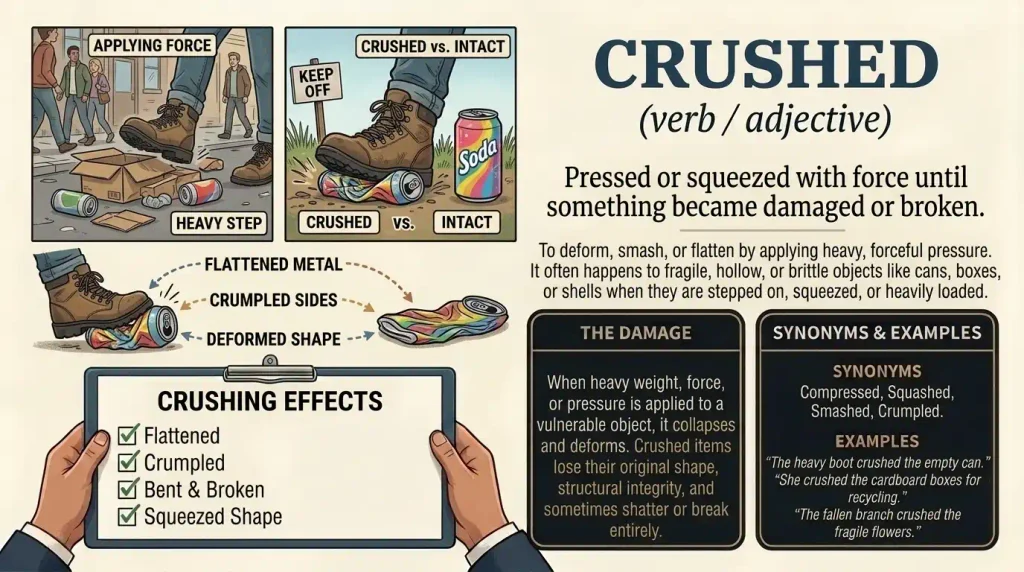
Crushed (Verb) — US / UK: /krʌʃt/
Meaning: Pressed or squeezed with force until something became damaged or broken.
Tone/Register: Neutral; common in everyday English.
Examples:
The heavy boots crushed the small plants.
The equipment crushed the cardboard box.
Stomped on (Verb Phrase) — US / UK: /stɑːmpt ɑːn/; /stɒmpt ɒn/
Meaning: Stepped on something forcefully, often with anger or emphasis.
Tone/Register: Informal; expressive.
Examples:
He stomped on the empty can.
Someone stomped on my new shoes in the crowd.
Trodden (Verb) — US / UK: /ˈtrɑː.dən/; /ˈtrɒd.ən/
Meaning: Stepped on or walked over, especially repeatedly.
Tone/Register: Neutral to literary; often used in British English and established expressions.
Examples:
The grass was trodden flat after the picnic.
We followed a well-trodden trail through the forest.
Flattened (Verb) — US / UK: /ˈflæt.ənd/
Meaning: Made flat by pressure, weight, or force.
Tone/Register: Neutral; widely used.
Examples:
The crowd flattened the cardboard decorations.
The storm flattened several rows of garden plants.
Squashed (Verb) — US / UK: /skwɑːʃt/; /skwɒʃt/
Meaning: Pressed into a flatter or distorted shape.
Tone/Register: Informal; common in conversation.
Examples:
My sandwich got squashed inside the backpack.
The little seedlings were squashed under someone’s boots.
Stamped on (Verb Phrase) — US / UK: /stæmpt ɑːn/; /stæmpt ɒn/
Meaning: Brought a foot down forcefully onto something.
Tone/Register: Neutral to forceful.
Examples:
She stamped on the broken plastic lid.
The demonstrator stamped on the paper sign.
Stepped on (Verb Phrase) — US / UK: /stept ɑːn/; /stept ɒn/
Meaning: Placed a foot on something, sometimes causing damage.
Tone/Register: Neutral; very common.
Examples:
I accidentally stepped on a flower.
He stepped on the corner of the poster.
Trod on (Verb Phrase) — US / UK: /trɑːd ɑːn/; /trɒd ɒn/
Meaning: Walked on or placed a foot on something.
Tone/Register: Neutral to literary.
Examples:
Someone trod on the wet grass.
I trod on a fallen branch while hiking.
Smashed (Verb) — US / UK: /smæʃt/
Meaning: Broke or damaged something violently or with considerable force.
Tone/Register: Informal to neutral; strong.
Examples:
The heavy boots smashed the fragile display.
The fallen equipment smashed the flower pots.
Pulverized (Verb) — US / UK: /ˈpʌl.və.raɪzd/
Meaning: Reduced something to tiny pieces or powder through extreme force.
Tone/Register: Technical or emphatic.
Examples:
The machine pulverized the dry material.
The powerful impact pulverized the brittle object.
Mangled (Verb) — US / UK: /ˈmæŋ.ɡəld/
Meaning: Severely damaged or distorted something.
Tone/Register: Strong; often used in reports or descriptions of serious damage.
Examples:
The vehicle mangled the metal barrier.
The machinery mangled the discarded container.
Damaged (Verb) — US / UK: /ˈdæm.ɪdʒd/
Meaning: Harmed something so that its condition or usefulness declined.
Tone/Register: Neutral; suitable for formal writing.
Examples:
The busy crowd damaged the lawn.
Repeated foot traffic damaged the delicate surface.
Ruined (Verb) — US / UK: /ˈruː.ɪnd/
Meaning: Spoiled or destroyed something’s condition, appearance, or usefulness.
Tone/Register: Neutral to emotional.
Examples:
The visitors ruined the flower bed.
Mud and heavy footsteps ruined the clean carpet.
Wrecked (Verb) — US / UK: /rekt/
Meaning: Seriously damaged or destroyed something.
Tone/Register: Informal to neutral; emphatic.
Examples:
The crowd wrecked the temporary garden display.
Heavy boots wrecked the carefully arranged decorations.
Destroyed (Verb) — US / UK: /dɪˈstrɔɪd/
Meaning: Damaged something so badly that it no longer existed or functioned as before.
Tone/Register: Neutral to strong.
Examples:
The stampede destroyed the small garden.
The repeated pressure destroyed the fragile model.
Crumpled (Verb) — US / UK: /ˈkrʌm.pəld/
Meaning: Pressed or folded something into an irregular, wrinkled shape.
Tone/Register: Neutral.
Examples:
The crowd crumpled the paper banner.
A heavy shoe crumpled the cardboard cup.
Pressed down (Verb Phrase) — US / UK: /prest daʊn/
Meaning: Applied downward force to something.
Tone/Register: Neutral; descriptive.
Examples:
The boots pressed down the soft grass.
The weight pressed down the young plants.
Ground into the dirt (Verb Phrase) — US / UK: /ɡraʊnd ˈɪn.tuː ðə dɝːt/
Meaning: Crushed or rubbed something into the ground through repeated pressure.
Tone/Register: Descriptive; vivid.
Examples:
The muddy shoes ground the petals into the dirt.
The crowd ground the paper scraps into the soil.
Trampled down (Verb Phrase) — US / UK: /ˈtræm.pəld daʊn/
Meaning: Pressed something down by walking or stepping over it repeatedly.
Tone/Register: Neutral; descriptive.
Examples:
The hikers trampled down the tall grass.
Workers trampled down the loose vegetation beside the path.
Trodden down (Verb Phrase) — US / UK: /ˈtrɑː.dən daʊn/; /ˈtrɒd.ən daʊn/
Meaning: Flattened through repeated walking or stepping.
Tone/Register: Neutral to literary.
Examples:
The grass was trodden down near the gate.
Foot traffic had trodden down the muddy track.
Flattened underfoot (Phrase) — US / UK: /ˈflæt.ənd ˌʌn.dɚˈfʊt/; /ˈflæt.ənd ˌʌn.dəˈfʊt/
Meaning: Made flat by the feet of people or animals.
Tone/Register: Descriptive; often written.
Examples:
The fallen leaves lay flattened underfoot.
Small flowers were flattened underfoot along the busy path.
Crushed underfoot (Phrase) — US / UK: /krʌʃt ˌʌn.dɚˈfʊt/; /krʌʃt ˌʌn.dəˈfʊt/
Meaning: Broken or compressed beneath people’s or animals’ feet.
Tone/Register: Descriptive; vivid.
Examples:
The dry leaves crunched as they were crushed underfoot.
Tiny shells were crushed underfoot near the shoreline.
Stamped flat (Verb Phrase) — US / UK: /stæmpt flæt/
Meaning: Made completely flat by forceful stamping.
Tone/Register: Neutral to emphatic.
Examples:
The children stamped the loose cardboard flat.
The weeds were stamped flat during the cleanup.
Trampled over (Verb Phrase) — US / UK: /ˈtræm.pəld ˈoʊ.vɚ/; /ˈtræm.pəld ˈəʊ.və/
Meaning: Walked heavily across something, often leaving it damaged.
Tone/Register: Neutral; descriptive.
Examples:
Visitors trampled over the flower beds.
The crowd trampled over the scattered paper decorations.
Walked over (Verb Phrase) — US / UK: /wɔːkt ˈoʊ.vɚ/; /wɔːkt ˈəʊ.və/
Meaning: Walked across or on something.
Tone/Register: Neutral; less forceful than trampled.
Examples:
Several people walked over the grassy patch.
He walked over the flattened cardboard without noticing it.
Trodden upon (Verb Phrase) — US / UK: /ˈtrɑː.dən əˈpɑːn/; /ˈtrɒd.ən əˈpɒn/
Meaning: Stepped on or walked over something.
Tone/Register: Formal or literary.
Examples:
The delicate plants had been trodden upon.
The old path was trodden upon by generations of travelers.
Stomped flat (Verb Phrase) — US / UK: /stɑːmpt flæt/; /stɒmpt flæt/
Meaning: Flattened by forceful or repeated stomping.
Tone/Register: Informal; vivid.
Examples:
He stomped the empty carton flat.
The weeds were stomped flat near the fence.
Crushed beneath (Verb Phrase) — US / UK: /krʌʃt bɪˈniːθ/
Meaning: Compressed or broken under the weight of something.
Tone/Register: Neutral; descriptive.
Examples:
The flowers were crushed beneath a heavy boot.
The cardboard was crushed beneath the stacked boxes.
Battered (Verb) — US / UK: /ˈbæt.ɚd/; /ˈbæt.əd/
Meaning: Damaged through repeated blows, impacts, or harsh treatment.
Tone/Register: Strong; often descriptive.
Examples:
The makeshift display was battered by the rushing crowd.
The old sign looked battered after the festival.
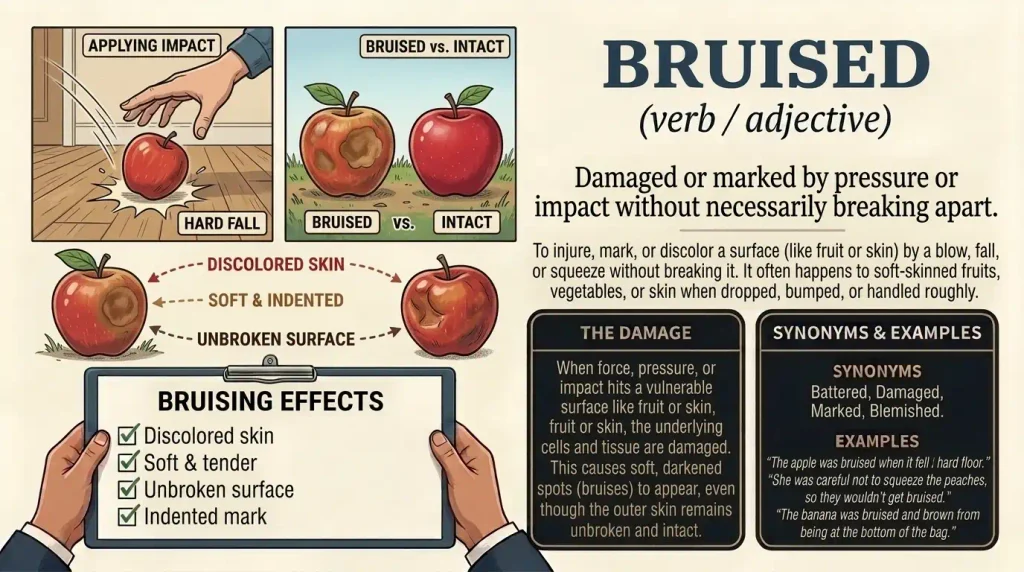
Bruised (Verb) — US / UK: /bruːzd/
Meaning: Damaged or marked by pressure or impact without necessarily breaking apart.
Tone/Register: Neutral; can also describe emotional hurt.
Examples:
The delicate fruit was bruised under the heavy basket.
The soft petals were bruised by careless handling.
Compressed (Verb) — US / UK: /kəmˈprest/
Meaning: Pressed into a smaller space or reduced in volume by pressure.
Tone/Register: Technical or formal.
Examples:
The soil was compressed by repeated foot traffic.
The soft packaging compressed beneath the heavy load.
Crushed flat (Verb Phrase) — US / UK: /krʌʃt flæt/
Meaning: Pressed down until something became flat.
Tone/Register: Neutral; emphatic.
Examples:
The empty can was crushed flat beneath his shoe.
The grass beside the entrance was crushed flat by visitors.
Trampled into submission (Phrase) — US / UK: /ˈtræm.pəld ˈɪn.tuː səbˈmɪʃ.ən/
Meaning: Overpowered or subdued through force, pressure, or relentless opposition.
Tone/Register: Figurative; dramatic.
Examples:
The smaller group felt trampled into submission during the debate.
The novel depicts a community trampled into submission by a tyrant.
Oppressed (Verb) — US / UK: /əˈprest/
Meaning: Treated cruelly or unfairly by someone with power.
Tone/Register: Formal; social and political contexts.
Examples:
The people were oppressed by an unjust regime.
The story follows workers who felt oppressed by their employer.
Violated (Verb) — US / UK: /ˈvaɪ.ə.leɪ.tɪd/
Meaning: Disregarded or infringed upon a person’s rights, privacy, or boundaries.
Tone/Register: Formal; legal or interpersonal.
Examples:
The policy violated the workers’ basic rights.
She felt that the group had violated her personal boundaries.
Disregarded (Verb) — US / UK: /ˌdɪs.rɪˈɡɑːr.dɪd/; /ˌdɪs.rɪˈɡɑː.dɪd/
Meaning: Ignored something that deserved attention or respect.
Tone/Register: Formal to neutral.
Examples:
The manager disregarded the team’s concerns.
The proposal disregarded the needs of residents.
Disrespected (Verb) — US / UK: /ˌdɪs.rɪˈspek.tɪd/
Meaning: Treated a person, belief, or rule without proper respect.
Tone/Register: Everyday; emotional.
Examples:
She felt disrespected when her ideas were dismissed.
The players disrespected the rules during the match.
Humiliated (Verb) — US / UK: /hjuːˈmɪl.i.eɪ.tɪd/
Meaning: Made someone feel deeply embarrassed or ashamed.
Tone/Register: Emotional; interpersonal.
Examples:
The coach humiliated the player in front of the team.
He felt humiliated when his private mistake became public.
Subjugated (Verb) — US / UK: /ˈsʌb.dʒə.ɡeɪ.tɪd/
Meaning: Brought a person or group under control through force or domination.
Tone/Register: Formal; historical or political.
Examples:
The empire subjugated neighboring communities.
The book examines how powerful rulers subjugated their rivals.
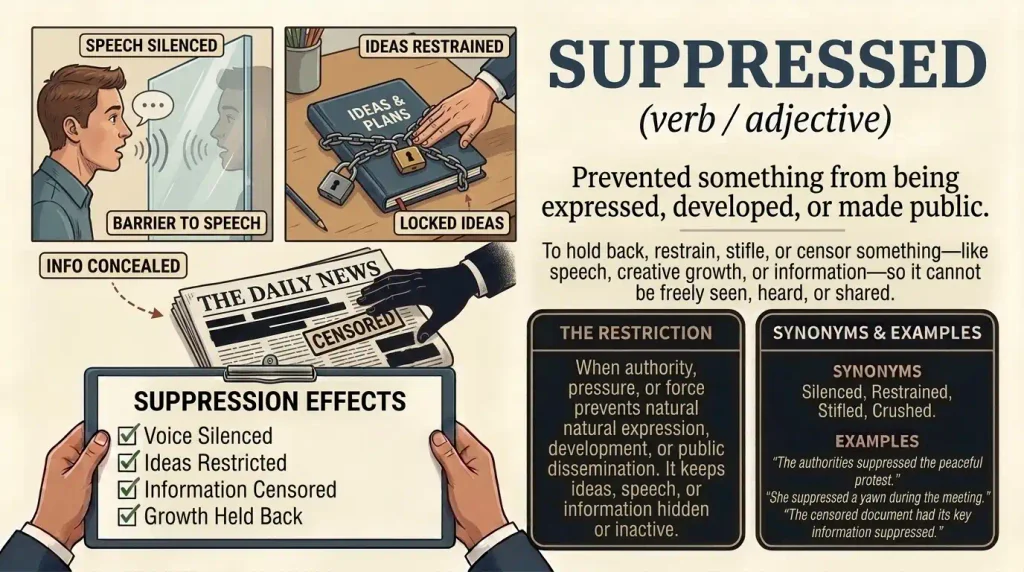
Suppressed (Verb) — US / UK: /səˈprest/
Meaning: Prevented something from being expressed, developed, or made public.
Tone/Register: Formal; political and social contexts.
Examples:
The authorities suppressed peaceful protests.
The manager suppressed criticism instead of addressing the problem.
Crushed someone’s spirit (Phrase) — US / UK: /krʌʃt ˈsʌm.wʌnz ˈspɪr.ɪt/
Meaning: Seriously weakened someone’s confidence, hope, or emotional strength.
Tone/Register: Figurative; emotional.
Examples:
Repeated insults crushed his spirit.
The harsh criticism nearly crushed the young writer’s spirit.
Walked all over (Phrase) — US / UK: /wɔːkt ɔːl ˈoʊ.vɚ/; /wɔːkt ɔːl ˈəʊ.və/
Meaning: Took unfair advantage of someone or treated them without respect.
Tone/Register: Informal; idiomatic.
Examples:
She refused to let her colleagues walk all over her.
He felt that his kindness allowed others to walk all over him.
Trampled on someone’s rights (Phrase) — US / UK: /ˈtræm.pəld ɑːn ˈsʌm.wʌnz raɪts/; /ˈtræm.pəld ɒn ˈsʌm.wʌnz raɪts/
Meaning: Disregarded or violated another person’s rights through unfair or abusive actions.
Tone/Register: Formal to emphatic; political and legal discussion.
Examples:
The new law trampled on citizens’ rights.
The campaign challenged leaders who trampled on workers’ rights.
Stifled (Verb) — US / UK: /ˈstaɪ.fəld/
Meaning: Prevented an idea, feeling, or activity from developing or being expressed freely.
Tone/Register: Formal to neutral; figurative.
Examples:
The strict rules stifled creativity in the classroom.
Fear stifled her willingness to speak openly.
Overpowered (Verb) — US / UK: /ˌoʊ.vɚˈpaʊ.ɚd/; /ˌəʊ.vəˈpaʊ.əd/
Meaning: Defeated or overwhelmed someone or something through superior force.
Tone/Register: Neutral to dramatic.
Examples:
The larger team overpowered its opponents.
The rushing crowd overpowered the small security team.
Crushed beneath the crowd (Phrase) — US / UK: /krʌʃt bɪˈniːθ ðə kraʊd/
Meaning: Pressed under the weight or force of a crowd.
Tone/Register: Serious; news and safety contexts.
Examples:
The barriers collapsed under the pressure of the crowd.
Organizers worked to prevent anyone from being crushed beneath the crowd.
Synonyms for Trampled by Tone
Tone helps you choose a word that fits the situation. A casual conversation may need a simple phrase, while an academic essay may require more precise language.
Positive
There is no direct positive synonym for trampled. If you want to describe a useful result, focus on the outcome instead. For example, a well-trodden path can suggest a familiar route.
Neutral
- Stepped on: Simple and common.
- Flattened: Emphasizes a flat result.
- Trodden: Often describes surfaces or paths.
- Damaged: Broad and factual.
- Compressed: Suitable for technical explanations.
Negative
- Crushed: Emphasizes pressure and harm.
- Smashed: Suggests forceful damage.
- Destroyed: Indicates severe damage.
- Oppressed: Describes unfair treatment.
- Violated: Highlights the infringement of rights or boundaries.
Playful or Informal
- Squashed: Casual and conversational.
- Stomped on: Vivid and forceful.
- Walked all over: An idiom for unfair treatment.
- Wrecked: Informal and emphatic.
“Trampled” vs. Close Alternatives
Trampled vs. Stepped On
It often suggests repeated, heavy, or careless steps that cause damage. Stepped on can describe a single accidental action.
Use trampled for a flattened flower bed. Use stepped on when someone accidentally puts a foot on your shoe.
Trampled vs. Crushed
Trampled emphasizes stepping or walking over something. Crushed emphasizes pressure that damages or compresses it, regardless of the source.
Use trampled for grass damaged by a crowd. Use crushed for a can flattened under a boot.
Trampled vs. Flattened
Trampled describes the action of stepping heavily on something. Flattened focuses on the result, which may happen through footsteps, machinery, or strong winds.
Use trampled to explain what people did. Use flattened to describe the condition of the plants afterward.
How “Trampled” Changes by Context
Daily Conversation
Use familiar expressions such as stepped on, squashed, or stomped on. They make ordinary situations easy to understand.
Example: “Someone stepped on my lunch bag and squashed the sandwich.”
Writing and Blogging
Choose precise verbs to avoid repeating the same word. Trampled suits scenes involving crowds, gardens, trails, and damaged objects. Crushed works when pressure matters more than footsteps.
Professional or Academic Writing
Use damaged, compressed, or violated when the context calls for precision. For example, a report may state that foot traffic damaged vegetation, while a legal discussion may describe an infringement of rights.
Creative and Informal Writing
Vivid words create stronger images. Stomped on can communicate anger, while ground into the dirt gives a reader a clearer picture of physical damage.
Common Mistakes Learners Make
Treating Every Synonym as Identical
Not every alternative fits every sentence. A crowd can trample grass, but oppress usually describes unfair treatment of people or groups. Match the word to its intended meaning.
Using “Trampled” for Every Type of Damage
An object can break without anyone stepping on it. Use smashed, crushed, or damaged when the action does not involve footsteps.
Confusing Literal and Figurative Meanings
“The crowd trampled the flowers” describes physical damage. “The policy trampled on people’s rights” uses the word figuratively to describe disrespect or infringement.
Overusing Strong Words
Words such as pulverized and destroyed suggest serious damage. They may exaggerate a minor accident. Choose flattened or stepped on when the result is less severe.
Register Notes
Stepped on is common in speech. Trodden may sound more literary, while subjugated belongs to formal discussions of power and control.
For related vocabulary practice, explore a synonym article about crushed to understand how pressure-based words differ from words about walking.
Real-Life Examples Using “Trampled”
Workplace
A delivery team moves heavy equipment through a landscaped entrance. The manager notes that workers trampled the flower bed and asks them to use the paved path.
Social Situations
At a crowded event, someone steps on another person’s shoes. The person might say, “Please be careful. You just stepped on my foot.”
Media and Pop Culture
A news report may describe a crowd pushing through a narrow entrance. Responsible reporting distinguishes between people being trampled, objects being crushed, and a crowd simply moving through a packed space.
Writing and Storytelling
A novelist might describe a character returning to find a garden trampled after a stormy night. The verb quickly communicates disorder and damage.
Suggested External Reference
For a reliable dictionary definition, pronunciation, and usage examples, consult Merriam-Webster’s dictionary. Compare its entry for trample with related words to understand which alternatives best match your intended meaning.
Practice Exercises
1. A group walks repeatedly over a flower bed, damaging the plants. Which word fits best?
A. Trampled
B. Admired
C. Polished
D. Watered
2. Someone accidentally places a foot on your shoe. Which phrase is most natural?
A. Subjugated
B. Stepped on
C. Pulverized
D. Suppressed
3. A soda can becomes flat under a heavy boot. Which phrase describes the result?
A. Stifled
B. Disregarded
C. Crushed flat
D. Oppressed
4. You are writing a formal report about harm to a lawn caused by repeated foot traffic. Which word is most suitable?
A. Damaged
B. Snazzy
C. Tempting
D. Cheerful
5. A character angrily brings a foot down on an empty box. Which expression best shows the action?
A. Trodden upon
B. Stomped on
C. Disregarded
D. Subjugated
6. A political essay discusses a government ignoring citizens’ basic rights. Which expression fits?
A. Squashed
B. Flattened
C. Trampled on their rights
D. Stamped flat
7. A path looks flat because many people have walked along it. Which word can describe it?
A. Well-trodden
B. Violated
C. Mangled
D. Humiliated
8. A machine reduces dry material into tiny particles. Which verb is most precise?
A. Disrespected
B. Pulverized
C. Trodden
D. Walked over
9. Someone treats a helpful colleague unfairly and takes advantage of their kindness. Which idiom fits?
A. Crushed flat
B. Flattened underfoot
C. Walked all over
D. Stamped flat
10. Strong winds make a row of plants lie flat. Which word focuses on the result?
A. Oppressed
B. Flattened
C. Violated
D. Disregarded
Reflection Task
Write one original sentence using crushed, stomped on, flattened, or another synonym. Explain why your chosen word fits the situation.
Answer Key: 1-A, 2-B, 3-C, 4-A, 5-B, 6-C, 7-A, 8-B, 9-C, 10-B,
Conclusion
Synonyms for trampled help you describe physical damage, forceful movement, and figurative disrespect with greater accuracy. The right choice makes your meaning easier to understand.
Students can use these alternatives in essays, while bloggers and content writers can make descriptions more engaging. Everyday speakers can also explain accidents and difficult situations clearly.
Practise the differences between trampled, crushed, flattened, and stepped on. Use them in emails, short stories, schoolwork, and daily conversations to build confidence.
Keep learning one word at a time. Write your own examples, notice how native speakers use these expressions, and choose the synonym that communicates your meaning most naturally.
Frequently Asked Questions
1. What is the difference between “trampled” and “trodden”?
Trampled often suggests heavy, repeated, or forceful steps that damage something. Trodden is a form of tread and commonly describes something people have walked over. The words overlap, especially when describing grass or paths. However, trampled usually creates a stronger impression of force or damage.
2. Can “trampled” describe feelings or human rights?
Yes. English speakers use trampled figuratively when someone ignores or violates another person’s rights, dignity, or feelings. For example, “The unfair decision trampled on their rights.” This usage communicates disrespect or abuse of power rather than literal foot contact.
3. What is the opposite of trampled?
Possible opposites include protected, preserved, untouched, and undamaged, depending on the sentence. For example, “The protected flowers remained untouched by visitors.” There is no single opposite that works in every context because trampled can describe physical damage or figurative mistreatment.
4. Is “trampled” a formal or informal word?
Trampled works in both everyday conversation and formal writing. It appears in descriptions of damaged plants, crowded events, and violations of rights. In a technical report, damaged by foot traffic may offer greater precision. In a story, trampled can create a more vivid image.
5. What does “trampled underfoot” mean?
Trampled underfoot means crushed, flattened, or damaged beneath people’s or animals’ feet. It can also describe something treated as unimportant or disrespected. For instance, leaves may be trampled underfoot on a busy path, while a figurative expression may refer to principles that powerful people ignore.
6. How can I use synonyms for trampled in an essay?
Choose a synonym that accurately describes the action and its result. Use flattened when the shape changes, crushed when pressure causes damage, and stepped on for a specific footstep. For figurative discussions, consider violated, disregarded, or oppressed, depending on the meaning you want to convey.
7. Which synonym for trampled is best for SEO writing?
The best synonym depends on the topic and the reader’s search intent. Crushed, flattened, and stepped on suit physical descriptions, while violated or oppressed may fit discussions about rights and power. Use related terms naturally, maintain accurate meanings, and avoid inserting synonyms where they do not fit.
8. What does “trampled” mean in a crowd-related incident?
In a crowd-related incident, trampled generally describes people or objects being stepped on amid dense movement or loss of space. The word can indicate a serious hazard when people fall or become trapped. Reports should distinguish verified facts from assumptions and use precise language about what occurred.

Samia Noor is the founder and lead writer at SynonymGenius.com, where she creates accurate, reader-focused English language content that helps people communicate with clarity and confidence. She specializes in synonyms, antonyms, word meanings, idioms, and practical vocabulary guides that make complex language concepts simple and easy to understand. Every article is thoroughly researched, carefully fact-checked, and written in clear, accessible language using reliable sources and real-world examples. Her mission is to provide trustworthy, high-quality content that supports students, writers, educators, professionals, and English learners at every stage of their language journey.
Her editorial approach emphasizes accuracy, transparency, and genuine value for readers while following modern E-E-A-T and content quality standards. She regularly reviews and updates published content to ensure it remains current, reliable, and easy to understand. Through SynonymGenius.com, Samia Noor is committed to publishing dependable language resources that help readers expand their vocabulary, strengthen their writing skills, improve communication, and build confidence in academic, professional, and everyday English.