
Two old friends spot each other across a crowded station after ten years apart. One raised eyebrow says “I missed you”; a quick nod answers “me too.” Nothing is spoken, and nothing needs to be. That is the territory of unspoken: feelings, rules, and understandings that live between people without becoming sentences.
If you are hunting for synonyms for unspoken, this guide collects 40 alternatives for those wordless moments, from the warmth of a shared glance to the tension of a feeling nobody names. Every entry pairs a clear meaning with tone guidance and real example sentences, so the difference between tacit, implicit, and unstated stops being guesswork.
Each synonym makes a different claim. An unwritten rule points at habit; an unspoken one hints people avoid discussing it. A suppressed feeling is held back on purpose, while an unexpressed one simply never found its way out. Students, bloggers, and everyday writers all gain precision once they feel these distinctions.
Below you will find what unspoken means, where it comes from, and how to pronounce it, followed by 40 synonyms for unspoken with meanings, tone notes, and examples, plus comparisons, usage guidance, mistakes to avoid, four everyday scenarios, and a short quiz.
What Unspoken Means
Unspoken describes something real that never becomes words: a feeling two people share without discussing it, a rule everyone follows without reading it anywhere, or an expectation hanging in the air at work or at home.
Its signature is the gap between knowing and saying. People may fully understand a friend’s hurt, a manager’s expectation, or a family’s avoided topic, yet nobody turns it into a sentence. That silence can feel warm, like trust between old friends, or heavy, like a subject everyone fears raising.
Part of Speech
- Adjective: Unspoken describes nouns (feelings, rules, agreements, expectations) that are not expressed in words.
- Common phrases: unspoken feelings, unspoken rules, unspoken agreement, unspoken expectations.
Example: They shared an unspoken understanding that neither would mention the argument.
Connotative Meaning
(Connotation means the emotional or cultural associations a word carries beyond its basic dictionary definition.)
- Positive tone: Deep trust, mutual understanding, emotional closeness, or quiet respect.
- Negative tone: Suppressed feelings, unresolved conflict, uncomfortable expectations, or topics people fear discussing.
- Neutral tone: Something simply left unstated, such as an assumption nobody has formally explained.
The surrounding context decides whether unspoken feels comforting, tense, or purely factual.
Where the Word Unspoken Comes From
Unspoken is a straightforward English compound: the prefix un-, meaning “not,” joined to spoken, the past participle of speak. Assembled, the word says exactly what it means: something that has not been spoken.
The parts are ancient, but the compound grew into its modern sense over centuries, as English speakers needed a single word for understandings and feelings that exist without words.
Historical Development
Old English period (450–1100): Speakers used sprecan, meaning “to speak,” alongside the negative prefix un-. The exact modern compound did not exist yet, but its building blocks were already in daily use.
Middle English period (1100–1500): Pronunciation and spelling shifted, and spoken settled into the form we recognize. Expressions began to separate what people said aloud from what they left unsaid.
Modern English period (1500–present): Unspoken broadened beyond literal silence. Today it describes hidden emotions, rules followed without discussion, and expectations absorbed from social context.
Saying Unspoken Out Loud
- US IPA: /ʌnˈspoʊkən/
- UK IPA: /ʌnˈspəʊkən/
Syllables: un-spo-ken, three beats, with the stress on the middle one: un-SPO-ken.
Affixation pattern:
- Prefix: un-, meaning “not”
- Base: spoken, the past participle of speak
- Suffix: none, the word is complete as a prefix-plus-participle compound
40 Alternatives for Unspoken
The following 40 alternatives cover different shades of unspoken. Some describe ideas that stay unstated, while others point to literal silence, hidden emotions, or messages sent indirectly. Read the meaning and tone notes before swapping one into your sentence.
1. Unstated (Adjective) — US: /ʌnˈsteɪtɪd/ | UK: /ʌnˈsteɪtɪd/
Meaning: Left out of spoken words and never formally declared or put on the record.
Tone/Register: Neutral, formal, academic.
Examples:
- The unstated expectation was that everyone would arrive early.
- Her concerns remained unstated during the meeting.
2. Unexpressed (Adjective) — US: /ˌʌnɪkˈsprɛst/ | UK: /ˌʌnɪkˈsprest/
Meaning: Kept inside and never sent out through speech, behavior, or any other channel.
Tone/Register: Neutral, emotional, literary.
Examples:
- He struggled with unexpressed feelings after their argument.
- Her unexpressed disappointment was easy to sense.
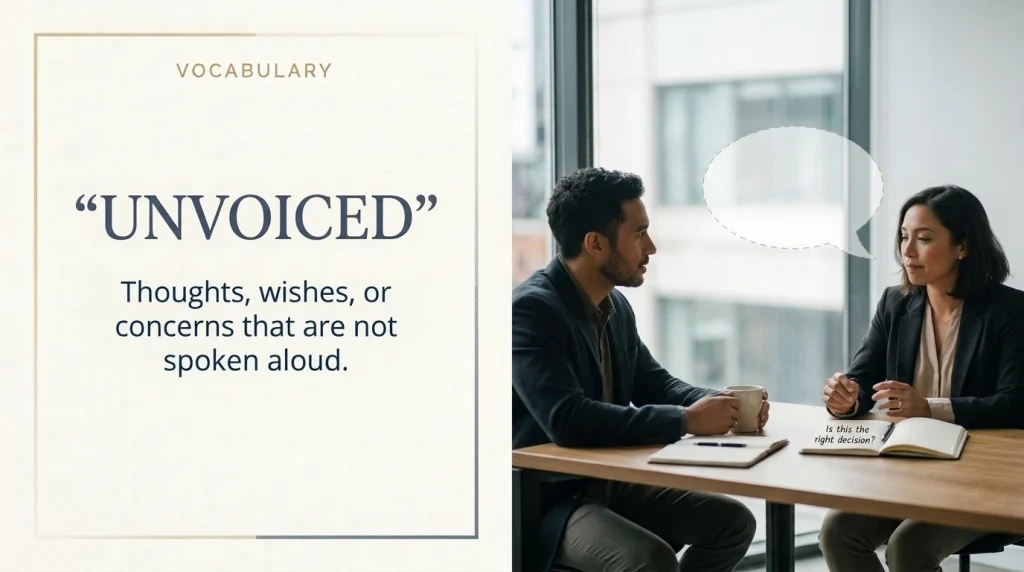
3. Unvoiced (Adjective) — US: /ʌnˈvɔɪst/ | UK: /ʌnˈvɔɪst/
Meaning: Never said out loud, particularly when describing thoughts, wishes, or worries carried quietly.
Tone/Register: Neutral, literary, professional.
Examples:
- Several employees had unvoiced concerns about the new policy.
- She carried an unvoiced wish to reconnect with her friend.
4. Tacit (Adjective) — US: /ˈtæsɪt/ | UK: /ˈtæsɪt/
Meaning: Accepted or understood between people with nothing spelled out directly.
Tone/Register: Formal, academic, business.
Examples:
- They reached a tacit agreement to avoid the subject.
- His silence gave tacit approval to the proposal.
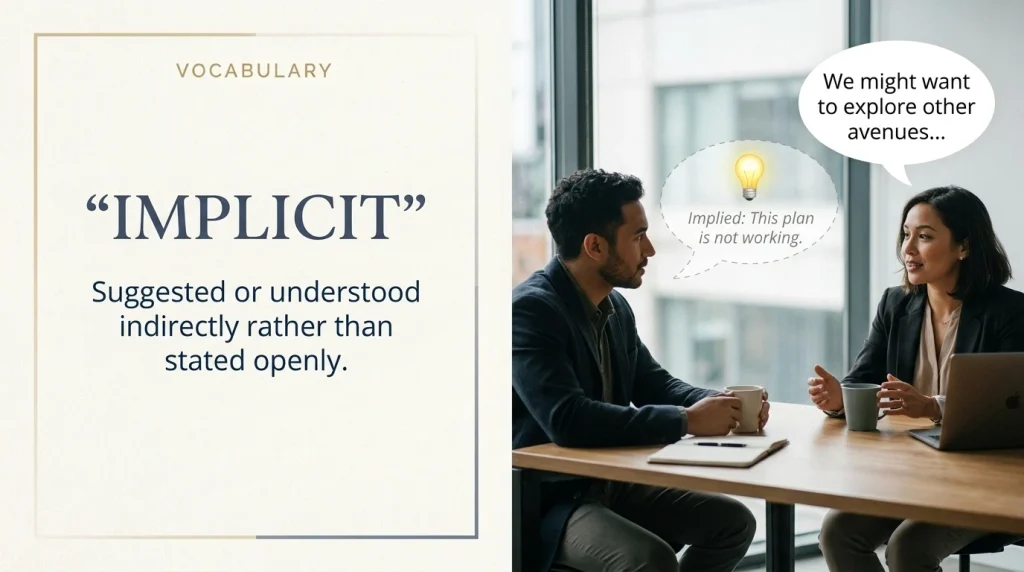
5. Implicit (Adjective) — US: /ɪmˈplɪsɪt/ | UK: /ɪmˈplɪsɪt/
Meaning: Hinted at or folded into the situation rather than laid out in plain terms.
Tone/Register: Academic, professional, neutral.
Examples:
- The email carried an implicit warning about the deadline.
- There was an implicit expectation that she would lead the project.
6. Uncommunicated (Adjective) — US: /ˌʌnkəˈmjuːnɪˌkeɪtɪd/ | UK: /ˌʌnkəˈmjuːnɪˌkeɪtɪd/
Meaning: Never passed along or shared with anyone else.
Tone/Register: Formal, professional, neutral.
Examples:
- Their uncommunicated expectations confused the whole team.
- The plan failed because several important details remained uncommunicated.
7. Unarticulated (Adjective) — US: /ˌʌnɑrˈtɪkjəˌleɪtɪd/ | UK: /ˌʌnɑːˈtɪkjʊleɪtɪd/
Meaning: Not yet shaped into clear words, often because the feeling or idea is hard to explain.
Tone/Register: Formal, academic, literary.
Examples:
- He felt an unarticulated fear about the future.
- Her unarticulated concerns finally emerged during the discussion.
8. Silent (Adjective) — US: /ˈsaɪlənt/ | UK: /ˈsaɪlənt/
Meaning: Without speech or open communication, though the quiet itself can carry meaning.
Tone/Register: Neutral, emotional, literary.
Examples:
- They exchanged a silent look across the room.
- His silent disagreement became obvious when he refused to participate.
9. Wordless (Adjective) — US: /ˈwɝːdləs/ | UK: /ˈwɜːdləs/
Meaning: Happening or shared without any words at all.
Tone/Register: Emotional, literary, descriptive.
Examples:
- A wordless hug reassured her after the difficult day.
- They shared a wordless moment of understanding.
10. Unsaid (Adjective) — US: /ʌnˈsɛd/ | UK: /ʌnˈsɛd/
Meaning: Never spoken, whether held back on purpose or simply never said.
Tone/Register: Neutral, conversational, literary.
Examples:
- There were many unsaid things between the two friends.
- His apology left one important truth unsaid.
11. Unuttered (Adjective) — US: /ʌnˈʌtərd/ | UK: /ʌnˈʌtəd/
Meaning: Never let out of the mouth; kept entirely unvoiced.
Tone/Register: Literary, formal.
Examples:
- An unuttered question lingered in her mind.
- He swallowed his unuttered response and walked away.
12. Unmentioned (Adjective) — US: /ʌnˈmɛnʃənd/ | UK: /ʌnˈmenʃənd/
Meaning: Never brought up or referred to, in conversation or in print.
Tone/Register: Neutral, professional, academic.
Examples:
- The unmentioned issue continued to affect the team.
- One important detail remained unmentioned in the report.
13. Undisclosed (Adjective) — US: /ˌʌndɪsˈkloʊzd/ | UK: /ˌʌndɪsˈkləʊzd/
Meaning: Held back from others and kept private, never revealed.
Tone/Register: Formal, legal, business.
Examples:
- The reason for her departure remained undisclosed.
- They agreed to keep the undisclosed details confidential.
14. Concealed (Adjective) — US: /kənˈsiːld/ | UK: /kənˈsiːld/
Meaning: Hidden on purpose, kept out of sight, out of mind, or out of the conversation.
Tone/Register: Neutral, formal, sometimes negative.
Examples:
- His concealed resentment surfaced during the argument.
- She concealed her disappointment behind a smile.
15. Hidden (Adjective) — US: /ˈhɪdən/ | UK: /ˈhɪdən/
Meaning: Not out in the open: unseen, unacknowledged, or never put into words.
Tone/Register: Neutral, conversational, literary.
Examples:
- A hidden sadness lay behind his cheerful manner.
- Their hidden expectations eventually created tension.
16. Suppressed (Adjective) — US: /səˈprɛst/ | UK: /səˈprest/
Meaning: Pushed down on purpose so it never shows or gets expressed.
Tone/Register: Formal, psychological, emotional.
Examples:
- She spoke calmly despite her suppressed anger.
- His suppressed frustration became clear near the end of the meeting.
17. Repressed (Adjective) — US: /rɪˈprɛst/ | UK: /rɪˈprest/
Meaning: Buried away from awareness or expression, most often when the emotion is painful or difficult.
Tone/Register: Psychological, formal, literary.
Examples:
- The novel explores his repressed guilt.
- Years of repressed resentment damaged their relationship.
18. Implied (Adjective) — US: /ɪmˈplaɪd/ | UK: /ɪmˈplaɪd/
Meaning: Pointed at indirectly instead of stated outright.
Tone/Register: Neutral, academic, professional.
Examples:
- Her implied criticism made the conversation uncomfortable.
- The message contained an implied promise of support.
19. Understood (Adjective) — US: /ˌʌndərˈstʊd/ | UK: /ˌʌndəˈstʊd/
Meaning: Recognized and accepted by everyone involved, with no explanation required.
Tone/Register: Neutral, conversational, professional.
Examples:
- It was understood that everyone would help clean up.
- Their shared responsibilities were understood without discussion.
20. Assumed (Adjective) — US: /əˈsuːmd/ | UK: /əˈsjuːmd/
Meaning: Taken as true or expected, though nobody actually confirmed it.
Tone/Register: Neutral, academic, conversational.
Examples:
- Her attendance was assumed, but nobody asked her directly.
- The assumed deadline caused confusion among the staff.
21. Unwritten (Adjective) — US: /ʌnˈrɪtən/ | UK: /ʌnˈrɪtən/
Meaning: Never written down as a rule, yet followed and recognized all the same.
Tone/Register: Neutral, professional, social.
Examples:
- An unwritten rule required newcomers to introduce themselves.
- Their workplace had an unwritten tradition of sharing lunch.
22. Unacknowledged (Adjective) — US: /ˌʌnəkˈnɑːlɪdʒd/ | UK: /ˌʌnəkˈnɒlɪdʒd/
Meaning: Never openly recognized, admitted, or given its due attention.
Tone/Register: Formal, emotional, academic.
Examples:
- Her unacknowledged contribution helped the whole team succeed.
- An unacknowledged tension lingered between the neighbors.
23. Unconfessed (Adjective) — US: /ˌʌnkənˈfɛst/ | UK: /ˌʌnkənˈfest/
Meaning: Never admitted or brought into the open, particularly with feelings, faults, or guilt.
Tone/Register: Literary, emotional, formal.
Examples:
- His unconfessed affection complicated their friendship.
- The story follows a character burdened by unconfessed guilt.
24. Unshared (Adjective) — US: /ˌʌnˈʃɛrd/ | UK: /ˌʌnˈʃeəd/
Meaning: Kept to oneself and never communicated or disclosed to anyone.
Tone/Register: Neutral, conversational, emotional.
Examples:
- Their unshared worries kept them emotionally distant.
- She finally discussed the fears she had kept unshared for years.
25. Unreported (Adjective) — US: /ˌʌnrɪˈpɔːrtɪd/ | UK: /ˌʌnrɪˈpɔːtɪd/
Meaning: Never formally logged or passed on to the person or authority who should hear it.
Tone/Register: Formal, journalistic, professional.
Examples:
- The incident remained unreported for several weeks.
- Several unreported concerns emerged during the review.
26. Unannounced (Adjective) — US: /ˌʌnəˈnaʊnst/ | UK: /ˌʌnəˈnaʊnst/
Meaning: Never declared or communicated in advance.
Tone/Register: Neutral, professional, conversational.
Examples:
- The manager made an unannounced visit to the office.
- Their unannounced change surprised the entire team.
27. Unformulated (Adjective) — US: /ˌʌnˈfɔːrmjəˌleɪtɪd/ | UK: /ˌʌnˈfɔːmjʊleɪtɪd/
Meaning: Still loose and unshaped, not yet worked into a clear idea or statement.
Tone/Register: Academic, formal.
Examples:
- She had an unformulated idea about improving the service.
- His unformulated concerns became clearer after reflection.
28. Unphrased (Adjective) — US: /ʌnˈfreɪzd/ | UK: /ʌnˈfreɪzd/
Meaning: Not yet settled into a definite wording; still hovering without a phrase to hold it.
Tone/Register: Literary, descriptive, less common.
Examples:
- An unphrased question lingered at the back of his mind.
- She sensed an unphrased concern in her colleague’s response.
29. Mute (Adjective) — US: /mjuːt/ | UK: /mjuːt/
Meaning: Without speech in the moment, whether from inability or unwillingness to talk.
Tone/Register: Neutral, literary; use thoughtfully when describing people.
Examples:
- He gave a mute acknowledgment with a nod.
- Her mute reaction conveyed more than a lengthy reply could.
30. Speechless (Adjective) — US: /ˈspiːtʃləs/ | UK: /ˈspiːtʃləs/
Meaning: Struck unable to speak for a moment, usually by shock, surprise, or strong feeling.
Tone/Register: Conversational, emotional.
Examples:
- I was speechless when they announced the surprise.
- She stood speechless after hearing the unexpected news.
31. Reticent (Adjective) — US: /ˈrɛtɪsənt/ | UK: /ˈretɪsənt/
Meaning: Holding back thoughts and feelings rather than sharing them openly.
Tone/Register: Formal, professional, literary.
Examples:
- He remained reticent about his plans for the future.
- She was reticent when the conversation turned personal.
32. Reserved (Adjective) — US: /rɪˈzɝːvd/ | UK: /rɪˈzɜːvd/
Meaning: Quiet and held in, especially where personal opinions or emotions are concerned.
Tone/Register: Neutral, professional, conversational.
Examples:
- Her reserved manner made it difficult to read her feelings.
- He stayed reserved during the heated discussion.
33. Unspoken-of (Adjective) — US: /ʌnˈspoʊkən əv/ | UK: /ʌnˈspəʊkən əv/
Meaning: Steered clear of in conversation, the subject everyone avoids naming.
Tone/Register: Literary, less common.
Examples:
- The family treated the old dispute as an unspoken-of subject.
- Their unspoken-of disagreement shaped later decisions.
34. Tacitly Accepted (Phrase) — US: /ˈtæsɪtli ækˈsɛptɪd/ | UK: /ˈtæsɪtli əkˈseptɪd/
Meaning: Gone along with silently, with no spoken confirmation or official approval.
Tone/Register: Formal, academic, business.
Examples:
- The new arrangement was tacitly accepted by the group.
- Everyone tacitly accepted that the deadline could not change.
35. Taken for Granted (Phrase) — US: /ˈteɪkən fər ˈɡræntɪd/ | UK: /ˈteɪkən fə ˈɡrɑːntɪd/
Meaning: Assumed as a given, expected without question and rarely appreciated.
Tone/Register: Conversational, neutral, sometimes negative.
Examples:
- It was taken for granted that she would organize the event.
- Their daily support was taken for granted for too long.
36. Beneath the Surface (Phrase) — US: /bɪˈniːθ ðə ˈsɝːfɪs/ | UK: /bɪˈniːθ ðə ˈsɜːfɪs/
Meaning: Running underneath the visible layer, present in a person or situation but not openly shown.
Tone/Register: Descriptive, literary, conversational.
Examples:
- Beneath the surface, he felt deeply disappointed.
- Tension simmered beneath the surface during the meeting.
37. Between the Lines (Phrase) — US: /bɪˈtwiːn ðə ˈlaɪnz/ | UK: /bɪˈtwiːn ðə ˈlaɪnz/
Meaning: Carried by hints and implications rather than said straight out.
Tone/Register: Conversational, literary, professional.
Examples:
- Reading between the lines, I realized she wanted to leave.
- His email suggested, between the lines, that the project was in trouble.
38. Left Unsaid (Phrase) — US: /lɛft ʌnˈsɛd/ | UK: /left ʌnˈsed/
Meaning: Passed over in speech or writing, whether on purpose or by accident.
Tone/Register: Neutral, emotional, literary.
Examples:
- The most important part of his apology was left unsaid.
- She left her disappointment unsaid to avoid another argument.
39. Not Put into Words (Phrase) — US: /nɑːt pʊt ˈɪntuː wɝːdz/ | UK: /nɒt pʊt ˈɪntuː wɜːdz/
Meaning: Never turned into spoken language, often because the feeling or idea resists description.
Tone/Register: Conversational, descriptive.
Examples:
- Her gratitude was real but not put into words.
- He felt a sense of belonging that he could not put into words.
40. Unspoken Agreement (Noun Phrase) — US: /ʌnˈspoʊkən əˈɡriːmənt/ | UK: /ʌnˈspəʊkən əˈɡriːmənt/
Meaning: A shared understanding between people that was never talked through or agreed aloud.
Tone/Register: Neutral, professional, social.
Examples:
- They had an unspoken agreement to keep the matter private.
- An unspoken agreement helped the roommates share responsibilities fairly.
Matching Each Synonym to Its Mood
Tone decides whether a synonym warms a sentence or chills it. Use these groupings as a starting map, then trust your ear.
Positive
Wordless: Celebrates connection without speech. Understood: Suggests comfortable mutual knowledge. Tacitly accepted: Implies smooth consensus. Unspoken agreement: Points to trust that needs no discussion.
Neutral
Unstated: A plain fact, the information simply was not said. Unmentioned: An omission without blame. Implicit: Indirect meaning, stated plainly. Not put into words: Wording never happened, no judgment attached.
Negative
Suppressed: Feelings pushed down deliberately. Concealed: Intentional hiding. Undisclosed: A secretive or official edge. Taken for granted: The sting of being unappreciated.
Playful or Informal
Unsaid: Casual and conversational. Between the lines: A friendly idiom for reading hints. Left unsaid: Light enough for storytelling.
When in doubt, match the mood of your sentence first and the dictionary meaning second.
Unspoken vs. Its Closest Cousins
Unstated vs. Unspoken
Unstated points at information: facts or terms never put into words. Unspoken reaches further, covering feelings, relationships, and social rules. An unstated assumption belongs in a report; an unspoken bond belongs between people.
Unspoken vs. Tacit
Tacit implies shared acceptance: everyone involved has silently gone along with it. Unspoken can be one-sided: unspoken love may live in one person’s heart without the other agreeing to anything.
Unspoken vs. Implicit
Implicit describes meaning carried indirectly, like a warning tucked inside a polite email. Unspoken describes the absence of expression itself: a feeling nobody voiced at all.
Picking the Right Word for Each Situation
Daily Conversation
Reach for unsaid, wordless, or not put into words. Example: “We hugged, and a lot was left unsaid.” Familiar words keep the moment human instead of stiff.
Writing and Blogging
Use unspoken, unstated, or implicit according to your exact point, and stay consistent within an article. Swapping terms just to avoid repetition can quietly change your meaning.
Professional or Academic Writing
Prefer tacit, implicit, unstated, or uncommunicated. These carry the precision formal writing demands. Example: “The study rests on an unstated assumption about participant behavior.”
Creative and Informal Writing
Let characters speak naturally while the narrator uses literary shades like unvoiced or unuttered. Match the word to the voice on the page.

Mistakes Worth Avoiding
Mistake 1: Using Every Synonym Interchangeably
A tacit agreement sounds natural; a speechless agreement sounds odd, because speechless describes a person struck unable to talk, not a deal. Check what the word describes before substituting it.
Mistake 2: Confusing Silence with Hidden Meaning
Silent can mean only that nobody is talking; implicit means a message exists indirectly. A silent room holds no hidden message by default, so do not treat the two as the same.
Mistake 3: Treating Unspoken and Undisclosed as Identical
Undisclosed suggests information deliberately kept private, often officially. Unspoken can describe something never voiced when nobody is hiding anything. A family’s unspoken sadness is not a company’s undisclosed figures.
Mistake 4: Overusing Formal Vocabulary
Tacit and unarticulated fit essays and reports but sound stiff at the dinner table. In casual speech, unsaid or wordless lands better.
Mistake 5: Calling Every Quiet Person Speechless
Speechless means briefly unable to speak from shock or strong emotion. A quiet, private person is reticent or reserved, not speechless. Save it for moments that genuinely steal someone’s words.
Formal or Casual: Choosing Your Register
Formal: tacit, implicit, unarticulated, unstated, undisclosed, uncommunicated. These suit essays, reports, and professional emails.
Informal: unsaid, wordless, left unsaid, not put into words. These suit conversation, personal essays, and friendly blogs.
Spoken English: “We never actually said it out loud.” Written English: “Their arrangement remained tacit throughout the negotiations.” Let the setting choose the word.
Unspoken in Everyday Life
A Silent Agreement Between Friends
Mara and Jon have split every restaurant bill down the middle for six years without once discussing it. When the check arrives, both reach for their wallets at the same moment. Their silent agreement simply works.
An Unwritten Office Rule
Nobody told Priya the team never schedules meetings before ten, but by her second week she had absorbed the unwritten rule from the empty calendar slots and grateful smiles. The office ran on expectations nobody had written down.
A Tense Family Dinner
At the holiday table, everyone avoided mentioning last spring’s argument. An unspoken tension sat between the passing dishes, broken only by small talk about the weather, nobody named it, and everybody felt it.
A Coach’s Wordless Signal
With two minutes left and the game tied, the coach caught his striker’s eye and tapped his wrist. One wordless signal sent the substitute sprinting to the sideline, the stadium understood before the announcer did.
Practice Exercises
Choose the best answer for each situation. Consider the meaning, tone, and context before selecting an option.
1. Two colleagues agree to support a decision without discussing it openly. Which word best describes their agreement?
A. Speechless
B. Tacit
C. Concealed
D. Unreported
2. A student has an idea but has not yet explained it clearly. Which word fits best?
A. Unformulated
B. Unannounced
C. Unwritten
D. Reserved
3. A friend feels sad but does not share those feelings. Which alternative is most suitable?
A. Undisclosed
B. Unexpressed
C. Unreported
D. Unannounced
4. A company has a workplace rule that nobody has formally written down. What is the best description?
A. An unconfessed rule
B. A wordless rule
C. An unwritten rule
D. An unuttered rule
5. Someone gives an indirect warning without saying it plainly. Which word fits best?
A. Implicit
B. Speechless
C. Unshared
D. Mute
6. A person cannot speak temporarily because of unexpected news. Which word describes the reaction?
A. Reticent
B. Reserved
C. Speechless
D. Tacit
7. A report leaves out a detail rather than discussing it. Which word is most appropriate?
A. Unmentioned
B. Wordless
C. Repressed
D. Unconfessed
8. A character hides anger and deliberately prevents it from showing. Which word best describes the anger?
A. Implied
B. Suppressed
C. Unwritten
D. Assumed
9. A person rarely shares private opinions and avoids personal questions. Which adjective fits best?
A. Unphrased
B. Reticent
C. Unannounced
D. Unreported
10. Two people communicate affection through a hug without speaking. Which word describes the moment?
A. Undisclosed
B. Wordless
C. Unformulated
D. Unstated
Part Two
11. A message hints that a deadline may be extended without directly promising it. Which word describes the message?
A. Unvoiced
B. Implicit
C. Unconfessed
D. Unreported
12. A family avoids discussing an old disagreement. Which phrase best describes the topic?
A. Taken for granted
B. Unspoken-of
C. Speechless
D. Unformulated
13. A person assumes everyone understands a responsibility, but nobody has discussed it. What caused the problem?
A. Uncommunicated expectations
B. Wordless gratitude
C. Unannounced visitors
D. Unconfessed feelings
14. A writer wants to describe tension that people hide beneath friendly behavior. Which phrase is most suitable?
A. Between the lines
B. Beneath the surface
C. Taken for granted
D. Not put into words
15. A colleague’s email suggests criticism without stating it directly. Which phrase describes how the reader discovers the message?
A. Reading between the lines
B. Leaving it unreported
C. Remaining speechless
D. Keeping it unwritten
Answer Key: 1-B, 2-A, 3-B, 4-C, 5-A, 6-C, 7-A, 8-B, 9-B, 10-B, 11-B, 12-B, 13-A, 14-B, 15-A
Reflection Task
Write two short sentences about a real-life situation involving an unspoken feeling or expectation. Replace unspoken with a suitable synonym in the second sentence. Explain how your word choice changes the tone.
External Reference
To double-check definitions, pronunciation, or example usage, the word unspoken has a full entry in the Merriam-Webster Dictionary, a reliable place to confirm how the word is defined and how it behaves in real sentences.
FAQs
1. What is the best synonym for unspoken feelings?
Unexpressed is an excellent alternative when feelings have not been communicated. Unvoiced emphasizes feelings that a person has not spoken aloud, while suppressed suggests deliberate restraint. For example, “She struggled with unexpressed sadness” describes an emotion that remains unshared. Choose the alternative that best reflects whether the feeling is simply unstated or actively held back.
2. What is another word for an unspoken agreement?
Tacit agreement is one of the most precise alternatives. It describes an understanding that people accept without formally discussing or confirming it. For example, coworkers may have a tacit agreement to help one another during busy periods. An unwritten agreement is also useful, especially when you want to emphasize that the arrangement has not been formally recorded.
3. How do you describe something that everyone knows but nobody discusses?
You can describe it as an open secret, an unspoken truth, or something understood without discussion, depending on the situation. An open secret is information that many people know but do not openly acknowledge. An unspoken truth emphasizes a reality that remains unexpressed. These phrases are not exact synonyms, so consider whether the situation involves shared knowledge, avoidance, or silent understanding.
4. What is the difference between unspoken and unspoken-for?
Unspoken means not expressed in words. Unspoken-for is not a standard alternative with the same meaning, so it should not replace unspoken in ordinary writing. The expression spoken for usually means claimed, reserved, or already committed. For example, “The available seat is already spoken for” means someone has claimed it, not that nobody has discussed it.
5. Can unspoken be used to describe rules and expectations?
Yes. Unspoken rules and unspoken expectations are common expressions in English. They refer to social standards or assumptions that people follow without clearly explaining them. For instance, a workplace may have an unspoken rule that everyone helps new employees. If you want a more formal alternative, implicit expectations or unwritten rules may communicate the idea more precisely.
6. What is a formal synonym for unspoken in academic writing?
Implicit, tacit, and unstated are useful formal alternatives. Use implicit when a meaning is suggested indirectly, tacit when people share an understanding without explicit agreement, and unstated when information has not been directly expressed. For example, “The study relies on an unstated assumption” is suitable for academic writing because it identifies a premise that the author has not explicitly explained.
7. What is the difference between unspoken and unexpressed?
Unspoken often emphasizes the absence of words, while unexpressed can include feelings or ideas that have not been communicated through words, actions, or other forms of expression. For example, an unspoken apology has not been said aloud. Unexpressed regret may remain hidden even when a person has opportunities to communicate it in other ways.
8. How can I use synonyms for unspoken without changing my sentence’s meaning?
Identify what remains unexpressed before choosing a replacement. Use unstated for information, tacit for shared understanding, unvoiced for thoughts or concerns, and suppressed for feelings deliberately held back. Read the revised sentence aloud to check its tone and naturalness. A thesaurus can help you discover options, but context determines whether a replacement fits.
Conclusion
Unspoken covers the feelings, rules, and understandings that live without words, and you now have 40 precise alternatives for naming them. Words like tacit, implicit, and unstated let you say exactly what kind of silence you mean.
The payoff is precision. Matching each synonym to its mood and situation keeps your writing sharp, whether you are drafting an essay, a story, or a difficult email.
Pick one new word from the list today and use it in a real sentence. Notice how it changes the tone, that small experiment is the fastest way to make these words yours.

Samia Noor is the founder and lead writer at SynonymGenius.com, where she creates accurate, reader-focused English language content that helps people communicate with clarity and confidence. She specializes in synonyms, antonyms, word meanings, idioms, and practical vocabulary guides that make complex language concepts simple and easy to understand. Every article is thoroughly researched, carefully fact-checked, and written in clear, accessible language using reliable sources and real-world examples. Her mission is to provide trustworthy, high-quality content that supports students, writers, educators, professionals, and English learners at every stage of their language journey.
Her editorial approach emphasizes accuracy, transparency, and genuine value for readers while following modern E-E-A-T and content quality standards. She regularly reviews and updates published content to ensure it remains current, reliable, and easy to understand. Through SynonymGenius.com, Samia Noor is committed to publishing dependable language resources that help readers expand their vocabulary, strengthen their writing skills, improve communication, and build confidence in academic, professional, and everyday English.