
Synonyms for swap include exchange, switch, trade, interchange, substitute, and barter. These alternatives describe giving one thing, choice, person, or position in return for another, depending on the context.
Synonyms for swap can make everyday English sound more natural and precise. Imagine two friends deciding to exchange seats because one wants a better view.
The word is common in conversations, writing, shopping, workplaces, and technology. Learning synonyms for swap helps you avoid repeating the same simple verb.
Students can use these alternatives in essays and assignments. Bloggers and content writers can make their sentences more varied, while daily English users gain flexible vocabulary.
If you understand the small differences between these words, your writing becomes clearer. You can choose exchange for a neutral tone or switch for a quick change.
What Does “Swap” Really Mean?
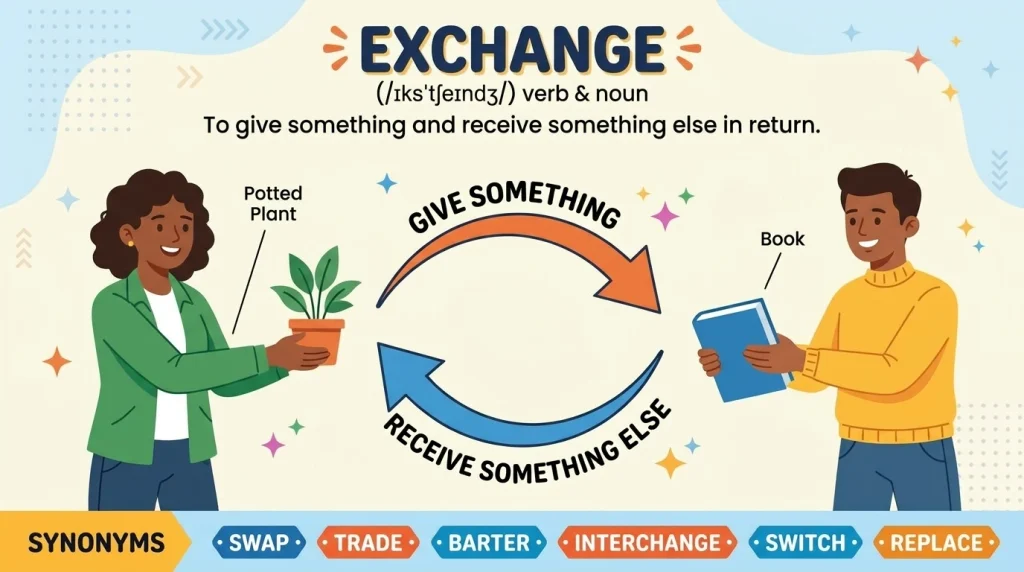
Swap means to give one thing to someone and receive another thing in return. It can also mean replacing one choice, position, or option with another.
As a verb, swap describes the action of exchanging or replacing something.
We decided to swap seats.
As a noun, swap refers to the exchange itself.
The two players made a quick swap.
Native speakers usually understand swap as a practical, mutual exchange. The word often suggests that both sides give something and receive something else.
It can describe physical objects, jobs, seats, schedules, ideas, responsibilities, or even digital items.
For example:
Can we swap places?
I swapped my old phone for a newer one.
She swapped her morning shift with a colleague.
The word often sounds natural and conversational. It is less formal than exchange in many situations.
Connotative Meaning
Connotation (the feeling or association a word carries beyond its basic dictionary meaning) can affect how a synonym sounds.
Positive tone:
Swap can suggest cooperation, flexibility, convenience, or a fair exchange.
Negative tone:
Some alternatives, such as trade-off, may suggest that something valuable was sacrificed to gain something else.
Neutral tone:
Exchange, interchange, and switch can describe a simple change without strong emotion.
The best synonym depends on what exactly is being exchanged and how formal the situation is.
Etymology of “Swap”
The exact origin of swap is uncertain. Historical evidence records the verb around the early 13th century with an older sense connected to striking or hitting. Later, meanings related to making a bargain, trading, and exchanging developed. The exchange sense became established over time.
Old English: 450–1100
The modern word swap does not have a securely documented direct Old English ancestor. Its earliest recorded history appears later than the Old English period.
Middle English: 1100–1500
Early forms of swap were associated with striking or hitting. By the later Middle English period, the word developed associations with making a bargain or deal.
Modern English: 1500–Present
By the early modern period, swap had developed its familiar sense of exchanging one thing for another. The noun meaning of an exchange is recorded from the 17th century.
Pronunciation
US: /swɑːp/
UK: /swɒp/
Syllables
swap
It is a one-syllable word.
Affixation Pattern of “Swap”
Root: swap
Prefix: None
Suffix: None
Swap is a simple base word rather than a word formed through a common English prefix-and-suffix pattern.
Synonyms List
The following 50 alternatives cover the main meanings of swap. Some are direct synonyms, while others work best in particular contexts.
1. Exchange (Verb/Noun) — US /ɪksˈtʃeɪndʒ/ — UK /ɪksˈtʃeɪndʒ/
Meaning: To give something and receive something else in return.
Tone/Register: Neutral, formal, academic.
Examples:
We exchanged phone numbers after the meeting.
The students exchanged ideas about the project.
2. Switch (Verb/Noun) — US /swɪtʃ/ — UK /swɪtʃ/
Meaning: To change from one thing, option, or position to another.
Tone/Register: Neutral, everyday.
Examples:
Can we switch seats?
She switched from tea to coffee.
3. Trade (Verb/Noun) — US /treɪd/ — UK /treɪd/
Meaning: To give something in return for another thing, especially through an agreed transaction.
Tone/Register: Neutral, business.
Examples:
I traded my old bicycle for a guitar.
The players were traded to different teams.
4. Interchange (Verb/Noun) — US /ˌɪntərˈtʃeɪndʒ/ — UK /ˌɪntəˈtʃeɪndʒ/
Meaning: To exchange two things or use them in each other’s place.
Tone/Register: Formal, technical.
Examples:
The two parts are interchangeable.
The designers interchanged the two colors.
5. Substitute (Verb/Noun) — US /ˈsʌbstətuːt/ — UK /ˈsʌbstɪtjuːt/
Meaning: To replace one person or thing with another.
Tone/Register: Neutral, formal.
Examples:
We substituted fresh herbs for dried ones.
The coach substituted another player.
6. Replace (Verb) — US /rɪˈpleɪs/ — UK /rɪˈpleɪs/
Meaning: To put something new or different in the place of something else.
Tone/Register: Neutral.
Examples:
I need to replace my broken charger.
They replaced the old chairs with new ones.
7. Barter (Verb/Noun) — US /ˈbɑːrtər/ — UK /ˈbɑːtə/
Meaning: To exchange goods or services without using money.
Tone/Register: Neutral, business, traditional.
Examples:
They bartered vegetables for bread.
The villagers often bartered with one another.
8. Interchangeable (Adjective) — US /ˌɪntərˈtʃeɪndʒəbəl/ — UK /ˌɪntəˈtʃeɪndʒəbəl/
Meaning: Able to be used in place of one another.
Tone/Register: Formal, technical.
Examples:
These two batteries are interchangeable.
The terms are not always interchangeable.
9. Alternate (Verb) — US /ˈɔːltərneɪt/ — UK /ˈɔːltəneɪt/
Meaning: To take turns between two or more choices.
Tone/Register: Neutral, formal.
Examples:
We alternate between morning and evening shifts.
The children alternate seats every week.
10. Rotate (Verb) — US /ˈroʊteɪt/ — UK /rəʊˈteɪt/
Meaning: To regularly change positions, duties, or assignments.
Tone/Register: Neutral, professional.
Examples:
We rotate the team leaders each month.
The nurses rotate their weekend duties.
11. Change (Verb/Noun) — US /tʃeɪndʒ/ — UK /tʃeɪndʒ/
Meaning: To make something different or move from one option to another.
Tone/Register: Neutral, very common.
Examples:
I changed my seat before the movie started.
She changed her appointment to Friday.
12. Shift (Verb/Noun) — US /ʃɪft/ — UK /ʃɪft/
Meaning: To move or change something from one position, focus, or arrangement to another.
Tone/Register: Neutral, professional.
Examples:
We shifted the meeting to the afternoon.
The company shifted its focus to education.
13. Transfer (Verb/Noun) — US /trænsˈfɜːr/ — UK /trænsˈfɜː/
Meaning: To move something or someone from one place, person, or system to another.
Tone/Register: Formal, professional.
Examples:
She transferred the files to another folder.
The employee transferred to another department.
14. Trade in (Phrasal Verb) — US /treɪd ɪn/ — UK /treɪd ɪn/
Meaning: To give an old item as part of obtaining another one.
Tone/Register: Everyday, commercial.
Examples:
I traded in my old laptop.
He traded in his car for a smaller model.
15. Trade off (Phrasal Verb) — US /treɪd ɔːf/ — UK /treɪd ɒf/
Meaning: To accept one advantage or benefit in exchange for giving up another.
Tone/Register: Neutral, analytical.
Examples:
We traded off speed for accuracy.
The design trades off comfort for durability.
16. Trade places (Phrase) — US /treɪd ˈpleɪsɪz/ — UK /treɪd ˈpleɪsɪz/
Meaning: To exchange positions or situations with another person.
Tone/Register: Informal, conversational.
Examples:
Let’s trade places for a better view.
The two workers traded places for the afternoon.
17. Change places (Phrase) — US /tʃeɪndʒ ˈpleɪsɪz/ — UK /tʃeɪndʒ ˈpleɪsɪz/
Meaning: To exchange physical positions with someone.
Tone/Register: Neutral.
Examples:
Can we change places?
They changed places before the photo.
18. Switch out (Phrasal Verb) — US /swɪtʃ aʊt/ — UK /swɪtʃ aʊt/
Meaning: To remove one thing and put another in its place.
Tone/Register: Informal, everyday.
Examples:
Let’s switch out the old battery.
She switched out the black shoes for white ones.
19. Change over (Phrasal Verb) — US /tʃeɪndʒ ˈoʊvər/ — UK /tʃeɪndʒ ˈəʊvə/
Meaning: To move from one system, method, or arrangement to another.
Tone/Register: Neutral, professional.
Examples:
The office changed over to digital records.
We changed over to a new schedule.
20. Substitute for (Phrase) — US /ˈsʌbstətuːt fɔːr/ — UK /ˈsʌbstɪtjuːt fɔː/
Meaning: To use one thing or person instead of another.
Tone/Register: Formal, neutral.
Examples:
Can I substitute honey for sugar?
A temporary teacher substituted for the regular instructor.
21. Give and Take (Phrase) — US /ɡɪv ənd teɪk/ — UK /ɡɪv ənd teɪk/
Meaning: A mutual process in which both sides make concessions or provide something.
Tone/Register: Neutral, conversational.
Examples:
A good partnership requires give and take.
Their agreement involved plenty of give and take.
22. Deal (Verb/Noun) — US /diːl/ — UK /diːl/
Meaning: To arrange an exchange or agreement between people.
Tone/Register: Informal, business.
Examples:
They dealt their old equipment for supplies.
The two companies made a deal.
23. Reciprocate (Verb) — US /rɪˈsɪprəkeɪt/ — UK /rɪˈsɪprəkeɪt/
Meaning: To respond to an action by doing something similar in return.
Tone/Register: Formal.
Examples:
She reciprocated his offer to help.
Both teams reciprocated the gesture.
24. Return (Verb) — US /rɪˈtɜːrn/ — UK /rɪˈtɜːn/
Meaning: To give something back or provide something in response.
Tone/Register: Neutral.
Examples:
I returned the book after reading it.
He returned the favor the next day.
25. Give Back (Phrasal Verb) — US /ɡɪv bæk/ — UK /ɡɪv bæk/
Meaning: To return something to its original owner or place.
Tone/Register: Informal, everyday.
Examples:
Can you give back my pen?
She gave back the jacket after trying it on.
26. Hand Over (Phrasal Verb) — US /hænd ˈoʊvər/ — UK /hænd ˈəʊvə/
Meaning: To give something to another person, usually intentionally or officially.
Tone/Register: Neutral, formal.
Examples:
Please hand over the documents.
He handed over the keys to the new manager.
27. Pass (Verb) — US /pæs/ — UK /pɑːs/
Meaning: To give or move something from one person to another.
Tone/Register: Neutral, everyday.
Examples:
Pass me the blue folder.
She passed her seat to another passenger.
28. Move (Verb) — US /muːv/ — UK /muːv/
Meaning: To change the position, location, or arrangement of something.
Tone/Register: Neutral.
Examples:
We moved the meeting to Monday.
They moved the chairs around the room.
29. Reassign (Verb) — US /ˌriːəˈsaɪn/ — UK /ˌriːəˈsaɪn/
Meaning: To give a different task, role, or responsibility to someone.
Tone/Register: Formal, workplace.
Examples:
The manager reassigned the project to another employee.
She was reassigned to a different department.
30. Reallocate (Verb) — US /ˌriːˈæləkeɪt/ — UK /ˌriːˈæləkeɪt/
Meaning: To distribute resources or responsibilities differently.
Tone/Register: Formal, academic, business.
Examples:
The team reallocated its budget.
The company reallocated staff to urgent projects.
31. Permute (Verb) — US /pərˈmjuːt/ — UK /pəˈmjuːt/
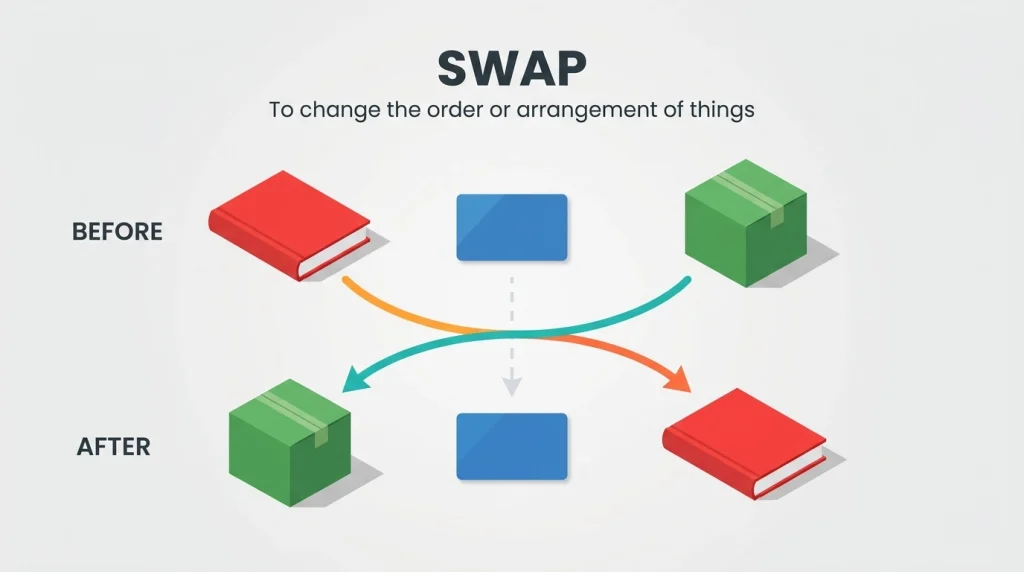
Meaning: To change the order or arrangement of things.
Tone/Register: Formal, mathematical.
Examples:
The program can permute the values.
Students learned how numbers can be permuted.
32. Interchange Positions (Phrase) — US /ˌɪntərˈtʃeɪndʒ pəˈzɪʃənz/ — UK /ˌɪntəˈtʃeɪndʒ pəˈzɪʃənz/
Meaning: To exchange the places or roles occupied by two people or things.
Tone/Register: Formal.
Examples:
The players interchanged positions during the match.
The diagrams interchange positions for comparison.
33. Exchange Places (Phrase) — US /ɪksˈtʃeɪndʒ ˈpleɪsɪz/ — UK /ɪksˈtʃeɪndʒ ˈpleɪsɪz/
Meaning: To take another person’s position while that person takes yours.
Tone/Register: Neutral.
Examples:
The passengers exchanged places.
The children exchanged places during the game.
34. Exchange Roles (Phrase) — US /ɪksˈtʃeɪndʒ roʊlz/ — UK /ɪksˈtʃeɪndʒ rəʊlz/
Meaning: To take each other’s responsibilities or functions.
Tone/Register: Neutral, professional.
Examples:
The students exchanged roles for the activity.
The managers exchanged roles for one day.
35. Rotate Roles (Phrase) — US /ˈroʊteɪt roʊlz/ — UK /rəʊˈteɪt rəʊlz/
Meaning: To regularly give different people different responsibilities.
Tone/Register: Professional, educational.
Examples:
The teacher rotates roles during group work.
We rotate roles so everyone gains experience.
36. Rotate Duties (Phrase) — US /ˈroʊteɪt ˈduːtiz/ — UK /rəʊˈteɪt ˈdjuːtiz/
Meaning: To change who performs particular responsibilities.
Tone/Register: Workplace, neutral.
Examples:
The staff rotates duties every week.
We rotate cleaning duties among team members.
37. Reconfigure (Verb) — US /ˌriːkənˈfɪɡjər/ — UK /ˌriːkənˈfɪɡə/
Meaning: To arrange something differently to create a new setup.
Tone/Register: Technical, formal.
Examples:
We reconfigured the office layout.
The technician reconfigured the network.
38. Rearrange (Verb) — US /ˌriːəˈreɪndʒ/ — UK /ˌriːəˈreɪndʒ/
Meaning: To change the order or position of things.
Tone/Register: Neutral.
Examples:
I rearranged the books by color.
She rearranged the chairs before the meeting.
39. Reshuffle (Verb/Noun) — US /ˌriːˈʃʌfəl/ — UK /ˌriːˈʃʌfəl/
Meaning: To change the positions or order of people or things.
Tone/Register: Informal, journalistic.
Examples:
The manager reshuffled the team.
The cabinet faced a major reshuffle.
40. Rotate Out (Phrasal Verb) — US /roʊˈteɪt aʊt/ — UK /rəʊˈteɪt aʊt/
Meaning: To remove one person or item and replace it with another as part of a rotation.
Tone/Register: Informal, professional.
Examples:
We rotate out team members every month.
The coach rotated out two players.
41. Cycle (Verb) — US /ˈsaɪkəl/ — UK /ˈsaɪkəl/
Meaning: To move through a repeated sequence of alternatives or positions.
Tone/Register: Neutral, technical.
Examples:
The system cycles through different settings.
The team cycles workers through several tasks.
42. Vary (Verb) — US /ˈveri/ — UK /ˈveəri/
Meaning: To make something different from one occasion or situation to another.
Tone/Register: Neutral, academic.
Examples:
We vary the exercises each week.
The teacher varies the activities for different learners.
43. Modify (Verb) — US /ˈmɑːdəfaɪ/ — UK /ˈmɒdɪfaɪ/
Meaning: To change something slightly to make it more suitable.
Tone/Register: Formal, academic.
Examples:
We modified the schedule.
The writer modified the sentence for clarity.
44. Alter (Verb) — US /ˈɔːltər/ — UK /ˈɔːltə/
Meaning: To change part of something without necessarily replacing the whole thing.
Tone/Register: Formal, neutral.
Examples:
They altered the design slightly.
I altered my plans after the meeting.
45. Transform (Verb) — US /trænsˈfɔːrm/ — UK /trænsˈfɔːm/
Meaning: To change something significantly into a different form.
Tone/Register: Formal, descriptive.
Examples:
The renovation transformed the room.
Technology transformed the way we communicate.
46. Convert (Verb) — US /kənˈvɜːrt/ — UK /kənˈvɜːt/
Meaning: To change something from one form, system, or use into another.
Tone/Register: Formal, technical.
Examples:
We converted the file into a PDF.
They converted the room into a study.
47. Trade Across (Phrase) — US /treɪd əˈkrɔːs/ — UK /treɪd əˈkrɒs/
Meaning: To exchange goods, services, or assets between different groups or markets.
Tone/Register: Business, formal.
Examples:
The companies trade across international markets.
Farmers trade across nearby regions.
48. Horse-Trade (Verb) — US /ˈhɔːrs treɪd/ — UK /ˈhɔːs treɪd/
Meaning: To negotiate strongly over an exchange or agreement.
Tone/Register: Informal, idiomatic.
Examples:
The two sides horse-traded over the final terms.
They spent hours horse-trading before reaching an agreement.
49. Barter Away (Phrasal Verb) — US /ˈbɑːrtər əˈweɪ/ — UK /ˈbɑːtə əˈweɪ/
Meaning: To give something valuable away in an exchange.
Tone/Register: Informal, sometimes negative.
Examples:
He bartered away his best tools.
She did not want to barter away her freedom.
50. Give in Exchange (Phrase) — US /ɡɪv ɪn ɪksˈtʃeɪndʒ/ — UK /ɡɪv ɪn ɪksˈtʃeɪndʒ/
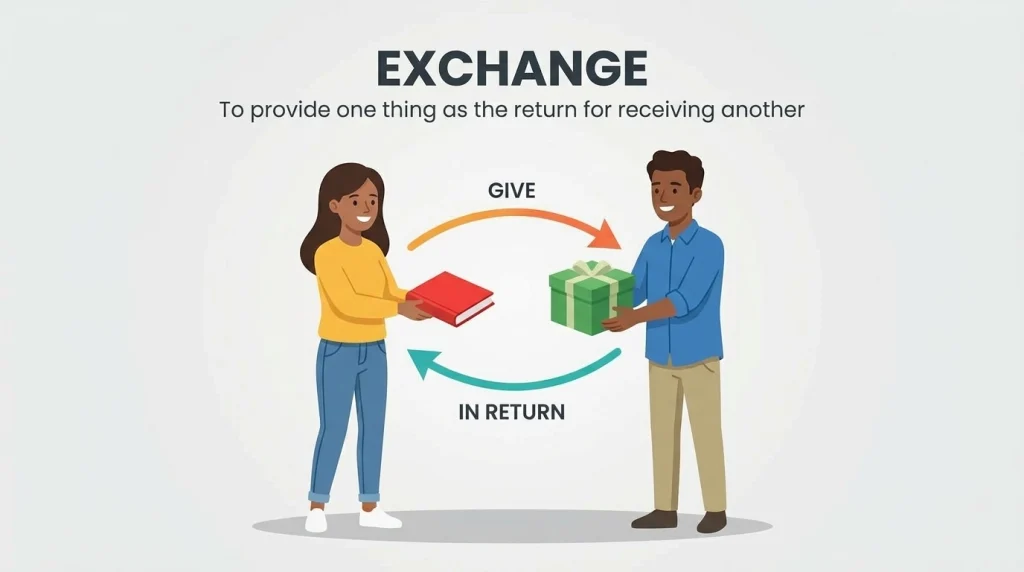
Meaning: To provide one thing as the return for receiving another.
Tone/Register: Neutral, formal.
Examples:
She gave her notes in exchange for his textbook.
They gave extra time in exchange for better results.
Synonyms for Swap by Tone
Positive or Cooperative
Some alternatives can highlight cooperation or mutual benefit.
Exchange, reciprocate, give and take, barter, and trade often suggest that both sides participate in an arrangement.
We exchanged ideas during the discussion.
Neutral
Neutral alternatives work well in most everyday and professional situations.
Swap, switch, change, replace, substitute, transfer, shift, rearrange, and alternate are useful choices.
Formal
Formal writing often favors words that clearly describe the exact type of change.
Interchange, reallocate, reassign, modify, alter, permute, transfer, and convert can fit academic or professional contexts.
Informal or Playful
Swap, switch out, trade places, change places, horse-trade, and barter away can sound more conversational.
Tone matters because two words can describe a similar action but create different impressions. Choosing exchange instead of swap, for example, can make a sentence sound more formal.
“Swap” vs Close Alternatives
Swap vs Exchange
The Swap usually sounds more casual and conversational.
Exchange is broader and works especially well in formal writing.
We swapped seats.
We exchanged documents.
Swap vs Switch
Switch usually focuses on changing from one option to another.
Swap more strongly suggests that two things or people exchange places or possessions.
I switched to a different plan.
We swapped seats.
Swap vs Trade
Trade often suggests an agreed transaction, especially involving goods, services, business, sports, or possessions.
I swapped books with my friend.
The team traded its player.
How “Swap” Changes by Context
Daily Conversation
In everyday speech, swap is short, natural, and friendly.
People often use it when talking about seats, clothes, shifts, food, books, or small possessions.
Can we swap seats?
This sounds more relaxed than Can we exchange seats?
Writing and Blogging
Writers can use swap when the subject feels conversational.
For formal articles, exchange or substitute may provide a more polished tone.
Using different alternatives also prevents repetitive writing.
Professional or Academic English
Professional contexts often require greater precision.
Use transfer for moving ownership or responsibility, reallocate for resources, and substitute for replacing one option with another.
Creative or Informal English
Swap works naturally in stories and dialogue.
It can make a character’s speech feel relaxed and realistic.
“Let’s swap places,” Maya said.
Common Mistakes Learners Make
Using “Swap” for Every Type of Change
Not every change is a swap.
If something simply becomes different, change may be better.
I changed my plans.
If two things replace each other, swap may be more precise.
We swapped our plans.
Confusing Swap and Replace
Replace normally means that one thing takes the place of another.
Swap usually suggests a two-way exchange.
I replaced my old phone.
This does not necessarily mean someone received the old phone.
I swapped my old phone for a new one.
This clearly suggests an exchange.
Using “Barter” in Every Exchange
Barter specifically suggests exchanging goods or services without ordinary money being the main medium.
It is not always a natural substitute for swap.
Overusing “Switch”
Switch is extremely common, but it does not always communicate mutual exchange.
I switched jobs.
This means I changed jobs.
It does not necessarily mean two people exchanged jobs.
Register Notes
Swap: Informal to neutral, especially common in conversation.
Exchange: Neutral to formal.
Switch: Neutral and highly common in speech.
Trade: Neutral, with strong business and transaction uses.
Substitute: Neutral to formal.
Interchange: Formal or technical.
Reallocate: Formal and professional.
Barter: Neutral but more specific.
For additional vocabulary practice, a related synonym article can help you compare swap with other words for change and exchange.
Real-Life Mini Scenarios
Workplace
Two employees may swap shifts when one has an appointment.
“Can we swap shifts on Friday?”
Here, swap sounds natural because both employees exchange responsibilities.
Social Situation
Friends may swap seats at a concert.
“Let’s swap seats. You can see the stage better from here.”
Media and Pop Culture
Sports writers often use trade when discussing professional players.
The club traded the player during the season.
In this context, trade is more precise than swap.
Writing and Storytelling
A novelist may use exchange when describing a formal or meaningful interaction.
The two characters exchanged letters for years.
The word creates a more polished tone than swapped letters.
Why Learning Synonyms for “Swap” Matters
- Knowing one word is useful. Knowing several related words gives you control over meaning and tone.
- A student may need exchange in an essay, while swap works better in a conversation.
- A blogger may choose switch to describe changing options and replace to describe removing an old item.
- A content writer can also avoid repetitive sentences by selecting a synonym that matches the exact context.
- This is more than vocabulary expansion. It is a way to communicate with greater accuracy.
External source for further word-history research: Online Etymology Dictionary
Practice Exercises
Choose the best answer for each situation.
1. Two friends want to exchange their seats at a cinema. Which word sounds most natural?
A. Allocate
B. Swap
C. Transform
D. Convert
2. A company moves money from one department to another. Which word fits best?
A. Reallocate
B. Swap
C. Barter
D. Horse-trade
3. You replace sugar with honey in a recipe. Which word is most suitable?
A. Substitute
B. Rotate
C. Transfer
D. Reciprocate
4. A professional sports team gives one player to another team. Which word is common?
A. Modify
B. Trade
C. Rearrange
D. Alternate
5. You change from one software system to another. Which phrase works well?
A. Change over
B. Give back
C. Trade places
D. Barter away
6. Two students take each other’s roles during a classroom activity. What is best?
A. Exchange roles
B. Replace roles
C. Convert roles
D. Alter roles
7. A manager changes an employee’s department and responsibilities. Which word is most precise?
A. Reassign
B. Swap
C. Barter
D. Permute
8. Two people negotiate strongly before agreeing to a deal. Which informal phrase fits?
A. Horse-trade
B. Rotate
C. Transfer
D. Substitute
9. You want a neutral word for giving something and receiving another thing in return.
A. Exchange
B. Reshuffle
C. Modify
D. Shift
10. A system moves through several options repeatedly. Which word fits best?
A. Cycle
B. Barter
C. Replace
D. Trade in
Answer Key: 1-B | 2-A | 3-A | 4-B | 5-A | 6-A | 7-A | 8-A | 9-A | 10-A
FAQs
What is the best synonym for swap in formal English?
Exchange is usually the strongest formal synonym for swap. It clearly describes giving one thing and receiving another. Depending on the situation, substitute, transfer, or interchange may be more precise. For example, an academic writer might use “exchange information” instead of the more conversational “swap information.”
What is another word for swap between two people?
Exchange is the most broadly useful alternative when two people give something to each other. Trade, interchange, and switch can also work depending on the situation. If the two people exchange physical positions, trade places or change places may sound more natural.
What is a synonym for swap in a sentence about seats?
Switch, exchange, and trade places can all work. In casual conversation, “Can we swap seats?” sounds especially natural. “Can we switch seats?” is also common. “Exchange seats” sounds slightly more formal and may be preferable in polished writing.
What is the difference between swap and switch?
Swap generally emphasizes an exchange between two things or people. Switch often emphasizes changing from one option to another. For example, “We swapped seats” suggests two people exchanged positions, while “I switched seats” simply means I moved to a different seat.
Can trade be used instead of swap?
Yes, but the context matters. Trade often suggests an agreed transaction involving goods, possessions, services, sports players, or business arrangements. Swap is broader and more conversational. “I swapped books with my friend” sounds natural, while “The team traded a player” is more precise in sports.
What is the opposite of swap?
There is no single perfect opposite in every context. Depending on the sentence, possible contrasts include keep, retain, hold, maintain, or stay with. For example, instead of swapping seats, you might “keep your seat.” The correct opposite depends on what kind of exchange is being discussed.
Is swap formal or informal English?
Swap is generally neutral to informal and is extremely common in everyday conversation. It is perfectly understandable in professional writing, but exchange, substitute, transfer, or reallocate may sound more appropriate when a formal or technical distinction matters.
How can I use synonyms for swap without changing the meaning?
First, identify what is actually happening. Use exchange for a mutual exchange, switch for changing options, replace for putting one thing in another’s place, trade for an agreed transaction, and substitute when one option takes the place of another. This keeps your vocabulary varied without losing accuracy.
Conclusion
Learning synonyms for swap helps you express exchanges, changes, and replacements with greater accuracy. Each alternative adds a slightly different shade of meaning.
For students, bloggers, and content writers, this vocabulary can make sentences more natural and less repetitive. It also improves everyday communication.
Try using these words in emails, essays, conversations, and short writing exercises. Small vocabulary changes can make your English much more precise.
Keep practicing one synonym at a time. The more naturally you use words like exchange, switch, trade, and substitute, the stronger your English becomes.

Samia Noor is the founder and lead writer at SynonymGenius.com, where she creates accurate, reader-focused English language content that helps people communicate with clarity and confidence. She specializes in synonyms, antonyms, word meanings, idioms, and practical vocabulary guides that make complex language concepts simple and easy to understand. Every article is thoroughly researched, carefully fact-checked, and written in clear, accessible language using reliable sources and real-world examples. Her mission is to provide trustworthy, high-quality content that supports students, writers, educators, professionals, and English learners at every stage of their language journey.
Her editorial approach emphasizes accuracy, transparency, and genuine value for readers while following modern E-E-A-T and content quality standards. She regularly reviews and updates published content to ensure it remains current, reliable, and easy to understand. Through SynonymGenius.com, Samia Noor is committed to publishing dependable language resources that help readers expand their vocabulary, strengthen their writing skills, improve communication, and build confidence in academic, professional, and everyday English.